Tough Negotiations for Terrific Toy Collections | American Pickers | History
Tough Negotiations for Terrific Toy Collections | American Pickers | History

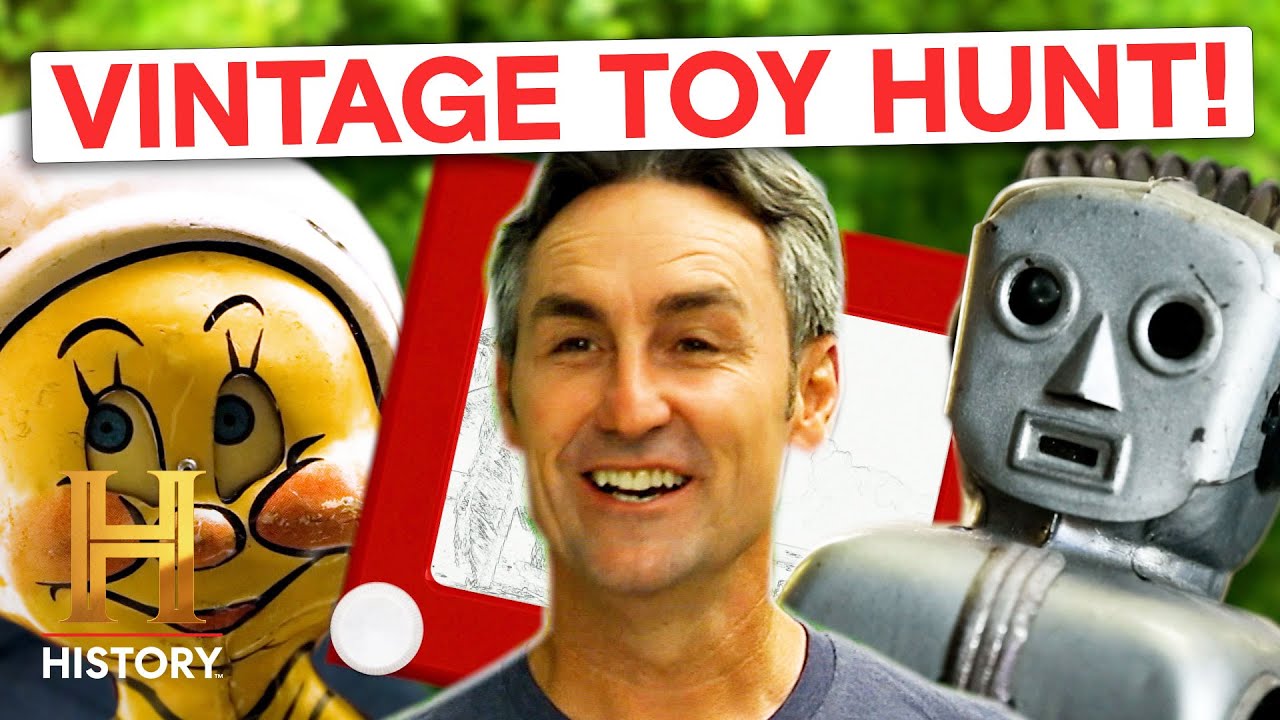
All you gotta do is say toys! Check out this toy collection compilation from American Pickers.
Excuse the mess.
MIKE WOLFE: Oh, this isn’t messy for us.
FRANK FRITZ: Uh-uh. – These are what I really like.
– Do you? – Oh, yeah.
This is the largest collection of Marx toys on display anywhere in the world.
Collecting toys is a fever.
I hope there’s no cure.
MIKE WOLFE: There’s, like, so much stuff to see in here.
I love it.
You know you’re getting older when the toys that you played with as a kid are now considered antiques.
So Francis, is everything I’m looking at here for sale?
A lot of stuff is for sale.
Here’s a really nice toy.
This one was made in Great Britain.
You don’t see too many march toys made in Great Britain.
FRANK FRITZ: A lot of these toys I’ve had, or still have.
But the Goofy toy– I don’t have this one.
Missing one ear, though.
FRANK FRITZ: It is missing one ear.
But the ears are made out of rubber.
You can make them and put it back in.
Or you can just leave it the way it is.
Does it work?
Oh, oh, oh.
It’s kind of a funny toy with his legs going everywhere.
FRANK FRITZ: That is so cool.
Beep, beep, beep, beep, beep, beep, beep, beep, beep, beep, beep, beep, beep, beep, beep.
Kind of reminds me of my wife going around in circles all the time.
FRANK FRITZ: [laughs] Is this something you would sell?
Yeah, I would sell– $475.
It’s in great condition.
And what the seller is is when Frances bombed it up and it did the full circle right in front of me.
He had me at the first lap.
How about $450?
$450?
– We’re so close. – So close.
I can do it. – $450?
– $450. – All right.
It’s not scuffed up.
It’s in great condition.
It works.
I think it’s worth at least $700.
What about the Buck Rogers one?
Buck Rogers was a pulp fiction hero from the 1920s that traveled through space.
He started out in books.
Then he went to comic strips, then he went to the radio, then he went to television and video.
He’s been around for generations.
So naturally, Marx licensed the character to make toys.
What I liked about these is, you know, they have flints inside of them.
And what would happen is when you wound them up, it would have shot sparks out the back.
Flint would come out and take your nog off.
Something like that.
Yeah, I don’t need the thing hitting me in the eyes.
Kids toys today are digital.
Whatever they’re doing, they’re not actually doing it, because it’s on a screen.
These toys are cool because you had to have an imagination– flying that through the air, you know, winding it up, seeing the sparks shoot out.
That was a big deal back then.
[toys clatter] – Ah, hear that? – I know.
That’s good. I like that.
I like that sound.
FRANCIS TURNER: Very high quality toys.
They still run, just like they did back then when they made them.
These toys are going to be running 60, 80 years from now.
FRANK FRITZ: Which one is rarer?
I would think this would be the earlier one.
FRANK FRITZ: Now, both of them have some condition problems, but they’re still very collectible.
One’s made in the ’30s, one’s made in the early ’40s.
Just to see a toy that’s 80 years old, that it still exists– these are the kind of toys you just can’t find anymore.
What would you have to have on this one?
This one’s a little– it’s got a little damage on it here.
It’s been played with on here, you know.
– Yeah. $450. – $450.
What would you do if I bought both of them?
$900?
Ooh, that’s not two– that’s still another $450.
I mean, if they were mint in the box– yeah, then we’d be talking $500, $600.
But the way the condition they are, I’ve got to get them for a cheaper price.
Let’s do like $650 or so. – $650?
Yeah.
No, no.
We couldn’t do $650.
How about $700?
MIKE WOLFE: When you’re very little, you want to show off your toys.
You bring them over to your friend’s house, and you guys play with each other’s toys.
And you might even do some trading.
And that’s where you learn to deal.
$775– they’re yours.
$725.
So when Francis and Frank are going at it– $750.
It just reminded me of that.
– $735. – OK.
– All right. – I’ll do it.
OK.
It was awesome to see little Frankie in his element with Francis.
Francis, what can you tell me about the Charlie McCarthy?
This reminds me of my first girlfriend.
FRANK FRITZ: It’s a nice example of a Marx toy.
How about $100 and a half?
FRANCIS TURNER: I can do it.
All right, you got it.
What can we do on the car here?
It’s in really great condition.
It works.
When the bumper hits on the front, the heads pop up.
How about $1,200?
Make it $1,250 and it’s yours.
I mean, I don’t come across this stuff.
I think I can get $1,500 to maybe $1,800 out of it to the right guy.
And now, these toys you’ve got here– these are the same concept as Charles McCarthy.
– Yeah. – It has the same motor.
Probably the same guy cast the same stamping and everything.
It’s just with different comic characters.
What would you have to have for these three characters?
You have B.O. Plenty, which came from Dick Tracy.
FRANCIS TURNER: With a nose like that, that has to be Pinocchio.
That’s no lie.
Then you have Dopey, one of the seven dwarfs.
Like, I could do maybe $675, and I think that would be the best.
You got a deal.
This place is getting me junk drunk.
– What’s upstairs?
Some toys up there when I was a kid.
FRANK FRITZ: Coming in!
Coming in hot.
FRANK FRITZ: Coming in hot! Coming in hot!
[interposing voices] All you had to do is say toys.
BRUCE: This is my old room over here.
MIKE WOLFE: Yee-ha! – Wow.
Look at all these– oh man!
MIKE WOLFE: Holy cow! Man– Super score!
MIKE WOLFE (VOICEOVER): We get upstairs, and there is stuff everywhere.
There’s toys in boxes.
I don’t know which way to look.
This was one of my favorite games when I was a kid, Spirograph. – Spirograph.
Spirograph!
Oh my god, was that my favorite.
FRANK FRITZ (VOICEOVER): I can remember opening up my first Spirograph for Christmas.
I didn’t know what it was.
My grandma helped me.
You put the pins in the gear.
You could put different gears in, the big ones, the small ones.
BRUCE: And that would make a different design inside of the design.
FRANK FRITZ: You could make just about anything.
Next thing you know, I’m an artist.
[interposing voices] MIKE WOLFE: Oh, look at that!
FRANK FRITZ: It looks like you never even played with.
BRUCE: Never played with.
Well, I played with that.
I evidently just kept putting it back.
FRANK FRITZ: You kept it in great shape.
Man, that’s very unusual– FRANK FRITZ: I mean, look at the designs.
–for a boy.
BRUCE: All the pieces were still there.
I think that was something that I learned from my dad with tools, that once you get a project done, you put things away.
So the next time you want to use it, they’re all still there.
29 bucks.
Oh, what’s this?
FRANK FRITZ: Etch A Sketch.
You remember that toy?
Boy, man, did I have the fun on this!
MIKE WOLFE: I’m telling you. – Some people were so good.
MIKE WOLFE: Is it working?
Yeah, it’s working.
BRUCE: I remember playing with that an awful lot, just amazed at what drawings and things that you could come up with.
Ohio Art made this.
This was popular ’70s.
Yeah.
It’s in the original box.
Some people were so good at these.
They used to have competitions.
MIKE WOLFE: Look at that.
20 bucks.
I’ll go with that.
Good deal.
I love it.
MIKE WOLFE: Look at that! Spudsie!
– Yeah, you wind it up– – I don’t think I remember that.
– –and you throw it around– – It’s like hot potato?
It’s like the hot potato.
BRUCE: There was another one there.
So you just toss it until it friggin’ blows up?
Yeah. Till it blows up.
There’s still time.
Yeah, it’s still going.
It usually needs a little WD-40.
[alarm rings] Dude, you blew up!
MIKE WOLFE: Bruce played with these things, but then he learned to put them away.
$25. – Good.
– All right. – All right.
MIKE WOLFE: Look at that! ’63-’64 Corvette, SS Camaro.
FRANK FRITZ: Yep!
MIKE WOLFE: Anything that Chevrolet would have put their name on– oh look at this, they even put Chevy on the racetrack.
This actually had the Chevy bow tie on it.
You opened it up and it had the Chevy dealership on the track.
“See the USA in your Chevrolet.” I can kind of remember getting that, but I was getting a little bit older in age.
Who needed the toy cars?
I was actually driving the real things.
It was never even played with, Bruce!
Man, your dad must have had you really out there friggin’ working on the farm, you never even played– look at this!
FRANK FRITZ: Original batteries!
MIKE WOLFE: They’re not even screwed up!
$30.
You gotta go more on that.
Give me a number.
$50 on that.
$50.
I appreciate it.
Holy cow, Bruce.
Wow!
Man, you got the cobwebs down here, whoa!
[squealing] Look at this, whoa!
FRANK FRITZ: There you go. I’m set!
Watch out– ooh, yeah.
Look, they got like little circles in them, Frank.
FRANK FRITZ: That is a whole city right there, man.
MIKE WOLFE: Yeah, can you imagine the spiders that are in here?
Made you a little space.
MIKE WOLFE: What?
FRANK FRITZ: Made you a little space.
Aren’t you thinking about where are the spiders are?
Holy cow!
FRANK FRITZ: Yeah!
Hey.
I found something motorcycle related.
Oh, look at that.
Side car fender.
Yeah, Servi-Car.
Servi-Car fender.
There’s another one here.
So it was a side car.
It was a Servi-Car.
Basically, that was a three-wheeler.
Harley Davidson made the Servi-Car car from 1932 to 1972, which is basically a three-wheeled motorcycle with cargo space.
There we go.
Look at that.
So these are later fenders.
They made Servi-Cars for a very long time.
They started in the mid-30s.
[interposing voices] These were later fenders because you can tell by the type of tail light that went on them.
On the fenders and the rear wheel, $300.
These are probably worth about, to the right guy, two a piece.
Servi-Cars aren’t real expensive bikes unless they’re really early.
The later stuff– like you can buy a complete bike– this sounds like a lot of money, but in the Harley world, it’s not– a complete bike for 10 grand.
Yeah.
Running and driving.
So 100, 100, and 100. $300.
What about 4?
How about 350?
Deal.
I was thinking that.
350.
All right. We’ll do 350.
Yeah, sounds good.
I appreciate it.
This is where I found the stuff, Robbie.
Look at these.
Bon Jovi.
Yeah, ’80s, LA Gun, Motley Crue, Skid Row.
Oh, yeah.
He’s bringing back the memories, man.
Bringing it back.
Look at that.
Is that a Rock ‘Em Sock ‘Em?
This is an amazing– no, this is way before Rock ‘Em Sock ‘Em, but it’s missing a very large piece right here.
Would you sell this?
Yes.
OK.
I could see why he kept this around because it’s an extremely hard piece to find.
And years ago, like let’s say 25, 30 years ago, even in this condition, this would have probably been at least $500.
Oh, yeah.
The Japanese were driving that market because a lot of these toys were made over there, and they were buying them back.
Now something like this, if it was really clean and nice, would probably realize half of that.
Are you talking ’20s, ’30s?
No, this is ’50s.
– ’50s. – ’50s.
– Yeah. – Yeah.
Golden age of sci-fi from late ’30s to the late ’40s, there were huge innovations in technology.
There was a focus on space travel.
And the robot was the ultimate manifestation of all of this.
I mean, it’s got such a ghostly look, almost kind of a Michael Myers look.
Right.
Look at that.
I see that.
Tin wind-up and battery-operated robots are extremely hard to find.
But if you find one to this day– like this one, it’s still pretty much intact, missing a few pieces.
It’s early sci-fi.
It’s early space race.
It’s in a time in America that will– it’ll never come again.
From the toys to the car you drove, everything was inspired by the future.
It’s got some rust on it and stuff.
Toy guys are very picky.
It’s like a $75, $100 piece.
Right.
That’s what it’s worth now.
I would do $65 in the condition it’s in.
75.
Can you do 75?
Sure.
[laughs] I’m doing it.
I can tell you guys were hanging around with your dad a lot.
Yes.
This was his inventory.
This was his warehouse.
And if you’re going to make it in this business, you’ve got to buy a little bit of everything, and that’s what we’re finding here.
Mike, and Robbie, and my dad were all birds of the same feather, you know?
I think my dad would be proud of us, that we’re taking it over and making something out of it.
What a day.
What a day.
Yes.
Tell you what, your dad was a special guy.
I can sense it in everything around here.
Yes, he was.
Honestly, he was.
Danny and Corrina, they’ve got a little project here ahead of them.
But I think they’re well underway Your dad had a great eye, and all this stuff, taking care of you way beyond him.
– Yeah, so– – Yes.
Thank you.
– And that’s a good thing. – I appreciate that.
– All right, god bless you guys. – God bless you guys.
We’ll see you down the road. Thank you.
Have a good one.
Be safe.
– These were toys that Yes, sure did.
Do you remember Jumbo, blowing the bubbles?
LINDA: Oh yeah, I loved that.
I got that about 1958, ’59.
FRANK: Yeah, I’ve got a couple of these, and they are so cool.
They’re battery operated.
They have a little cup.
You put a little bit of dishwashing soap in it.
It bends down, picks it up, and then blows air through it, which makes the bubble come out.
Problem with battery-operated toys, once they sit, they don’t work.
Right.
FRANK: The box is a little– is what it is.
LINDA: Yeah.
What would you have to have for this?
Oh, 30.
Right on the button. [cash register sound] See, we’re thinking the same now.
We’re getting there, all right.
She’s treating you right.
We’re talking the same language now.
FRANK: You got it.
Bubbles.
I used to love to play with that thing.
MAN: I was kind of surprised she sold that.
But– Surprise surprise.
Yeah, that’s a good thing.
FRANK: Was this one of your toys too, that you actually played with?
LINDA: Well, really, that was my mom and dad’s toys.
This is one of mom and dad’s.
This was made by Linemar.
I can’t walk by toys.
If they’re in the original box, I’m going to buy them.
This is going to be just like the Dumbo, the blowing bubbles.
It’s not going to work.
You know, once they’re used all the time, battery-operated toys do not work.
The motors freeze up.
This is just for display only.
For just a collectible toy to stick in a shelf or something like that– it’s got a nice little box on it– 35 bucks?
– Good. – Good deal?
Yeah, good deal.
OK, I’ll take it.
The fur is not tattered.
The control box is there, the wire, everything, the original box.
For $35, I can’t beat it.
MIKE: Frank is having so much fun here.
[laughing] He looks like a kid on Christmas morning.
FRANK: Hey, Linda.
LINDA: Yeah?
FRANK: Ruby the Rhythm Rabbit.
All right.
“A funny jig time bunny.
Music box that plays real music.” So see, something like this is probably going to work, ’cause you’re going to put this little guy on.
MAN: Spring-operated, and you wind it.
FRANK: And you wind him and he does a little dance.
Ruby Rhythm Rabbit?
I mean, have you ever seen one before?
I haven’t.
“Push me down over the wire, extend forward until my feet touch the stage, and I’m ready to dance.” OK.
Let’s do the dance.
How much?
$50.
$50?
How about $30?
OK.
All right.
Got you.
Linda held true to her words.
At the beginning of the pitch, she said, Frank, pay my price now, I’ll take care of you later.
And she sure did.
MIKE: Hand me some stuff, Frankie.
FRANK: All right, buddy. Be careful with this now.
This is a nice piece.
MAN: Today it seemed like Mike and Frank, when they were picking granddad’s collection, they appreciated the things that my granddad had collected.
Anytime Mike and Frank want to come back, they’re more than welcome.
MIKE: At the end of the day, when we leave places with these items, it’s not just the item.
I’ll put that up near the front.
FRANK: Put it up to the front, I don’t want it to get messed up.
MIKE: It was the experience we had.
But the biggie is the story.
Thanks guys.
Catch you on the flip side.
Thank you guys.
God bless you. – We’ll see y’all later.
[honking] See you later.
See y’all.