Most Shocking Mysteries of 2025 (Pt. 1) | The Secret of Skinwalker Ranch
Most Shocking Mysteries of 2025 (Pt. 1) | The Secret of Skinwalker Ranch

TRAVIS: What’s going on? ERIK: Well, you know, I’ve looked at the ceramics from the mesa under the microscope.
-Super exciting. -ERIK: Yeah.
TRAVIS: For over three years now, we’ve been drilling in the mesa on Skinwalker Ranch, in an effort to identify a massive object and several smaller anomalies that we believe are buried inside there. And last night, after the drill may have hit one of these objects about 470 feet in our borehole, we made an incredible discovery in the drilling spoils. Pieces of ceramics that appeared to be highly engineered. Let me repeat that– pieces of ceramics that appeared to be highly engineered.
ERIK: Let me show you the chemical analysis of this sample that we were just looking at.
This is from the handheld XRF system.
TRAVIS: Erik’s XRF, or X-ray fluorescence machine, uses X-rays to determine the elements in an object. That might help us figure out what these ceramics could actually be used for.
So, look at what we’re seeing here.
There’s the nickel, and there is the iron.
TRAVIS: Well, and the cobalt and strontium and thorium and all that is very interesting, too.
Everyday common ceramics wouldn’t be made -of these kinds of elements. -ERIK: No.
The fact that we see cobalt and nickel in this does hint of magnetic properties.
I have some small magnets, some rare earth magnets, that we can use to take a look at these parts and see if they respond in any way.
TRAVIS: Normal ceramics are usually made of clay, not metallic elements. So, if this stuff is magnetic, it’s another clue of something that was engineered for a specific purpose.
-ERIK: Moment of truth. -SAM: Oh, boy.
-TRAVIS: What? -ROYSTON: Whoa.
Whoa, whoa. Whoa.
-What? -Can you believe that?
They’re even magnetic. Like, I’m still trying wrap my head…
-Like– -TRAVIS: Ceramics aren’t magnetic.
ERIK: I got to see this again.
-ROBERTS: Do the other pieces do it? -I don’t know.
-ROYSTON: Whoa. -That’s no small effect.
Wait a second.
TRAVIS: What’s going on?
ERIK: Now, it feels like the magnet is repelling the ceramic.
There’s more going on here.
Yeah, I want you to feel this.
Watch.
TRAVIS: Well, it’s pushing against it right now.
You’re right, Erik.
The ceramic has changed to having a repulsive magnetic field.
How does that happen?
There are no naturally-occurring magnetic materials that can both attract and repel magnets.
The fact that this ceramic is doing both is crazy, and I’m not sure what to make of it… other than it was engineered for some purpose. This actually has very similar elemental makeup that you might see from superconductors.
A superconductor is a revolutionary material that scientists are still researching and developing today. It can transfer massive amounts of energy with no resistance or energy loss.
This is really complicated science. The superconductors interact with magnets in strange ways, just like we’re seeing with this ceramic. What’s amazing about superconductors is that because they can repel normal magnetic fields, they’re used today for propulsion in high-tech vehicles like magnetic levitation trains. But some scientists have suggested that superconductors could one day be used in the construction of things like spacecraft. So, if this ceramic is a superconductor, what the hell is inside the mesa? -BRIAN: Hey, guys. -ERIK: Dr. Patchett. -BRIAN: Good to see you. -ERIK: Good to see you. -Doctor. -Hey.
TRAVIS: The next day, ranch owner Brandon Fugal arranged for us to meet with physicist Dr. Brian Patchett at Utah Valley University to examine samples of the strange ceramic material that we found in the mesa.
TRAVIS: We couldn’t wait to see the surface of this material in much more detail than our microscope on the ranch could give us. -ERIK: So, I’ve got several samples mounted. -BRIAN: Sure.
-So I’m going to bring these over. -Okay.
ERIK: They go inside the instrument.
All right, I’ll close this up.
-I am so anxious to see– -And now we will vacuum this down.
There we go.
I’m gonna reposition this a little.
Zoom in a little bit.
ERIK: I can see some clearly-defined, -like, holes right now. -Oh, yeah.
Are those holes getting bigger?
-ERIK: Yes. I think so. -BRIAN: Yeah, yeah.
What?
TRAVIS: It is. It’s opening up!
BRIAN: Yeah.
ERIK: What in the world is going on?
TRAVIS: Holy crap. Look at that!
TRAVIS: What if it’s the electron beam from the microscope that’s causing this?
Let’s turn it off to see if it goes back to normal.
BRIAN: Yeah. We can do that.
TRAVIS: We were stunned to see the surface of a solid, ceramic material suddenly become porous with big holes. All I could think was that maybe the electron beam from the SEM was damaging it.
BRIAN: Let’s see what happens.
BRIAN: Okay.
TRAVIS: All right, here we go.
ERIK: So, that does not look as porous…
-TRAVIS: No. -ERIK: …as it was.
BRIAN: Not nearly.
I have the old screen grab.
BRANDON: Look at that.
BRIAN: This is healing.
I’ve never seen anything that is capable of doing this.
This stuff is fixing itself.
Yes. It’s healing. That’s exactly right!
Unbelievable.
Like I said before, I’ve worked a lot with highly-engineered ceramic materials for the space industry because of their heat-absorbing and energy-conducting properties.
But neither I nor the other two scientists in the lab have ever seen a ceramic do this kind of stuff.
Well, can we do an elemental analysis of it?
Sure.
Well, right now, what is happening is we’re bombarding the surface with X-rays and determining the energy levels of the electrons in the material itself to help define what elements are present.
TRAVIS: Okay.
When we did our own similar scans back at the ranch, we were surprised to see elements like nickel, cobalt and thorium, which you don’t usually see in ceramics. So, we wanted to confirm the content with this lab’s much more sophisticated equipment.
This is the analysis of the exterior of the sample.
ERIK: So, this is just the elemental makeup of this sample on the surface versus the interior?
Yeah.
TRAVIS: So this shows some more elements than what we saw on the ranch.
We got, uh– carbon, oxygen -are the two most prevalent. -BRIAN: Mm-hmm.
And then you’ve got the next most prevalent, silicon, and then the next one is magnesium or aluminum.
They’re real close to each other.
And then calcium and then iron.
The amount of carbon is really interesting.
I was not expecting that.
-I wasn’t, either. -Quite a bit.
TRAVIS: And you know that’s one of main ingredients of stealth material.
I’ve actually made it before.
I covered a pickup truck with it once and made it invisible to police radar.
We used charcoal, which is your carbon, an aluminum binding agent, and, basically, spray glue.
And so, that’s one of the main ingredients used for radar cloaking technology by the military.
Since World War II, our military has been developing stealth material to make our fighter jets and other craft invisible to radar detection– and even to the naked eye, in some cases. Could this be same type of material?
And could that be what this material was used for?
BRANDON: So, what does that mean as far as what is in the mesa?
Uh… I don’t know.
You know, originally, the-the intent– and I think it made a lot of sense– was to drill, at– essentially, at all costs, so that we could study whatever that anomaly is.
Now we’ve encountered this.
I think we have to respond to the data, change our approach, possibly to an archaeological fashion.
-Right? -Yeah.
BRANDON: I want to pull the plug immediately on any further drilling activity.
-Yes. -TRAVIS: Absolutely.
BRANDON: Because we may damage the very thing that we are trying to study.
And I think we’re going to have to take a much more disciplined, careful approach, because what we have extracted is…
-It’s unbelievable. -Yeah.
We need to find the safest way to get it out of there.
BRANDON: I think we need time to carefully plot our next steps to preserve and properly study the nature of what is in the mesa.
Yeah, 100% agree with that.
This is definitely something incredibly interesting, something I definitely didn’t expect.
So, if we find more of it, is it all right if we bring it back here for analysis?
-Please do. -All right.
BRANDON: Well, after eight years of scientific investigation at Skinwalker Ranch under our stewardship, I think today marks a significant turning point that is going to take us in a whole new direction.
-Yes. Well, thank you for the time. -BRANDON: Thank you.
-Of course. -And I think it is time for us -to gather up and move on. -Yeah. Let’s go.
Hey, Pete.
Hey.
Yeah, it’s good to have you back.
Can’t wait to see what you’re packing this time.
[laughter] I brought some goodies.
You do photogrammetry.
ERIK BARD: Now, that’s good.
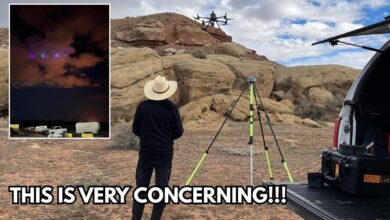
TRAVIS TAYLOR: So we invited technologist, Pete Kelcsey back to perform a final high tech 3D photogrammetry drone scan of the entire ranch.
Well, I’m excited to have you out here.
It’d be great to take you back to the mesa.
Let’s go.
All right, let’s do it.
TRAVIS TAYLOR: Photogrammetry is a process where thousands of high definition photographs are taken of an area of interest and combined to create a detailed three dimensional map, potentially revealing features that aren’t visible to the naked eye.
We want to get a 3D model of every part of the ranch to see if any anomalies appear.
If something shows up, maybe it will help us determine what is behind all the UAPs and the other phenomena that we’ve documented here.
This looks great.
So once all the data I have collected is post processed in a nice, neat package, I hand that to Erik, and he does the heavy lifting.
And that is spending hours and hours going through this data, because it’s all visual.
All right, I got all green lights here.
Spinning up.
Literally, it comes down to putting eyes on the model and looking for anything interesting.
TRAVIS TAYLOR: The day after Pete Kelsey conducted his photogrammetry scan of the ranch, he sent Erik all of his compiled data files for us to review.
ERIK BARD: Well, I’ve got only about a billion data points.
Of course, this comes out of Pete Kelsey’s recent survey work.
This is a three dimensional model.
It’s point cloud data.
What it is individual points that have been located through a complex algorithm coming out of all these thousands of pictures that he’s taken.
So you take all those images, you stitch them together, and you get a three dimensional model.
MAN: That’s incredible.
ERIK BARD: Oh, yeah.
Yeah, so I’ve been diving into this, and it turns out there are some very interesting artifacts showing up.
Whoa.
You might– I just saw one.
ERIK BARD: Did you see it?
Yeah, in the sky.
ERIK BARD: Yes.
MAN: Oh, weird.
ERIK BARD: Yes.
MAN: That looks like that’s a whole bunch of points right there. ERIK BARD: Oh, it is.
Well, what would cause it to do that if that’s up in the air?
That’s the question.
Look at this structure.
This phantom structure that’s sticking up in the sky.
TRAVIS TAYLOR: This is odd.
I got to tell you, wow, that thing is really prominent from here.
It’s like it’s a some sort of big feature.
ERIK BARD: It looks more than 100 feet in the air.
That’s nuts.
I’ve connected with Pete, and I’ve also spoken with the vendor of this software asking, is this common?
And the answer that I’ve gotten is no.
Really?
This is not a common thing in terrestrial surveys like this.
Are there any other areas in his survey that had this sort of artifact to them?
Yes.
I want to show you something at another location that we’ve visited that is part of this survey.
OK.
TRAVIS TAYLOR: Oh, there you go.
ERIK BARD: So let me spin us around.
I noticed a couple of things here.
Now, look at this.
ERIK BARD: And you may observe the same thing.
TRAVIS TAYLOR: So line those two up, and where are they pointing?
ERIK BARD: This feature, this artifact, the largest stone that was part of the stone circle, and that prominent thing that’s jutting up further to the South.
TRAVIS TAYLOR: They have three points in a line.
Wow.
Interestingly and somewhat mysteriously, the anomalies to the south and to the north of the stone circle align perfectly with that large center stone in the stone circle itself.
Could be a coincidence, but it sure is suggestive.
What are the odds of that?
ERIK BARD: Right.
We’ve learned not to ignore any anomalous features in our data, even if we have no idea what to make of them.
So that, to me, seems like you’ve almost drawn a Ray from the other anomaly through this stone to this anomaly.
We’ve got a line being drawn here, then what is that line pointing to?
What is the line there for?
We need to mark these spots, because what if this is somehow mapping an anomaly that we need to investigate?
Could Pete Kelsey have actually captured visual evidence that there really are portals on Skinwalker Ranch?
And could it help explain why we see UAPs appear and then suddenly disappear?
Well, we owe it to ourselves to follow up on every data anomaly that we come across, particularly when they’re as prominent as the ones we’re looking at.
Erik, the data is absolutely fascinating.
We need to meet with Brandon and review this and everything else we’ve learned this year.
I think we’ve just got to do that to follow up on this data.
ERIK BARD: Yeah, let’s do it.
Greetings, everyone.
MAN: Hey.
I think everyone would agree this past year has been the most productive year in history relative to the investigation at Skinwalker Ranch.
We launched this phase of the investigation with former Governor Herbert.
His interest and ongoing engagement with this effort has been an important part of really elevating the formality of this research and how important it is.
We also have joining us today investigative journalist George Knapp, best known as the leading journalist documenting the reality of, not only the ranch, but this type of phenomena.
I’d like to say governor, by the way, you have a really beautiful state, but it’s an awfully weird state.
I think today will be a very eye opening day and briefing for our guests.
Brandon, this next one, you have yet to see, because it just happened to us.
Really?
Yeah.
It is so bizarre.
I think it’d be a good idea to get everyone’s eyes on this.
Please, Let’s do.
ERIK BARD: This is a three dimensional model of Pete Kelsey’s recent survey work.
Pete scanned the entire mesa, and look at this structure.
Wow.
Incredible.
Wow.
BRANDON FUGAL: This looks like a solid structure in the sky.
ERIK BARD: Yes.
This object, whatever it is, it’s really fascinating.
What are we looking at?
We don’t know at this point.
Well, we need to talk about the reality of what we’re dealing with in this investigation.
Based on all of these combined events, how do we move forward?
I think everyone would agree that we move forward having a multidisciplinary, diverse approach to really tackling this problem set and taking the data that drives us in the right direction to uncover the secret of what lies on this ranch, both above and below.
It appears we are triggering contact in some way, shape, or form, and it is manifesting itself above the ranch in a very profound way.
We’re dealing with forces, we’re dealing with phenomena that redefines, not only our vision of reality, but potentially even history itself.
I’m very excited about the next chapter.
I think you’ve got momentum, again, like Dr. Taylor talking about, this should be a scalpel approach.
Erik, you’ve mentioned how we’ve got to be careful about what we’re doing here, so we don’t damage the information we’ll find.
Very much so.
You guys have made breakthroughs on so many different bases, and I can’t wait to see what comes next.
BRANDON FUGAL: Well, thank you, Governor, for your time and attention, and thank you, George, for joining us.
Glad to be here.
I want to thank everyone at this table for your sacrifice, for your professionalism, for your talents, your expertise.
We are opening new doors, new paths to explore.
I look forward to the path ahead and we’ll be in touch with you regarding next steps.
Thank you.
Thanks, Brianna.
BRIANNA: Thank you.
Thank you, Governor.
George, good to meet you.
As we wrap up this year’s investigation at Skinwalker Ranch, we all feel like we’re getting much closer to finding some real answers about this place.
I mean, when I first came to the ranch, I had never even seen a UAP.
We got something.
Hold on.
Look, look, look, what is that?
What we’ve witnessed and documented phenomena up in the sky– What the hell is that in the sky?
MAN: That thing is big and spherical.
TRAVIS TAYLOR: –that has changed my entire outlook on what I thought was possible.
Who knows what we could ultimately reveal?
ERIK BARD: Oh, my.
We owe it to ourselves and the entire world to figure out the truth behind this ranch.
BRANDON FUGAL: It takes courage to confront these topics, and I believe as we brave that territory, as we have the courage to delve deeper, both literally and figuratively, into Skinwalker Ranch, we’re going to find that, not only will we come to an understanding of the dark forces that we’re interacting with, but also the nature of our world and our reality.
Well, you guys ready to go at it again?
Yeah, we’re ready.
Aaron, you’re going to want to see this.
This is what came out of your tank, this material here.
It’s– it’s rather brittle.
Out of the spoils that we went and dumped over there.
This came out of the pit?
Yeah.
Yeah.
Any chance this could be coming off of your equipment?
There’s no way it would come out of the drill.
Well, I say we get at it and see if we can get you past that point.
All right.
Yeah, let’s see if we can break through there.
How far back are we?
We are about 311 foot.
OK.
And you’re still hitting up against that?
Yeah, still hitting up against it.
OK.
Boy, that thing sounds like it’s hitting something hard.
What the heck is– Hey, guys, come on down here.
So we’re coming up about 11 inches every 10 feet.
So it was– it was directing you downward.
And now you’re still on it, but it’s allowing you to go upwards.
Right.
So that– that tells us something about the shape of this hard layer.
Mm-hmm.
Or this– whatever this impenetrable thing is.
So it sounds like you’re describing kind of a “V.” May not even be a “V.” It could even be maybe a dome.
Oh, really?
Because you’re not that sharp of a turn.
I’m going to be really fascinated to see what’s coming out of that hole.
So when you guys get ready to dump the spoils, we definitely want to put a screen under there and catch it.
We definitely want to analyze that.
There we go.
More metal?
Check this out.
Wow, look at all the metal.
Hey, there’s one right– And some of it’s fairly– Look how much of this stuff is in this little spoils pile.
Mm-hmm.
Right?
So there’s no telling how much of this metallic crap there is still in that hillside.
The fact that we’re getting all these thin layers of this substance, and Aaron was hitting something so hard with this drill rig he couldn’t penetrate it, are we just chipping away at something much larger under the mesa?
I don’t know, but we have to find out.
We were all eager to see just what the huge dome-shaped object buried inside the mesa could be.
So we brought out underground visualization expert, Ryan Marcantel, to feed a specialized robotic camera into the hole we drilled.
Oh, wow.
So this goes right under the mesa.
400 feet that way.
Let’s get the equipment.
We can set it up.
Hopefully, you can just climb down, stand in that to feed it in.
Easy.
The robotics that we use are really designed for confined spaces.
Great to use in purposes like this.
So we brought out a VT-100, which is a robot with a PTC camera on it to an ATP readout.
It can be configured in many different forms.
Today, we’re using tracks, just because we’re navigating over different types of terrain.
Everything seems to be working fine.
What we’ll do is we’ll go ahead.
And I’ll get down there now and I’ll go ahead and put it in the hole. – OK.
And then we’ll go ahead and start, and we’ll keep a visual on everything.
All right, so we will start recording right now.
Let me at least get some here so it doesn’t have to work so hard.
Hey, Thomas, if you wouldn’t mind, I’mma go forward.
Just feed it into the hole as I’m going forward.
OK.
OK, go ahead.
Tracks are moving fine, Thomas?
THOMAS: Oh, yeah.
Oh, there we go.
So we bring in this camera that sits on crawlers, and it’s designed to crawl up.
And it can go up as far as 1,000 feet.
How– how far down is that?
We were a little over 10 foot while ago.
I’m actually looking right now at what looks like a great big boulder that looks like it may have actually fallen right over that opening.
You see what I’m talking about right there?
Oh, yeah.
That’s a big rock.
That is a big rock.
That’s a big rock.
What are the odds of one, which almost looks like a perfectly round boulder, going and covering up that opening.
Gosh, this ranch!
It’s odd how you say it’s very cylindrical.
That’s so odd.
It is just like it’s been plugged– It almost looks like it was just a plug that was stuck in place there.
Hey, Dragon, Tom, you guys copy?
You want to get it?
Yeah, Travis, go ahead.
Have you all found anything up there yet?
We just found a great big boulder, almost perfectly round, that fell down and blocked the entrance.
Now, that’s a little bit crazy and suspicious.
Just what the hell could be in this mesa?
And what is preventing us from finding out?
We’ll get it.
It’s just, by these means, it’s not going to happen today.
TRAVIS TAYLOR: Let’s get this stuff cleaned up and get out of here.
Thanks, Ryan. RYAN MARCANTEL: Oh, thank you.
THOMAS WINTERTON: I appreciate it.
RYAN MARCANTEL: Appreciate you guys.
Hey, gentlemen.
Hey, guys.
We’ve got the analysis back from the lab that did the scanning electron microscope elemental analysis of that material you guys pulled out of the drill hole.
Really?
Yeah.
The next day, Erik received a report from the Material Science and Engineering Department at the University of Utah about the metal the guys drilled out of the mesa.
So we all gathered in the command center to review it and see what this huge dome-shaped object might be made of.
The data that they gave us from the elemental analysis, it’s really interesting.
On one side of the material there’s tellurium, and on the other side of the material there’s europium.
Tellurium is a semiconductor material that is used in solar panels.
The europium, it’s been experimentally measured that under certain circumstances is a superconductor. – Really?
Yeah.
The elements found in this metal from deep inside the mesa has properties just like those of a semiconductor and a superconductor, which are both used in modern-day electronics like computer processors, MRI machines, electronic vehicles, radios, and even smartphones.
But why is it here on Skinwalker Ranch?
And what’s interesting is tellurium is the second most rare element on the planet.
Same goes for europium.
It is actually one of the most rare elements on the planet also.
That’s interesting.
Wow.
Those things have specific uses.
Both of those materials are used in developing modern quantum computer systems.
So it sounds like we’re looking at a structured material, like, as if it were perhaps deliberately structured.
At least, that’s what I’m reading into what you’re saying.
Well, how else do you get one of the elements only on one side and one of the elements only on the other side?
Mm-hmm.
Well, that’s a lot of information to digest.
You know what?
Are we hitting something that we’re not supposed to be finding?
Is there more at play here than that?
Is it, gosh, if we want to go crazy, some sort of a craft, or something like that, that was put in there, that we’re finally hitting into, that was never supposed to be discovered.
I don’t know.
Let’s not forget that we have been told many, many stories about these deep caverns.
The hill opening up and the ship flying in.
So– There’s so many questions.
Why only one element on one side?
Why one on the other?
Why is it so wafer thin?
Why the hell is it in our mesa?
I mean, there are so many questions that opens up.
Well, looking at what we’ve got in our hands, I’m going to take these samples to a metallurgist.
I am hopeful that we might be able to take samples like this and put them in front of someone who does this work, and ask, have you seen this stuff?
Good idea. Let’s do that.
Yes, let’s do it.
Let’s do it.
Good morning!
Morning!
Hey, Travis Taylor.
Ravi. Nice to meet you, sir.
Ravi, Erik Bard.
Nice to meet you.
So you did the analysis of the samples that we sent?
OK.
Now that’s interesting.
What among the rarer elements did you see in the sample?
Mm-hmm.
The way I understand it, there’s also trace elements of europium and tellurium in the sample.
OK.
This material was manufactured as opposed to a natural occurrence?
That’s interesting.
That’s actually very interesting.
If this huge dome-shaped object in the mesa is covered with the same kind of materials that NASA uses to protect space shuttles from burning up when they re-enter our atmosphere, could the rumors we’ve heard about a spacecraft being buried on Skinwalker Ranch really be true?
Well, I hope that we can find more samples in the not too distant future, and get back out here with more, and maybe get some more details and more– and more data that may help us get to that answer.
Well, this has been real enlightening.
– Fantastic. – Thank you very much.
Thank you.
Thank you, you too.