Josh Gates’ Dangerous Dive with Sharks on Hunt for WWII Wreckage | Expedition Unknown
Josh Gates' Dangerous Dive with Sharks on Hunt for WWII Wreckage | Expedition Unknown

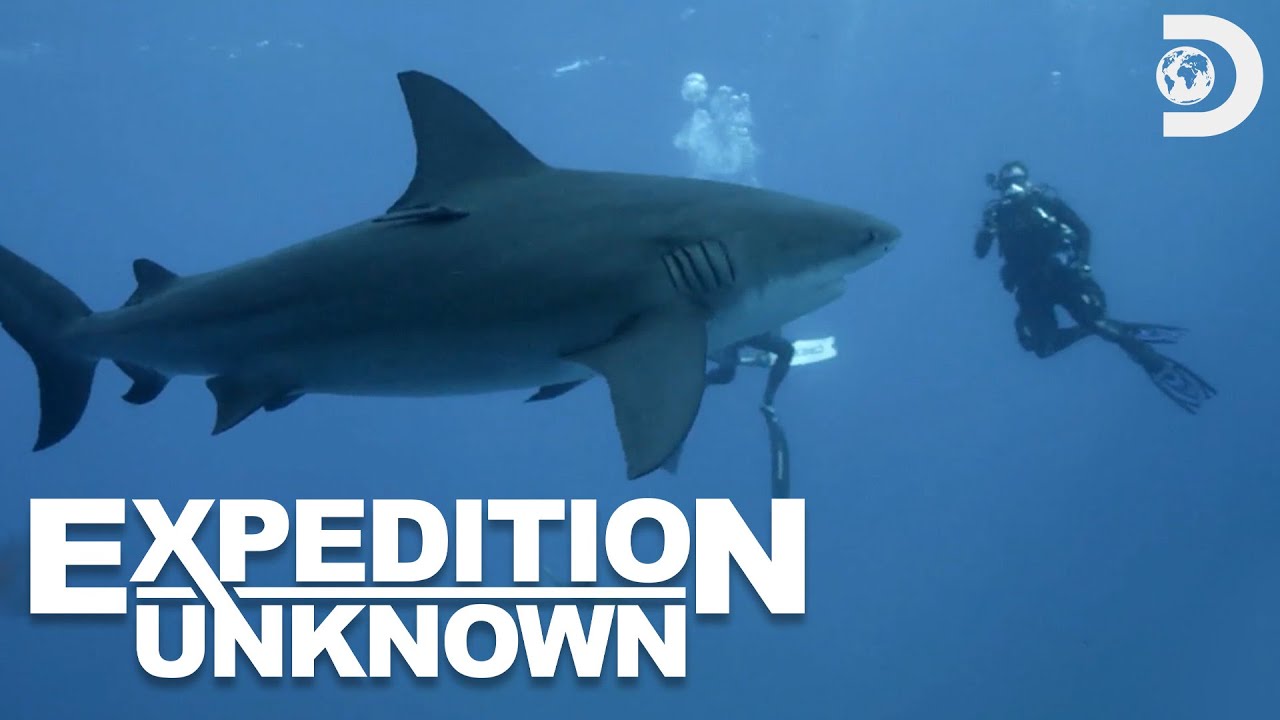
Got a big ball coming up here. Man, that’s a beast. Swimming back down though. I don’t see it anymore. He’s circling around. Look out.
[Music] [Applause] Tristan thinks he knows of some witnesses who’ve already been to the Norlando and may be able to show us the way. That’s the good news. The bad news is that those witnesses are sharks.
Specifically, bull sharks and tiger sharks. Apex predators well over 10 ft long that weigh more than 1,000 lbs. To conduct the world’s most dangerous interview, we take our vessel on the long journey more than 50 m out into open ocean where the rest of Tristan’s team is waiting above the wreckage of the Mungert Ball. We gather for a safety briefing with Dr.
Papa Stamatio and dive master Craig Jess. And I take it you’re going to be keeping us safe out here. Yes, sir. And how are we going to do that? So, this is the Monga T-ball wreck. It is a serious dive, guys. The depth on this dive is 140 ft. This is an exceedingly remote site, okay? So, a lot of the animal life and a lot of the pelagic life out here will not really have seen humans very often, if at all. And because they haven’t seen them, then they may be slightly more inquisitive. They may be slightly more in territorial and they may be slightly more aggressive. And will they come in from the sides, from underneath, like what’s their profile?
They will come from 360° field of attack. So, we have to be exceedingly aware of ourselves, our surroundings, and our team, okay, at all times on this dive. And what’s going to keep me uh what’s going to keep me from getting ripped to shreds down there, Tristan?
We’re going to give you a stick. A stick. A poker. Yeah. Oh, good. That’s an official term. A poker. Yeah. It’s just another form of protection. If they do get in your personal space, you can kind of push them off, right? Also, the shark’s good nature. Sure. Yeah. Sharks famous. Famous for their good nature.
Great. Okay. So, I got a stick and a prayer. All right. Should we get into it? Yep. Let’s do this. Let’s see what’s down there. Come on.
In addition to watching our backs, we need to watch the clock. When we reach the wreck at 140 ft, we’ll only have a few minutes of bottom time before the risk of decompression sickness sets in.
And at 50 m offshore, timely medical attention is not an option.
All right, heading down. Here we go.
Visibility looks good so far. Very clear blue. As we drop down, we’re swarmed by schools of amberjack. After more than 80 years on the otherwise featureless bottom of the Gulf, the Mungert Ball has likely transformed into an artificial reef, a thriving habitat for prey like these fish and the shark predators who feed on them.
Passing 50 ft. Visibility is definitely dropping off now. Yeah, I can’t make out the bottom of the wreck.
There’s a shark.
Oh, right there. Right there. Right there.
Yeah, that’s a bull shark. Look at that big bull shark.
It’s a top predator in this system.
They’re basically a shark that eats other sharks.
Not something to mess with.
Growing up to 12 feet long and weighing in at 1,300 lb, bull sharks are notoriously aggressive and unpredictable ambush predators. They literally have hundreds of inch long knifeedged teeth.
But don’t worry, I’ve got a stick. It’s circling back around. Be ready and stand your ground. Easy for you to say. With a flick of his powerful tail, the big bull surges forward at 25 mph.
Look out. He’s turning this way.
Don’t move, Josh. Let him swim past you.
Oh, I’m not moving. I’ve got my eyes on him. That was too close. It was just curious. Fortunately, we’re not on the menu today.
The farther down we go, the shorter our clock becomes if we want to avoid the bends. But Tristan believes this wreck is essential to finding the lost ship, the Norlando, if that is we ever get there.
Is that the bottom?
[Music] No, no, that’s that’s the wreck. Oh, that’s the wreck.
Look at that. That’s the Bungert Bowl.
Keep an eye out for sharks. There’s likely to be some around here in this mur. They’re going to be hard to see.
Yeah, that’s where these bulls like to hang out. They love it murky and dirty.
Bull sharks thrive in murky water where they can sneak up on their prey. Using what’s referred to as the bump and bite technique, they grope about for food in the darkness and latch on with jaws that bite at 1,300 lb per square in. The average nail gun uses only 130, so good luck with that. All right, I’m going inside. We’re over 140 ft deep. We’ve only got a 2 minutes of time at this depth before we have to go shallower.
Copy that.
It is so eerie in here. Yeah. 30 people died in here. This is a war. Great.
I think it’s time to go, guys. We’re out of time. We got to go. Copy that. As we make our way topside, we’ll have to run the gauntlet again.
More sharks out here. Look at that. All right, Tristan. I have to say an amazing experience seeing this wreck. But the question is, how is this going to lead us to the Nerindo?
It has to do with those sharks. What do you notice about them? Well, they’re definitely circling us and circling the wreck. Exactly.
These sharks know where this wreck is, and I can guarantee you they know where other wrecks are in the vicinity. So, let me make sure I got this right. You want to use sharks to find a shipwreck?
That’s exactly what I want to do. Sharks have a remarkable sense receptor organ known as ampulet of Laurenini. These small mucous-filled pores are concentrated around a shark’s mouth and snout and give them a sixth sense, the ability to detect electrical and magnetic fields such as those generated by their prey or an enormous metal shipwreck.
It’s likely the shark can detect that massive ship long before they could see it. Wow. So, they’re able to navigate back to it, maybe use it as a waypoint.
It’s like having a built-in GPS. And so you think those sharks can lead us to the Norlando? We just have to get them to show us where it is. How do we do that? We’re going to use trackers. And we have two different kinds. The first one is an active acoustic tracker. And the second is a camera tag. A camera tag. Yeah. And essentially, it’s shark count. So the shark is going to be showing us where these wrecks are.
Amazing. So how do we get these trackers on the sharks? We need to catch one. We need to catch a shark. Yeah, we need to catch one. All right, let’s catch a shark. Sounds safe. All right, well, we got some bait. Perfect. And we’ve got a big bull right underneath us. To keep the bull from taking our shark cuderie board to go, the bait is attached to a carbon steel hook and two buoys called polyballs, which will let us know where he goes, as well as tire him out. Here we go. We got a bull coming in. Oh, he’s got it. He’s on it.
Here we go. He’s off.
[Music] He can’t dive. Not with two barrels on him. He can jaws.
Oh, boys.
Think he’s back for his noon feeding.
I’ll do the whole movie. I don’t care.
Do the whole thing end to end.
It takes the entire team to wrangle this shark. A powerful bull can rip the line right through your hands or worse, pull you under.
It’s coming up. But when we try to bring the bull in, spit it out. Chew through. Spit it out.
Hook in half. How the Look at that.
Jeez. He literally bit this hook in half. Poundfor-pound, the bull has the strongest bite of any shark. Their powerful jaws can even crush bone, or in this case, a carbon steel hook rated to hold 4,000 lb. That shouldn’t happen.
I’ve never had one bite the end off like that. It’s ridiculous. That bull shark went through that like butter. You got more of these? I’ve got more of those.
Let’s catch another one. Let’s do it.
Come on.
We send out the bait. It’s coming this way. And in a matter of moments, bam, he took it. Got it. An even bigger bull is on our line.
Just let it go.
Hey, he’s running. Here we go. He’s diving. Definitely on. Both buoys are down. He’s going this way.
I see him down there.
I think we can start pulling in this shark. Here we go. That’s a big shark. But when you’re working with a creature that’s more than 10 ft long and packing 600 lb of pure muscle, the advantage goes to the shark.
Okay, there we go. Just keep him on the board right there.
Oh, the other one’s with him.
Grab the dorsal.
I got it.
Josh, watch out. Careful. She almost got my hand.
Okay, here we go. Let’s try again.
That mouth.
[Music] I’m on the dorsal fin.
Damn. Good hit. I got the dorsal. To be this close, to be holding this creature against the boat is absolutely all inspiring. It is just huge and it is just pure muscle.
It’s It’s unbelievable. T forwards.
Yeah.
[Music] Okay, tag is on. Here we go. The camera is attached, but we are still at risk.
Janice turns the shark over and with a few quick movements puts it into a state known as tonic immobility. Basically a trance where for a brief blissful moment she won’t bite at our hands as we release her. Then we’re safe to let her go. Ready?
[Music] Go.
All right, Norindo, here we come. For the next few hours, we catch and place camera tags on four more sharks. Beauty.
Two more to go. Building a firstofits-kind camera crew to locate the wreck of the Norindo. He’s got it.
He took it.
No. Yeah. Go find us a wreck. Okay, we got it. We got it. The bulls are out filming with the camera tags, but we won’t get to see the results for a day.
To actively track the shark population though, Tristan wants to use acoustic tags. With acoustic tags, we can follow the sharks in real time as they move from wreck to wreck.
Oh my word, that’s a tiger. It’s huge.
While attempting to place a tracking tag on a bull shark circling a decommissioned radio tower in the Florida Keys, Tristan, Janice, and I are surprised by an even deadlier predator.
Whoa, massive tiger shark. I lost her.
Where did she go?
Tiger sharks are bigger than bulls and can grow up to 16 ft long. Known for their powerful serrated teeth, which can slice through the toughest of prey, they’ve been nicknamed the garbage can of the sea. Because they can and will eat anything, including people.
I do not have eyes on her. She disappeared into that murky water below.
I got to do another attempt. I got to get this tag out. With dozens of bulls and a massive tiger shark circling just a few feet below us, Tristan leaves the safety of the tower. Okay, I’m taking my shot. Here we go.
I got it.
Nice beauty. Nice work, Tristan.
Beautiful female bull shark. Woohoo. All right, tag is in. Mission accomplished.
Let’s hope she’s swimming straight to the Nerindo. Let’s go back to the boat.
Here we go. Yep. Heading back.
We quickly jump back aboard the boat so we can send one of the research vessels off to chase and track the acoustic tagged shark.
The next morning, Yanis gets an important email. The first of our camera tags has surfaced and sent us GPS coordinates. Time to see if our cinematographers have found our missing tanker.
We follow the pings. Straight on, Johnny. Nice and slow. Carefully scanning the water for a red speck.
You think we’re close? Yeah, we’re getting really close.
We should be able to see it by now.
[Music] Everybody keep your eyes open. All sides of the boat. It’s got to be right here.
Johnny, let’s slow all the way down.
I see it. I see it. You got it. Right there. Right there. Where? Where? Where?
Oh, there it is. Just starboard. Just starboard. Right there. That’s our tag right there, dude. Nice work. Told you we’d find it. Yes.
Unbelievable. Nice one. All right, camera number two. Let’s find it. We spend the better part of a day getting emails and chasing cameras. There you go, man. All right. Tag number two.
Oh, there it is. Yeah, there it is. Off the bow. Off the bow. You see it right there.
Got it. Lucky number three. That’s it.
There it is. There it is. That’s got to be it, right? Thankfully, the sea is calm. Otherwise, we could be chasing these all the way to Cuba.
Got it.
With all of our footage in hand, we catch up with the big boat to see what we’ve got from both the camera tags and the acoustically tagged shark from yesterday. All right, so let’s talk data. So, we have a track here and we’re plotting a point every 30 minutes where that shark is. Okay, and here’s what it looks like.
And you can see that the shark is kind of following a contour. Yeah.
Essentially not really making any moves left or right. It’s kind of going on a fairly straight path. Yeah. And then it starts to mill around a certain area.
Look at that. And it starts to actually circle this. Right. So it’s kind of like maybe it’s found a reef habitat that it’s moving around and hunting. Or maybe it’s found a wreck. Or it could have found a wreck. Just like the way the sharks were circling around the mungerty ball, right? But but we have no idea what’s in this area. No. With the acoustic tracker, we know where the shark is, but we don’t know what it’s seeing. All right. So, that gives us a place to look, right? Now, what about the camera tags? We have camera footage shot by sharks. Yep. Your shark camera crew worked perfectly. Amazing. Let’s see it.
First look at selfshot shark footage.
We’re seeing what these animals do when we’re not around. Okay, so we got a shark here. Look at that. One of our sharks is going up to several other bull sharks. So, there actually, you know, clearly is sort of a group of them hanging around.
Oh, look at that.
That is cool. So much action. Can’t believe how many of them are just hanging out together.
Now, to the million-dollar question, the hunt for the Norindo. Did you find anything in this footage that may help us with that? So, there is something I want you to see. There is. Yeah. Come on. Okay. What did you find? Look in here. It’s murky. Okay. Wait for it.
It’s coming up. Okay.
[Music] Oh, right there. That is wreckage. That is definitely wreckage. Straight edge.
The question now is, is that a piece of debris that fell off a ship or is that a wreck? The only way we’re going to find that out is to go and take a look ourselves. All right, let’s dive. Yeah, let’s do it right now. Come on, let’s do it. Let’s go.
We take off for the target. Not only did one of the camera tags capture something that looks man-made, but it’s in the same vicinity the acoustically tagged shark was circling, an area well within our search zone for the Norindo. We may be zeroing in on the lost tanker. Let’s see what’s down there.
[Music] We splash down and start heading for the bottom. Our eyes wide open.
Be careful cuz we know that there’s sharks around. They brought us here.
Absolutely. Got my eyes open.
We don’t have to wait long. The local welcome wagon quickly swims up to greet us.
We’ve got sharks. 1:00.
4:00.
all the clocks.
Don’t panic. Just keep it in front of you. But it’s the merc below that we’re most worried about where bull sharks may be lurking to attack. And we wouldn’t know until it was too late. Need an example? Got a big bull coming up here.
Man, that’s a beast. Swimming back down, though. I don’t see it anymore. He’s circling around. Look out.
Whoa. Close. Close. Close.
Coming up on 50 ft. We should be near the bottom.
I can’t see anything. I don’t know why.
Oh, wait. There it is. There’s the bottom right there. You see it? Yeah, it’s just sand here. There must be something down here. Those sharks must have been circling something.
With a watchful eye on the sharks circling overhead, we fan out and scour the bottom for traces of a wreck.
But there’s a shadow up here. There’s something in front of us. Oh wow.
There’s a wall. Oh my god. It’s a wreck.
Has to be a big wreck. It’s a huge wreck.
That is a wreck. Yes. Nice work. Great job, sharks. Woohoo. Let’s go check this out. This thing is huge.
Okay, guys. Let’s make our way around this thing. Look for any distinguishing features. See if we can figure out if this is the Norlando.
Copy that. The wreck is hundreds of feet long, which fits. The Norlando was a little over 250. As we work our way around the wreck, we find a gaping hole on the starboard side of the vessel.
Guys, I found a way in. But was this damage caused by a Nazi torpedo or natural decay?
[Music] Can’t tell how old this is. Definitely been down here a while, but not sure this is World War II.
I don’t want to run into a shark down in these close quarters or find whatever’s left of Ben Gardner. So, I leave the wreck. The side of the hall looks about right, but we should be seeing a bridge and a smoke stack somewhere.
Yeah, I can’t see anything like that.
This wreck’s been down here a while, but it’s just too box shaped to be the Nolindo in my opinion. I agree. This thing doesn’t look like an old steamer.
It looks looks more like a barge vessel of some kind. Yeah, I think it’s a barge.
We’ve still got a real mystery on our winds here. I have no idea what this ship is, but I think not the Orlando.
Whatever this wreck once was, it now belongs to the sharks.
Whoa, watch your two big bull shark. And as uninvited guests, it’s now time for us to make our way to the surface.
Unbelievable. Absolutely incredible.
What a wreck. the huge steel ship down there. Not the Norlando. Really squared off. Some sort of industrial barge. I think it looks like a barge. And I think the real headline is here. This worked.
These sharks led us to a wreck. Who needs sonar when you’ve got sharks?
That’s right. So, we’ve got another wreck today to add to the charts here.
And in terms of the Norindo, we keep looking. At some point, a shark’s going to take us right to that. That’s right.
More work to be done. And we’re on the case. And the sharks are on the case.
They are. All right. Awesome work, guys.
Amazing job. Incredible. It’s a huge wreck down there. So cool.