Engineered Materials Rewrites the Ranch’s Entire Mystery | The Secret of Skinwalker Ranch
Engineered Materials Rewrites the Ranch’s Entire Mystery | The Secret of Skinwalker Ranch

TRAVIS: What’s going on? ERIK: Well, you know, I’ve looked at the ceramics from the mesa under the microscope.
-Super exciting. -ERIK: Yeah.
TRAVIS: For over three years now, we’ve been drilling in the mesa on Skinwalker Ranch, in an effort to identify a massive object and several smaller anomalies that we believe are buried inside there. And last night, after the drill may have hit one of these objects about 470 feet in our borehole, we made an incredible discovery in the drilling spoils. Pieces of ceramics that appeared to be highly engineered. Let me repeat that– pieces of ceramics that appeared to be highly engineered.
ERIK: Let me show you the chemical analysis of this sample that we were just looking at.
This is from the handheld XRF system.
TRAVIS: Erik’s XRF, or X-ray fluorescence machine, uses X-rays to determine the elements in an object. That might help us figure out what these ceramics could actually be used for.
So, look at what we’re seeing here.
There’s the nickel, and there is the iron.
TRAVIS: Well, and the cobalt and strontium and thorium and all that is very interesting, too.
Everyday common ceramics wouldn’t be made -of these kinds of elements. -ERIK: No.
The fact that we see cobalt and nickel in this does hint of magnetic properties.
I have some small magnets, some rare earth magnets, that we can use to take a look at these parts and see if they respond in any way.
TRAVIS: Normal ceramics are usually made of clay, not metallic elements. So, if this stuff is magnetic, it’s another clue of something that was engineered for a specific purpose.
-ERIK: Moment of truth. -SAM: Oh, boy.
-TRAVIS: What? -ROYSTON: Whoa.
Whoa, whoa. Whoa.
-What? -Can you believe that?
They’re even magnetic. Like, I’m still trying wrap my head…
-Like– -TRAVIS: Ceramics aren’t magnetic.
ERIK: I got to see this again.
-ROBERTS: Do the other pieces do it? -I don’t know.
-ROYSTON: Whoa. -That’s no small effect.
Wait a second.
TRAVIS: What’s going on?
ERIK: Now, it feels like the magnet is repelling the ceramic.
There’s more going on here.
Yeah, I want you to feel this.
Watch.
TRAVIS: Well, it’s pushing against it right now.
You’re right, Erik.
The ceramic has changed to having a repulsive magnetic field.
How does that happen?
There are no naturally-occurring magnetic materials that can both attract and repel magnets.
The fact that this ceramic is doing both is crazy, and I’m not sure what to make of it… other than it was engineered for some purpose. This actually has very similar elemental makeup that you might see from superconductors.
A superconductor is a revolutionary material that scientists are still researching and developing today. It can transfer massive amounts of energy with no resistance or energy loss.
This is really complicated science. The superconductors interact with magnets in strange ways, just like we’re seeing with this ceramic. What’s amazing about superconductors is that because they can repel normal magnetic fields, they’re used today for propulsion in high-tech vehicles like magnetic levitation trains. But some scientists have suggested that superconductors could one day be used in the construction of things like spacecraft. So, if this ceramic is a superconductor, what the hell is inside the mesa? -BRIAN: Hey, guys. -ERIK: Dr. Patchett. -BRIAN: Good to see you. -ERIK: Good to see you. -Doctor. -Hey.
TRAVIS: The next day, ranch owner Brandon Fugal arranged for us to meet with physicist Dr. Brian Patchett at Utah Valley University to examine samples of the strange ceramic material that we found in the mesa.
TRAVIS: We couldn’t wait to see the surface of this material in much more detail than our microscope on the ranch could give us. -ERIK: So, I’ve got several samples mounted. -BRIAN: Sure.
-So I’m going to bring these over. -Okay.
ERIK: They go inside the instrument.
All right, I’ll close this up.
-I am so anxious to see– -And now we will vacuum this down.
There we go.
I’m gonna reposition this a little.
Zoom in a little bit.
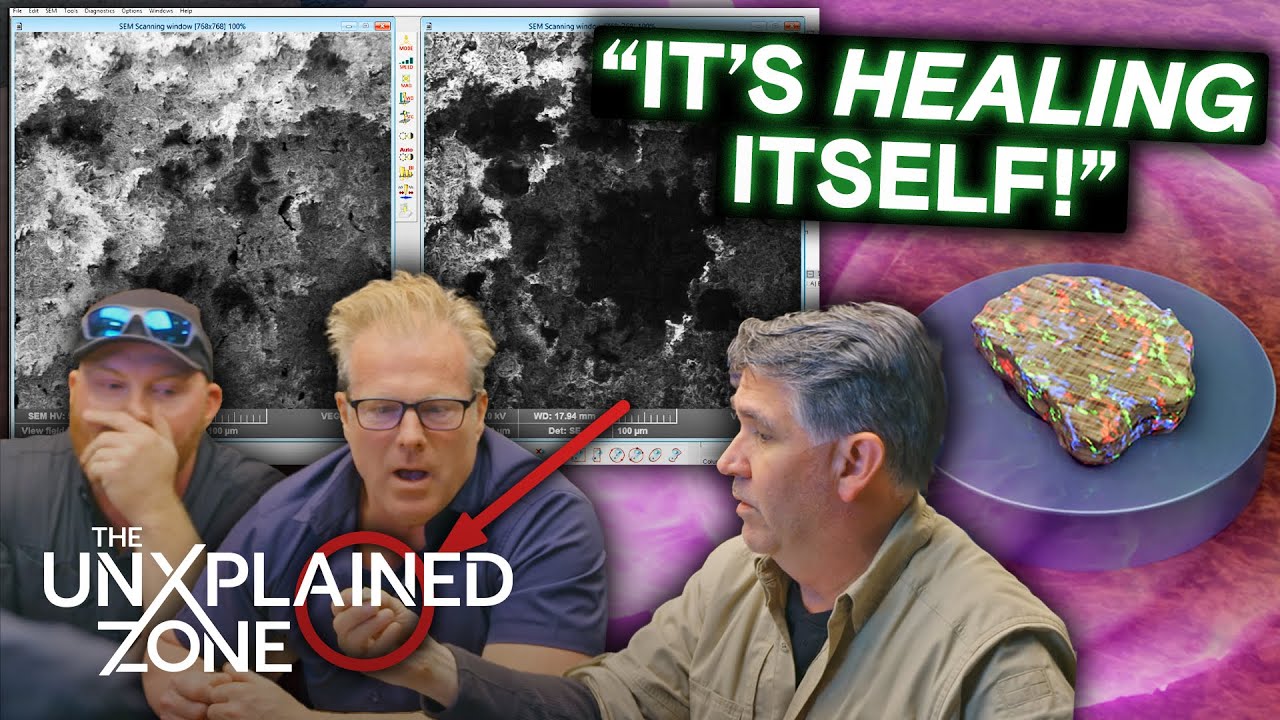
ERIK: I can see some clearly-defined, -like, holes right now. -Oh, yeah.
Are those holes getting bigger?
-ERIK: Yes. I think so. -BRIAN: Yeah, yeah.
What?
TRAVIS: It is. It’s opening up!
BRIAN: Yeah.
ERIK: What in the world is going on?
TRAVIS: Holy crap. Look at that!
TRAVIS: What if it’s the electron beam from the microscope that’s causing this?
Let’s turn it off to see if it goes back to normal.
BRIAN: Yeah. We can do that.
TRAVIS: We were stunned to see the surface of a solid, ceramic material suddenly become porous with big holes. All I could think was that maybe the electron beam from the SEM was damaging it.
BRIAN: Let’s see what happens.
BRIAN: Okay.
TRAVIS: All right, here we go.
ERIK: So, that does not look as porous…
-TRAVIS: No. -ERIK: …as it was.
BRIAN: Not nearly.
I have the old screen grab.
BRANDON: Look at that.
BRIAN: This is healing.
I’ve never seen anything that is capable of doing this.
This stuff is fixing itself.
Yes. It’s healing. That’s exactly right!
Unbelievable.
Like I said before, I’ve worked a lot with highly-engineered ceramic materials for the space industry because of their heat-absorbing and energy-conducting properties.
But neither I nor the other two scientists in the lab have ever seen a ceramic do this kind of stuff.
Well, can we do an elemental analysis of it?
Sure.
Well, right now, what is happening is we’re bombarding the surface with X-rays and determining the energy levels of the electrons in the material itself to help define what elements are present.
TRAVIS: Okay.
When we did our own similar scans back at the ranch, we were surprised to see elements like nickel, cobalt and thorium, which you don’t usually see in ceramics. So, we wanted to confirm the content with this lab’s much more sophisticated equipment.
This is the analysis of the exterior of the sample.
ERIK: So, this is just the elemental makeup of this sample on the surface versus the interior?
Yeah.
TRAVIS: So this shows some more elements than what we saw on the ranch.
We got, uh– carbon, oxygen -are the two most prevalent. -BRIAN: Mm-hmm.
And then you’ve got the next most prevalent, silicon, and then the next one is magnesium or aluminum.
They’re real close to each other.
And then calcium and then iron.
The amount of carbon is really interesting.
I was not expecting that.
-I wasn’t, either. -Quite a bit.
TRAVIS: And you know that’s one of main ingredients of stealth material.
I’ve actually made it before.
I covered a pickup truck with it once and made it invisible to police radar.
We used charcoal, which is your carbon, an aluminum binding agent, and, basically, spray glue.
And so, that’s one of the main ingredients used for radar cloaking technology by the military.
Since World War II, our military has been developing stealth material to make our fighter jets and other craft invisible to radar detection– and even to the naked eye, in some cases. Could this be same type of material?
And could that be what this material was used for?
BRANDON: So, what does that mean as far as what is in the mesa?
Uh… I don’t know.
You know, originally, the-the intent– and I think it made a lot of sense– was to drill, at– essentially, at all costs, so that we could study whatever that anomaly is.
Now we’ve encountered this.
I think we have to respond to the data, change our approach, possibly to an archaeological fashion.
-Right? -Yeah.
BRANDON: I want to pull the plug immediately on any further drilling activity.
-Yes. -TRAVIS: Absolutely.
BRANDON: Because we may damage the very thing that we are trying to study.
And I think we’re going to have to take a much more disciplined, careful approach, because what we have extracted is…
-It’s unbelievable. -Yeah.
We need to find the safest way to get it out of there.
BRANDON: I think we need time to carefully plot our next steps to preserve and properly study the nature of what is in the mesa.
Yeah, 100% agree with that.
This is definitely something incredibly interesting, something I definitely didn’t expect.
So, if we find more of it, is it all right if we bring it back here for analysis?
-Please do. -All right.
BRANDON: Well, after eight years of scientific investigation at Skinwalker Ranch under our stewardship, I think today marks a significant turning point that is going to take us in a whole new direction.
-Yes. Well, thank you for the time. -BRANDON: Thank you.
-Of course. -And I think it is time for us -to gather up and move on. -Yeah. Let’s go.