The Ox Shoes That Changed the Search | The Curse of Oak Island
The Ox Shoes That Changed the Search | The Curse of Oak Island

NARRATOR: Over on lot 26– GARY DRAYTON: This used to be owned by Samuel Ball, and it was farmland back in the day.
NARRATOR: –metal detection expert Gary Drayton, along with treasure hunter Michael John, are investigating an area near the foundation that once belonged to Samuel Ball.
They are hoping to find more clues as to why the 19th century Oak Island landowner mysteriously came to be one of the wealthiest men in the province of Nova Scotia.
What I’ve done– since we have cleared out the surface artifacts, I brought the big mama jamma.
There you go.
It’s a little bit of the bigger coil.
Yes.
[laughter] What’s the maximum depth for this one?
Like, a cannon ball-sized target, about six, seven feet.
Oh, yeah?
Wow.
This area is now cleared of trees and shrubs and bulrushes.
Gives me an opportunity to run the GPX 5000 with a 32-inch coil.
We’re looking for deep targets.
Look at that.
Is this a good little clearing to start?
Yeah.
I want to go in these wide open spaces.
Hopefully, we find something.
OK, we’re ready to rock and roll.
All righty.
MARTY LAGINA: Other than the interest in Samuel Ball, the human being, there is a little bit of a glimmer that he was a little bit more than meets the eye.
I don’t think there’s any way anybody that smart, that aware of things, wouldn’t have known exactly what was going on Oak Island the whole time he was there.
The more I can find out about this person, the better.
That was a small piece of iron.
Small piece?
Yup.
[humming] Come on.
Where are you?
[beeping] Oh.
[laughs] Look at that.
Very strong signal.
[beeping] Looks like it’s just here, mate.
OK.
[music playing] OK?
Yep.
See, I should be able to hit it.
That should be something good.
It’s deep, so it should be old.
Cool.
What we got here?
That’s it.
That’s probably it, yes.
Yeah.
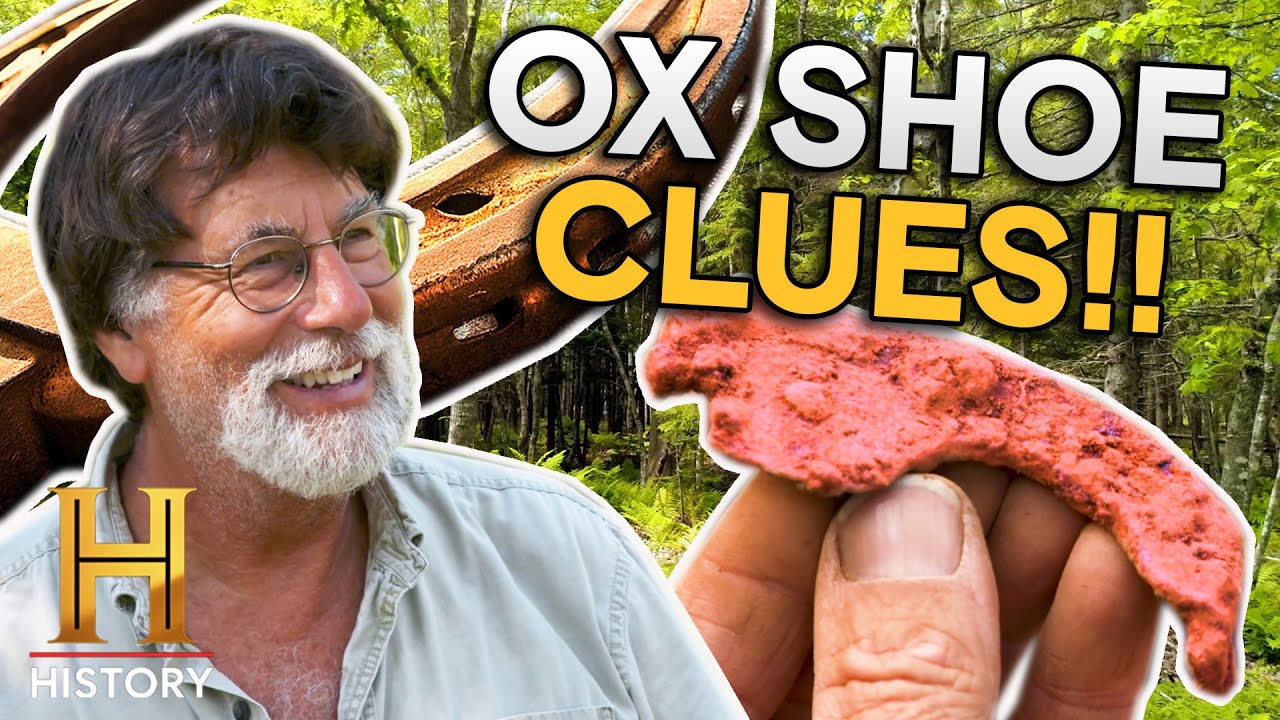
That is a little baby ox shoe.
We found the Shaq daddy, the mother of all ox shoes near the swamp.
And now we found a little baby one.
That is a small little ox shoe.
Now, we’ve pulled up several different ox shoes in really good condition.
And if there’s some kind of industrial operation, you’re going to need beast of burden to transport whatever you was doing there.
And when we show these to Carmen, hopefully, Carmen will give us a country of origin.
It is an oldie.
This is an old artifact.
I’ve just never seen them this small.
What a nice little artifact.
And I’m looking forward to taking this to Carmen Legge to– MICHAEL JOHN: Oh, yeah.
–to give us a story behind this.
Hey, great find, Michael.
MICHAEL JOHN: That’s right.
GARY DRAYTON: Great find.
We got to tell the archeologists about this area.
MICHAEL JOHN: That’s right, yeah.
GARY DRAYTON: So we’ll give it a go, mate?
RICK LAGINA: OK.
NARRATOR: Rick Lagina and metal detection expert Gary Drayton arrive at the uplands on lot 15.
It was in this area– What is this?
NARRATOR: –where just one week ago, Gary and Peter Fornetti discovered an unusual iron band on nearby lot 17, which once belonged to the wheel of an old cart or wagon.
This find not only dated to before the discovery of the money pit in 1795, but also offered evidence of a potential pathway between the swamp and the original treasure shaft.
To find this hidden road, it is Rick and Gary’s hope that uncovering a trail of pre-searcher artifacts between lot 15 and the money pit could prove this theory to be true.
We put flags on any target that sounds good to me.
Mm-hm.
And now, we’ve got permission to dig them up.
So all we’ve got to do is see what they are, put them in a bag, mark them exact same as the flag, and Bob’s your uncle.
OK.
Find something good.
RICK LAGINA: Metal detecting is different this year.
We have to create transects, or grids, across the island.
We also have to get a permit from the community’s culture and heritage for that process to continue.
It’s in that area there, mate.
NARRATOR: In 2010, Rick, Marty, Craig, and their partners obtained permission from the government of Nova Scotia to search for treasure on Oak Island.
It is the only location within the province where such activities are legal.
At the time, other than the late 18th century homesteads that once belonged to Samuel Ball on lot 25 and Daniel McGinnis on lot 21, they were subject to few restrictions regarding metal detecting activities across their property.
That all changed in the wake of the historic discoveries the team made last year in the swamp, such as the massive stone road and the cobblestone pathway, which may be leading in this direction on lot 15 and potentially even toward the original money pit.
I think the arising awareness in the public of how important this might be has caused regulators to sit up and pay attention, in large part due to the success of us making this real.
NARRATOR: Now, other than a designated green zone, which covers the money pit area from lot 18 to Smith’s Cove on lot 20, Gary must first mark metal targets that he detects with flags and then obtain permission from archaeologist Laird Niven to go back and retrieve whatever they may be.
GARY DRAYTON: There, mate.
[beeping] Oh, right here.
Ooh.
Our old friend, the pull tab.
Oh, imagine that.
Flag and tag it, even though it’s trash?
Yeah, I think issues like this need to be addressed with CCH.
This just seems like a waste of time and assets.
Yeah.
We have to really dig through the trash to get to the treasures.
RICK LAGINA: My hope is that the positive will outweigh the negative.
But to be honest, it will slow down the work.
Yeah, it’s like a scrap yard around here.
All right, our next flag is just here.
[beeping] Just here.
[beeping increases] That sounds even better.
RICK LAGINA: Mm-hm.
[beeping intensifies] Have a look at that.
Ox shoe.
That looks like an oldie.
Crazy, isn’t it?
So all that modern junk, and then we get an older ox shoe in this area.
Well, we’re not too far off the money pit as well.
And we found all those ox shoes down below the so-called pine tar kiln.
GARY DRAYTON: Yeah.
NARRATOR: An ox shoe?
Since the team has found a number of ox shoes over the last year on the island, might it be more evidence of not just a path between the swamp and the money pit, but also an operation to haul heavy cargo between the two locations as well?
That’s cool.
That’s what we want to be finding, some old stuff.
And I knew there had to be some more old stuff in here.
It’s just clearing all this out.
And unfortunately, somewhere like this, we’re going to have to take all the surface junk out to get to the good stuff.
GARY DRAYTON: Where you find ox shoes, you’re in an area which could potentially be a trail or an area where treasure was hauled, perhaps.
So this is exciting.
What is that?
French, British?
To me, it looks British because it’s got that wider bottom- and that thinner top.
NARRATOR: If Gary’s assessment about this ox shoe’s origin is correct, could that mean it may be connected to the British pine tar kiln that the team found on lot 15 last year, the same one that archaeologist David McGinnis believes to date back as far as the 16th century, and which Laird Niven suspects may have been used in the construction of the original money pit?
Maybe we should go back to the old aerials, plot this, these finds, against the old aerials where it’s cleared and see if they correspond.
Yeah.
Well, that’s good.
We know someone was here using an ox a long time ago.
Mm-hm.
That’s better, mate.
These are the type of finds we want to be recovering.
I knew we could sniff out an old find.
Onto the next flag.
NARRATOR: Approximately 50 miles North of Oak Island– [metal clangs] ALEX: Hey, Carmen.
NARRATOR: Alex Lagina and Jack Begley arrive at blacksmithing expert Carmen Legge’s shop in Centreville, Nova Scotia.
They are eager to have him examine the recent finds made by Jack and metal detection expert Gary Drayton on lot 15.
All right, let’s start with this one.
You’re going to know exactly what this is immediately.
Because we’ve come and shown you these before.
And we have a couple different ox shoe.
JACK: Yeah.
A winter shoe?
What do you mean by “winter shoe?” Is there a difference between the shoes that would be used by a British farmer or, you know, something like that, versus what would be used by the British military?
Or would you be able to tell?
So that’s not the same as the old shoes that we brought you in years past?
No, some of them were German, and there was also a few French shoes in there.
Mm-hmm.
Early 1700s.
NARRATOR: At Northville Farms in Centreville, Nova Scotia, blacksmithing expert Carmen Legge has just concluded that the ox shoes found on lot 15 could date back to as much as 150 years before the discovery of the Money Pit.
ALEX: Cool.
NARRATOR: Could that mean that the animal these belong to was in some way connected to the mysterious stone structure found on lot 15, a structure that might also have been involved in the construction of the Money Pit prior to 1795?
ALEX: We do have a few more from the same region.
Right, Jack?
JACK: Yeah, we got a couple different ox shoes.
ALEX: That seems much bigger.
Two different animals at least.
Yeah.
CARMEN: Yes.
One other interesting thing about the ox shoes is that we found both kinds on Oak Island in the vicinity of this lot 15 structure, which indicates that not only was there a large-scale industrial or military activity happening, it was happening in two different seasons for at least a decent length of time.
All these ox shoes were found in a line that it seemed like someone was hauling something between the swamp and the Money Pit.
And– JACK: Yeah.
Along the same trail.
A massive excavation.
JACK: Well, do you think this piece is related as well?
When you identified all the other objects, it really makes me think there was an old British military operation of sorts– –between the swamp and the Money Pit.
Or that’s what it appears to be.
We haven’t finished detecting the area.
So we’ll have to go back and see what else– ALEX: Yeah, we will– JACK: –we can find.
We’ll go back out there and look for some more stuff.
Thank you very much.
JACK: Thanks for all the help, man.
Thank you.
ALEX: We’ll see you soon, Carmen.
Take care.
DAVID MACINNES: This whole place is covered with fire-cracked rock.
While archaeologists David MacInnes, Aaron Taylor, and Liz Michels, continue to excavate the mysterious structure on lot 15– Let’s go, mate.
You keep me straight.
NARRATOR: –metal detection expert Gary Drayton, along with Jack Begley, search nearby in hopes of finding more evidence related to the recent discovery of an ancient Chinese coin.
As we get further away from the guys, we’re actually getting closer towards the swamp– an area which would have been traversed back in the day by anyone working in between the money pit and the swamp.
[beeping] We got to dig this.
This is no blasting cap.
There’s a big piece of iron here.
Just there, mate.
It’s about eight inches.
[music playing] [beeping] Yeah.
I see iron residue.
You’re on it.
[beeping] Ooh.
[laughs] Another ox shoe.
JACK BEGLEY: There’s another one.
Yeah.
That’s a smaller one.
But look how wide it is.
I kind of figured that was going to be an ox shoe.
Now, why would you have ox around here?
If you kind of line them up, though, you’re coming from the harbor and the swamp and it’s headed back towards where they’re excavating right now, the lot 15 feature.
You’ve got the peninsula down there.
You’ve got the paved area.
And now you’ve got ox shoes in an area where we know there hasn’t been a lot of farming.
So if we start finding these in one area and if they line up, it could be an old track.
Yeah.
And it lines right back towards the tar kiln.
NARRATOR: A pathway or a track leading from the swamp to the stone structure on lot 15?
Is it possible that Gary and Jack are finding evidence of an operation to move cargo away from the swamp?
If so, could that explain the massive stone paved feature the team unearthed in the swamp one year ago?
And also, perhaps the mysterious anomaly detected by seismic scanning buried some 50 feet deep in the middle of a brackish man-made bog.
OK, mate.
Let’s get back on track– [beeping] –which is kind of ironic, because I believe this could be a track.
I think so too, Gary.
[music playing] [beeping] Jack, I got more iron here, mate.
Look.
See, it disappeared completely.
There’s definitely iron there.
Right there.
Yup.
[music playing] [beeping] GARY DRAYTON: Yeah.
I can see the rust.
That’s a good sign.
Yeah, that is.
Hope there’s something cool.
[beeping] Wow.
[beeping] What the heck is that?
What the heck is that?
JACK BEGLEY: A pin for hauling something?
I don’t think it’s a pin.
I have seen similar things on horse and ox harnesses, where they have these knobs on the end.
Oh.
I think you might be right.
Yeah.
That’s what this reminds me of.
Where they’d, like, put the reins around that thing?
Yeah.
But this is heavy.
That’s what I like about it.
It’s nice and heavy.
So you think it’s really old, then.
Pre-1800s.
[suspenseful music] This is amazing.
Ox shoes were never really anything to get too excited about until you find them in the proper context.
So we’re definitely onto some sort of an oxen trail– Yeah.
–that leads between the paved area inside the swamp over to the money pit.
I mean, if we’re looking for tools and signs of activity between the swamp and where the guys are working up there, this is what we want to be finding.
Because some kind of hauling took place along here.
We’re on a track.
And hauling before they had any sorts or roads or trails.
Yup.
Obviously, they were pushed to have to quickly make some sort of a trail and force their oxen through it.
Sweet.
We’re on the right track, Gary.
GARY DRAYTON: Everything is lining up now.