JOSH GATES: I’m searching for an Avenger Torpedo bomber that collided with its wingman and disappeared off of Anacapa Island.
Historian Colin Colburn just made a huge break in the case, unearthing an eyewitness account of where the lost Avenger went down.
This is kind of a smoking gun.
If this is accurate, then 400 yards out on that bearing, there should be a lost World War II plane.
Right out there, 400 yards offshore.
So where does that leave us?
Well, from here, we can actually test the accuracy of these eyewitness reports.
And we can do that because we know where Buckley’s plane is.
Right, we have a baseline sitting out there.
Absolutely.
JOSH GATES: Diving the known wreck may help us solve the mystery of the lost Avenger.
Does the distance from shore and bearing off the lighthouse match the Coast Guard account?
And is the damage to the tail of the plane consistent with Buckley’s description of the collision?
OK, so we start with the known wreck, and then take that data and hopefully find the lost wreck.
That’s the hope.
JOSH GATES: All right.
And to help with that, Project Recover has arranged a vessel to take you out there.
Bigger than my kayak?
Slightly bigger than your kayak.
[MUSIC PLAYING] JOSH GATES: Colin wasn’t kidding.
Project Recover is working off of the research vessel Shearwater.
This 62 two foot catamaran was custom built by the National Oceanographic and Atmospheric Administration to conduct mapping and research in the Channel Islands.
We motor out to the coordinates of the known Avenger wreck, where I link back up with Project Recover co-founder, Eric Terrell, and his team on the top deck.
Hey, Josh, let me introduce you to Heidi.
– Hey. – Our data analyst.
– Nice to meet you. – Nice to meet you.
Pleasure.
And Drew, our lead archaeologist.
Nice to meet you as well.
So, OK, directly underneath us should be an Avenger.
That’s correct.
JOSH GATES: Accidentally discovered by divers, the location of the wreck was officially cataloged by the National Park Service in 1996.
Let’s start by talking about where we are.
We got Anacapa Island right here.
And there’s our lighthouse.
So the report puts the wreck at 300 degree bearing.
Kind of take a look at where we are right here.
We see that the bearing lines up almost perfectly to what the historical report is telling us.
And the distance from the lighthouse?
The distance in the record says 100 yards.
Now, I’m no expert, but we are way more than 100 yards from that lighthouse. – That’s correct.
Way more.
We are sitting at about 1,800 yards from the lighthouse.
OK, so it’s off by a factor of 18.
Yes.
So that’s hugely inaccurate.
Big time.
This is a really common fog of war chaos.
The angles are often very accurate, distances are generally horribly wrong.
So what does this data tell us about the lost Avenger on the other side of this island?
It’s probably going to be on an accurate bearing on that side, but we probably want to think about moving a greater distance from shore than what the historical record is telling us.
Right, because that distance may be just as inaccurate over there.
Exactly.
So in terms of the known wreck underneath us, what’s the plan?
Well, we would love to get some imagery.
And if we can get a lot of very high resolution photographs that overlap in all directions, then we can use photogrammetry, which is a technique which will allow us to align those photos and give us a 3D representation, a model of what the wreck looks like today.
Got it.
So get lots of photos of the wreck, use that to build a 3D model.
Exactly.
And that information will allow us to be able to understand if the crash site really is consistent with the wreck reports.
So, Heidi, you’re diving down, or– The water is a little cold.
I think it’s your turn.
Yeah.
We only just met, Heidi, but you’re really catching on to how this always goes for me.
[MUSIC PLAYING] I gear up and dive in.
[WATER SPLASHING] The frigid water bites through my thick wetsuit, but the real danger of this dive is depth.
The plane rests at nearly 120 feet, which means I only have a limited amount of bottom time before I have to surface to avoid decompression sickness.
I’ve got to make every second count.
Josh, do you copy?
Keep heading down the anchor line.
We’re really close to the wreck.
You should see it right away.
Josh, we’re about 10 yards from the wreck to the west, so just keep swimming that direction and you should find it.
JOSH GATES: Besides a lone crab who is definitely not happy to see me, this place is a desert.
Did we anchor too far off the target?
The clock is ticking.
I have to find this plane.
[MUSIC PLAYING] All right, good copy.
Go ahead and take your photographs.
You’ve got limited time at the bottom.
[MUSIC PLAYING] [CAMERA CLICKING] JOSH GATES: The thousands of photographs I take will be digitally stitched together to create a 3D model for detailed forensic study topside.
Not surprising given it’s a lot of aluminum and just natural degradation down there.
Copy that.
Be sure to focus on the tail section if you can.
That’s where it was hit.
[MUSIC PLAYING] JOSH GATES: As I move in close, I’m struck that this is more than just a wreck, it’s a memorial.
The pilot and radio man survived the crash, but tail gunner, Lawrence Works, didn’t make it.
The round impression at the rear of the cockpit is all that’s left of the turret where he sat.
[MUSIC PLAYING] Copy that.
[MUSIC PLAYING] JOSH GATES: After a brief decompression stop on the anchor line, I make my way to the surface.
Hey, Josh, how’d the dive go?
Oh, man.
Spectacular.
All this talk about these two Avengers, where they were, the men that were in them, to go down there and see one of them, it takes the whole thing from a story to a piece of history, really.
No, I get it, Josh.
Seeing those wrecks in person just really connects you to the site.
Really powerful to see it down there.
Great, let’s get you on board, and let’s start data processing.
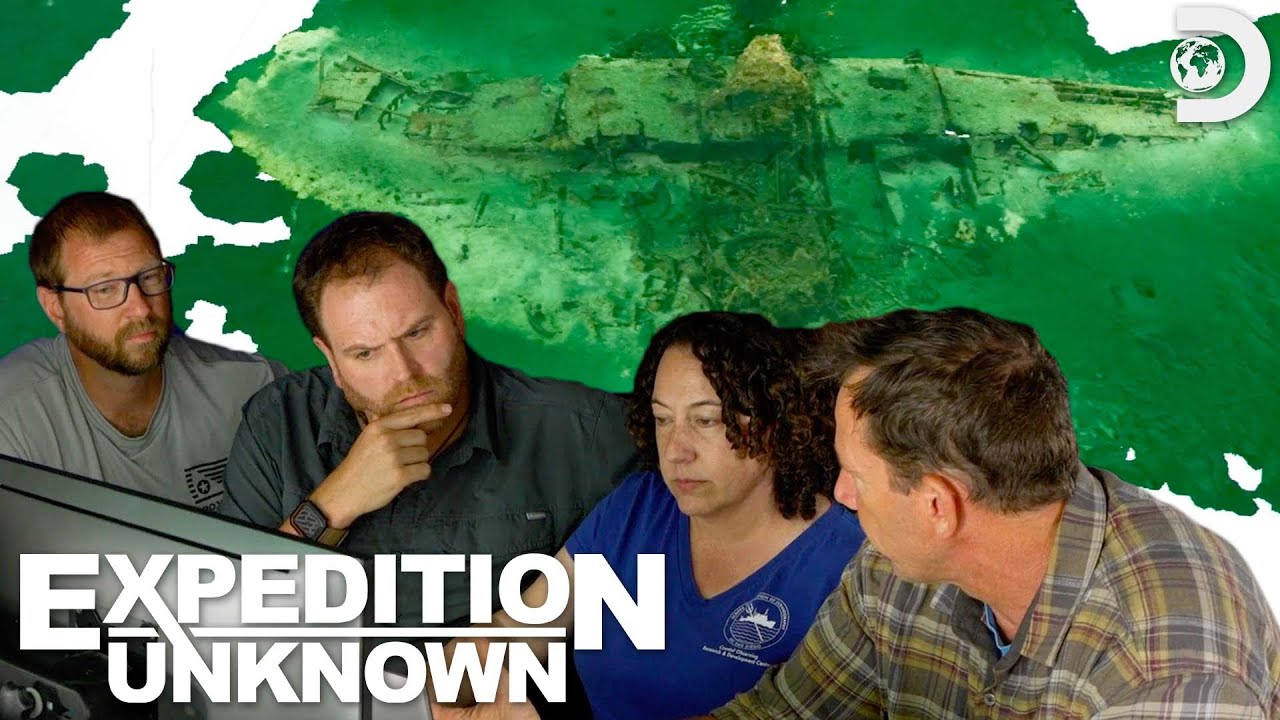
[MUSIC PLAYING] JOSH GATES: While I dry off, Heidi begins rendering the photos of Buckley’s Avenger.
A few hours later, we head inside the cabin to take a look.
OK, Heidi, what do we got?
Well, you collected a whole bunch of images, and they look amazing.
– We got good data. – We did.
It looks really good.
You want to see it?
Yes, I’m dying to see it.
Here we go.
After nearly eight decades of silence, the known wreck has a new story to tell, revealing clues that could lead us to the lost Avenger.
Oh, this is incredible.
Look at that.
Look how much detail we have here.
Like CSI World War II, this model allows Eric to reconstruct a play by play of the moment of impact.
Now take a look at the wing.
And we can see the damage where it hit the water.
It’s lost some of the aluminum skin along here.
That might have been torn away during the accident.
It probably cartwheeled in.
Probably hit– JOSH GATES: Right.
–port wing.
And the plane’s right side up.
If you look at the after action report, it calls out how, you know, it was an immediate water landing.
They didn’t call it a water crash.
That’s right.
And that’s not the only new intel we gather that will aid our search for the lost Avenger.
The one thing that jumped out at me when I was down there is the tail section, which is in a much worse shape.
It’s just almost completely gone because Rule’s plane came up, and his propeller actually connected with that horizontal stabilizer there.
So that might have been destroyed in flight even.
If the tail section of the known wreck was shredded in flight, one can only imagine the damage done to the propeller and canopy of the plane that hit it.
There’s a good chance that pilot Dennis Rule was killed instantly.
It’s amazing to see this because it won’t really be around forever.
You know, I mean, the actual wreck is eventually going to be consumed by the ocean.
Sure.
I mean, we’re seeing that here and it’s very rapidly degrading now.
JOSH GATES: Right.
If you look around the site, you see how the sediment has, really, a different texture to it.
And that’s because a lot of these sites have become artificial reefs.
Life has sort of taken hold in this area.
I call it the halo effect.
So let’s talk about how this helps us moving forward looking for the lost Avenger.
Look how flat this is to the sea floor.
It’s not very proud, so we need to keep that in mind when we’re looking for different sonar targets.
Right, it’s not really raised up.
It’s just– it’s got a really, really low elevation.
It might be maybe at most three feet off the seabed, so that’s going to tell us in the acoustic data how big of a shadow it might be throwing down on the sea floor when we’re trying to discriminate rocks and other debris from the airplane crash.
JOSH GATES: The lost Avenger, which sustained heavy damage, may be in far worse shape.
If all that’s left is scattered debris, the wreckage will blend in with the natural rock formations, making it nearly impossible to find.
Now we’ve got another one to find.
Yeah, absolutely.