Old Photos, New Evidence: Mesa Hides Advanced Tech Materials (S6) | The Secret of Skinwalker Ranch
Old Photos, New Evidence: Mesa Hides Advanced Tech Materials (S6) | The Secret of Skinwalker Ranch

TRAVIS: Hey, fellas. KALEB: Ooh.
Looks like some aerial photos.
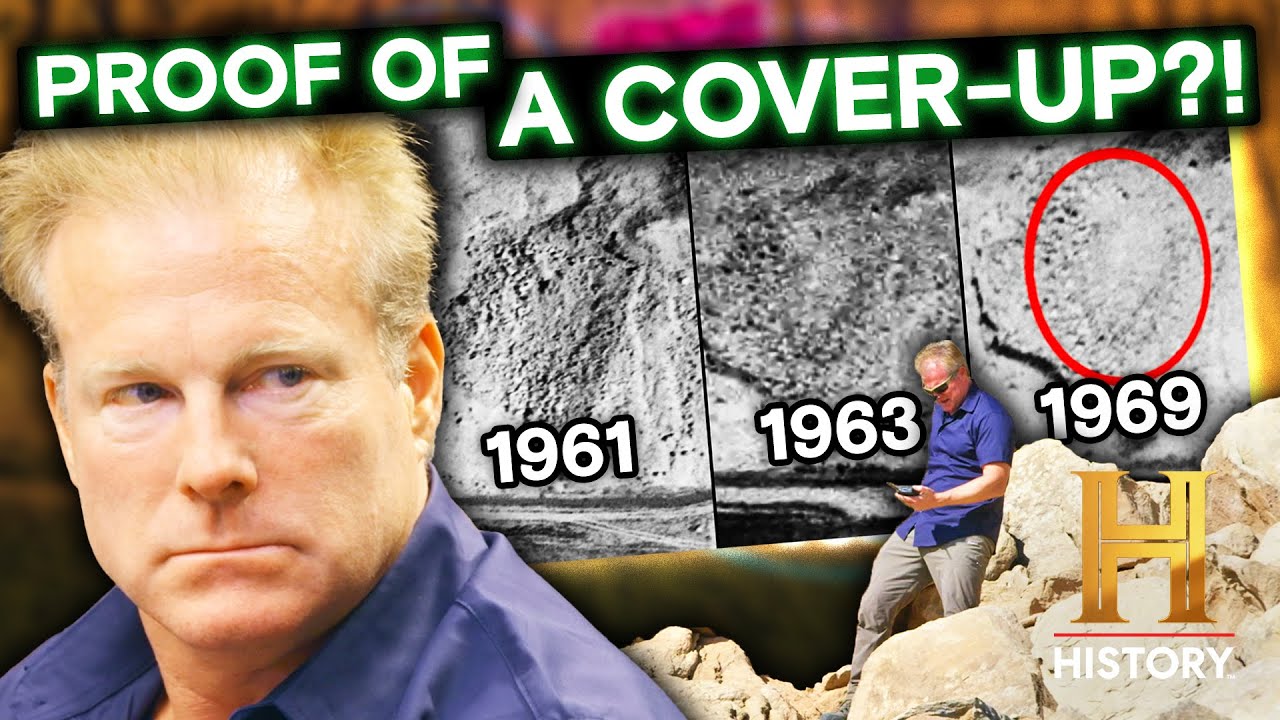
Believe it or not, this is an image of the drill site from 1969.
KALEB: Oh, wow.
-Damn. -ERIK: Yeah. Yeah.
SAM: So, why are we looking at old pictures?
TRAVIS: Just days ago at the drill site, we found that 1964 nickel.
Our investigation of a massive, possibly metallic object and a number of smaller anomalies buried inside the mesa on Skinwalker Ranch took a turn two weeks ago.
While searching through drilling spoils that came from nearly 470 feet in our second borehole, we found what could be an engineered ceramic material related to some kind of highly advanced technology. Things got even crazier a couple days ago, when team archaeologist Chris Roberts uncovered an encrusted 1964 nickel in those same drilling spoils. He explained that archaeologists will often bury a coin to mark the year of an official dig. The nickel could be evidence that an archaeological dig happened right here back in 1964. So, Erik and I scoured through records from the state of Utah and actually found some aerial photos of the mesa drill site that were taken during geological surveys over the past 60 years.
So, we think wh– that maybe So, we think wh– that maybe somebody knew about something there and it’s possible that there was an excavation or an archeological dig of some sort.
And so, we thought, well, if we go back and look through archival images, maybe we could see actual evidence of some kind of dig.
ERIK: Yeah, so I’ve got the historic aerial photos from the early ’60s.
You know, 1961, 1963, and then there’s a gap until 1969.
KALEB: Really? Wow.
Yeah, there’s no available images from ’63 to ’69.
Is that not fascinating?
That’s a coincidence on the timing, isn’t it?
TRAVIS: Why would there be missing photos from 1964, which is the same year as the nickel we found, and then all the way up through 1968?
Was it a clerical error? Or was it done on purpose?
The photos of the mesa from 1961, 1963 and 1969 look almost identical to the naked eye, but I wanted to make sure they weren’t doctored in some way.
So, I used an AI program to look for any evidence of artificial changes in them.
So, here’s all three of them beside each other, and, uh, you can see that there’s a significant spot that it thinks is– has been dithered or smoothed with some sort of filter in the 1969 image that’s not in the other images.
Right? This spot right here, it looks kind of like a leaf shape that seems raised or brighter or blurrier or something?
-KALEB: Yeah. -That right there means someone altered this picture.
THOMAS: That’s just incredible.
-But who? -That’s the big question, man.
And why?
And why between 1963 and 1969?
Why are there no archival photos, and why was this photo altered?
THOMAS: I mean, the fact that it was doctored indicates a cover-up.
If there’s no cover-up, why doctor the photos?
Interesting.
Definitely gonna dig in and… and see what else we can find as-as we move forward up in the mesa.
All right, well, thanks, guys.
Let’s get it and head out there. We’ve been working to drill our second, approximately 600-foot-long borehole, up through the mesa, so that we’d have two identical boreholes positioned on either side of the massive object buried in there. And once Borehole 2 was complete, our plan was to insert scanning devices into both boreholes so we could study what all these anomalies inside there are. But after finding those ceramic pieces in the spoils, we’ve decided to stop drilling Borehole 2 so that we don’t further damage whatever it is that’s in there.
JAN: So, I’m going to go over to the table right now and set up the radar.
TRAVIS: Late the next afternoon, ground-penetrating radar expert Jan Francke arrived at the ranch with a new, specialized GPR device to run down Borehole 1.
Jan, talk to me about what we’re gonna be able -to see as we go down that tube. -Right.
I think you said we can see out to about 20 feet.
-That’s a radius, right? Okay. -That’s a radius.
So, if there is something of a void, or, I guess a metal object, right, then we would definitely pick that up.
Okay.
TRAVIS: Once Jan’s scan is done, Sam Deriso has put together an entire sled of instruments to run a series of other scans, including magnetometry, which might confirm these objects are made of metal, and a gamma ray detector to show just how radioactive they might be.
THOMAS: Jan, let’s start -with your GPR device. -Yup.
-So, Kaleb and Jim are at the bottom of the hill. -Okay. Okay.
They’re gonna be assisting us, making sure that nothing gets caught up at the bottom.
Okay.
JAN: Okay.
THOMAS: All right, the GPR is in the pipe.
We’re gonna start our slow, steady descent. TRAVIS: I’m gonna get my hand-held instrument out of the Jeep, and I’m going to kind of walk up the mesa.
-Great. Sounds good. -All right, man.
TRAVIS: While the GPR device was being run down Borehole 1… One hundred and thirty.
TRAVIS: …I was hiking down the mesa along that line with my handheld spectrum analyzer. I wanted to look out for any strange energy spikes or radio frequency signals that we’ve detected in the past while we drilled both boreholes.
Here we go.
Look at that– bone dry.
-Awesome. -Awesome. Look how…
-Look how clean it is. -We just put an instrument from the top of the mesa down to the bottom for the first time.
JAN: It worked perfectly.
We should get really good data out of this.
I’m gonna head down right now and get started on that.
That sounds great.
Okay. See you guys.
ERIK: All right, Sam, you’re up.
SAM: Yeah. Just need to go, uh, get it recording, and then we’ll send it down.
THOMAS: So, you’re gonna be collecting the profile, the magnetometry data and the radiation.
-Awesome. Let’s do it. -Yeah.
What is inside of this mesa?
And might there have been a deliberate effort to conceal something? I want to get magnetometry information, I want to get side-looking, ground-penetrating radar measurements from Borehole 1. I’m anxious to take a look at the data and look for meaningful correlations. -ERIK: Hey, Jan. -TRAVIS: Hey, Jan.
Hey, guys, good to see you. I’m excited to show you what I’ve got.
The next morning, both Jan Francke and Sam Deriso already had their data from Borehole 1 processed.
So, we couldn’t wait to see what they might reveal about the buried objects in the mesa.
I■m gonna share my screen.
All right, does everybody see this? -Yes. -Okay, great. So this is the GPR scan that I took in Borehole 1. Along the X axis, we see the number of meters down the hole. I’ll move through the scan, going kind of deeper into the borehole as I advance. So let’s go down, you know, 30, 40. We’re down 50 meters into the hole, which is about 165 feet. Nothing to talk about until you get to about 270 feet to this. Wow. Look. I mean, look at that.
-Oh, wow. -What is that?
JAN: That is something that is so distinct. And it sits out away from the hole, approximately, 12 feet, and this thing is six feet thick.
That is just unbelievable.
-Oh, wow. -JAN: And then we see other little bits and pieces further down. TRAVIS: So, this is about 270 to 280 feet in.
-It’s the same place. Same place. -The same place that your data, Sam, was picking up the anomalous data.
Right.
This bears evidence of a similar structure, potentially to the large object we believe is in there.
-Yeah, it does. -Which means that what we encountered at Borehole 2 may be continuous with what’s happening near Borehole 1.
TRAVIS: Jan’s new GPR scans have also confirmed that there appears to be a central, massive object, that could be made of metal, between Borehole 1 and Borehole 2. And now, he’s given us data that suggests it’s at least six feet thick. Is this what’s covered in that ceramic material that we found?
Or what may have been emitting gamma rays when we put a camera in Borehole 2 earlier this week?
If so, what the heck is it?
So, Jan, would it be fair to say that we’re looking at something potentially not natural?
-Yeah. -Possibly technological -in the mesa? -I think it would be fair to say “Yes, absolutely.” That is amazing.
Wow.
ERIK: Well, guys, this is… this is great.
Jan, thank you for jumping on with us.
Always a pleasure.
Take care, guys.