The Triangular Clue That Changes Everything | The Curse of Oak Island
The Triangular Clue That Changes Everything | The Curse of Oak Island

GARY DRAYTON: This is where I want to detect, Rick.
NARRATOR: Rick and Gary head over to the triangle-shaped swamp where they are eager to continue searching for important clues connected to the massive stone-paved feature they unearthed earlier this year.
I’ve never, ever been able to get in there because the swamps always been high.
So let’s do this slow.
I’m going to zigzag along the bank.
[beeping] I love that sound.
The swamp has been probably the most interesting physical feature on the island.
We’ve made some interesting finds, but there’s no connective tissue.
There’s a lot of speculative tissue but there’s no aha moment.
We need to try to unravel this mystery.
[beeping] Sounds good, mate.
Careful it might be a bit mushy down there.
Might be a little bit squidgy.
[music playing] Seems to be dead there in the middle still.
[music playing] There it is.
It’s out.
[music playing] Tin can lid.
Oh.
Yeah.
Definitely not Templar related.
Yeah, good signal here.
Another good one.
Be nice to have a good find, not just a good signal, right?
[music playing] Ooh!
Ooh!
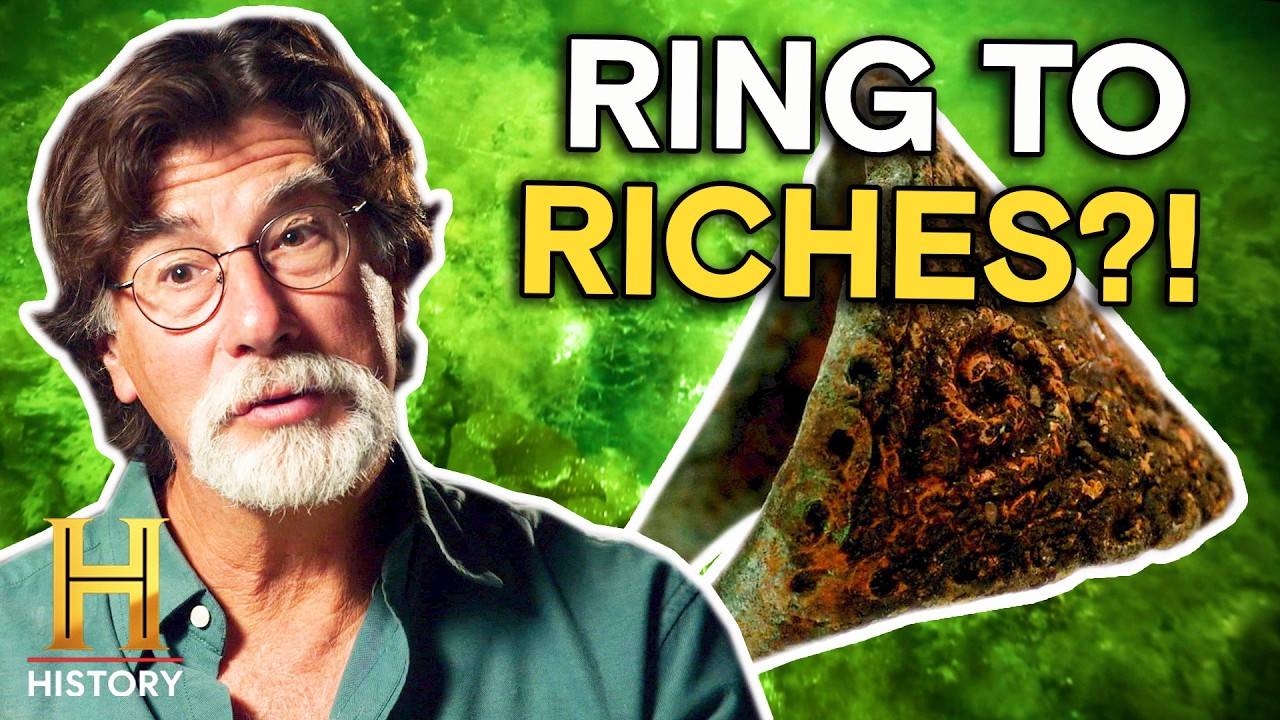
It’s a ring!
This is a ring, mate!
(LAUGHING) That is a ring.
Oh, yeah.
Look at that.
I don’t know what type it is.
I just don’t want to mess with it too much.
And what I like about this.
It’s a perfect shape.
It’s nice and thick.
And there’s a, there’s a lot of pattern on it.
It is quite intricate.
Yeah, that’s intricate.
And they did that in old rings.
Because a modern ring is more likely to have stones in it.
Stones in it.
NARRATOR: An ornate ring?
Could this simple piece of jewelry offer an important clue as to who might have constructed the elaborate stone formation at the swamp and possibly when?
That is a sweet find, mate.
Wasn’t expecting that.
No.
Is that top pocket?
This is a top pocket find, mate, for sure.
We’re back in business.
Sweet!
You are my lucky digger.
Bloody fantastic, mate. Beautiful.
[music playing] NARRATOR: Rick Lagina gathers with members of the team in the War Room to hear a highly anticipated report on the possible silver ring found one day ago in the Swamp.
RICK LAGINA: Doug, if you’d be kind enough to bring him up.
Certainly.
RICK LAGINA: And let’s say hello to the gentleman and hopefully get some really relevant information.
Hello, Professor.
How are you?
Good.
NARRATOR: Joining them via video conference is Charles Lewton-Brain, a professor at the Alberta College of Art and Design who has more than 30 years of experience as a professional gemologist and master goldsmith.
Having examined detailed photographs taken of the ring, Lewton-Brain has been able to determine not only when the object was made but also its possible origins.
Well, it’s always good when you get something out of your top pocket.
[laughter] I’ve found thousands of rings– gold, silver, bronze, copper.
And this ring’s got me stumped.
So I’m hoping you’ve got some good news for us.
I’m hoping this is kind of old.
Well, definitely kind of old.
I think we could start with that.
The repair is crude.
And because of the way it was done, it looks like somebody needed it done pretty quickly.
And I think there are two repairs.
I think there was one repair to make the ring a lot bigger and a second repair to make the ring a little smaller.
GARY DRAYTON: It does look like there was a bit of metal used for the repair, like silver or platinum.
It’s– it’s a good ring.
CHARLES LEWTON-BRAIN: But on the top part of that joint, it is still bright silver.
And the ring itself has corroded away, thinned out from that patch of metal.
So that could mean bronze, or it could mean a higher copper content, a silver alloy.
Where did this floral pattern– I mean, is there any cultural influence to it?
CHARLES LEWTON-BRAIN: The floral design definitely appears handmade.
The flower in the center is rather interesting because it appears to have been chiseled– that is, cut out using chisels, which implies older in time because saw blades don’t really become available to jewelers until the 1730s, 1750s.
And so prior to that, you would be cutting the metal out with a chisel.
So did I hear you correctly that it would be pre-1730?
It is.
Sweet.
CHARLES LEWTON-BRAIN: And the floral pattern reads European to me.
I see.
CHARLES LEWTON-BRAIN: Possibly Spanish.
[suspenseful music] NARRATOR: A Spanish silver ring dating back to the early 1700s or earlier?
Could it be in some way connected to the Spanish Maravedí coin dated to 1652 that Rick, Marty, and the team found six years ago in the swamp?
Yeah, now you’ve pointed out, I know that flower designs were really popular on a lot of the Spanish jewelry that you find from the treasure fleets around the world, actually.
RICK LAGINA: Well, you know, whenever we find things, we’re always looking to come to a greater understanding of possibly the who of it, but certainly when.
That timeline is instrumental in figuring out the who, what, when, where, and why, and how of Oak Island.
That’s for sure.
So we thank you for your help.
It’s been insightful.
Thank you.
RICK LAGINA: Thank you. – Good job, mate.
– Thank you. – Cheers.
I’m hoping there’s some more there.
RICK LAGINA: So let’s go.
NARRATOR: Before another day ends on Oak Island– MARTY LAGINA: Tony, welcome back to the War Room.
Thanks, Marty.
MARTY LAGINA: Yep.
NARRATOR: –Rick and Marty Lagina join members of the team, along with professional diver Tony Sampson in the War Room.
They are eager to follow up on data they retrieved during a recent investigation of the island’s southern shore that was conducted by the Centre for Geographic Sciences, otherwise known as COGS.
What we’re going to do here today is we’re going to go over the offshore data that the COGS students obtained for us.
And they came up with some interesting stuff on the seafloor.
So Jack and Alex have the data in front of them.
Why don’t you show Tony what we got?
Yeah, so Tony, we got the data on the screen there.
Uh-huh.
ALEX LAGINA: There’s a couple in particular that we’re especially interested in.
TONY SAMPSON: OK.
Jack, if you can pull up the image of 12.
On it.
Oh.
Right.
My god, that’s interesting.
MARTY LAGINA: Look at the shadow.
Look at the jagged top to that thing.
TONY SAMPSON: Mm-hmm.
MARTY LAGINA: And it’s very skinny.
I don’t think that’s a rock.
Yeah.
MARTY LAGINA: I think that’s something sticking out of the seafloor.
And anything sticking out of the seafloor near Oak Island is worth a look.
Yeah.
NARRATOR: In addition to finding what could be evidence of a flood tunnel off the island’s southern shore– JAMES NOBLE: These two yellow columns are possible vent locations.
NARRATOR: –the scans also detected a number of possible man-made objects on the ocean floor, including a mysterious triangle formation that appeared to point directly towards the Money Pit.
That is clearly worth a dive.
Yeah.
NARRATOR: While the team waits for the government permits they need in order to expand their excavation of Smith’s Cove, they will redirect their efforts in hopes of locating what is believed to be a second flood tunnel system, one that lies just off the island’s southern shore.
MARTY LAGINA: So let’s go to the next one.
ALEX LAGINA: This is the possible anchor.
TONY SAMPSON: Mm-hmm.
No, that’s very interesting.
ALEX LAGINA: And if you zoom in, you can see that there is a break in the shadow between these two objects.
Whoa.
Well, take these guys with you.
TONY SAMPSON: OK.
MARTY LAGINA: They both are certified divers.
TONY SAMPSON: OK.
Well, with that in mind, what we’ll do, guys, is, with these anomalies, we’ll run a line.
And then we can put an underwater compass on the bottom so you’ll have hard numbers as to where she is.
OK.
28 feet of water, lads, 51 degrees.
NARRATOR: The team’s first target will be the mysterious triangle-shaped formation, which appeared to point directly towards the Oak Island Money Pit, and which the team believes may be associated with a second man-made flood tunnel system, which in turn might lead directly to the money pit treasure vault.
MAN: Mark!
OK, so what we have here guys, in the bag, we have the compass so we can get Marty’s point and his orientation towards the Money Pit or wherever else.
Sounds great. JAMIE HERSEY: Got it?
Yep.
Excellent.
NARRATOR: While Tony Sampson and Alex Lagina perform their dive, Peter Fornetti will maintain continuous communication with them from the boat.
Should either diver need assistance during the operation, Jack Begley, who is also a certified scuba diver, will be ready to enter the water.
PETER FORNETTI: Surface to diver, over.
NARRATOR: Despite the fact that Alex and Tony have seen the anomaly on a sonar scan, they may have great difficulty actually finding it, due to the heavy vegetation covering the ocean floor.
Alex Lagina and Tony Sampson believe they may have finally located the mysterious triangular formation in the waters off the southern shore.
The fact that Alex and Tony have confirmed that the rock formation does point in the direction of the Money Pit is significant.
It suggests that it might have been deliberately placed here as some sort of marker, pointing the way to the Oak Island treasure vault.
PETER FORNETTI: Divers coming up.
NARRATOR: In recent years, the Laginas and their team have discovered a number of astonishing man-made stone structures throughout the swamp that have been dated to between 1200 and 1750 AD. But this year, after uncovering a number of wooden survey stakes and sections of a cobblestone pathway, they were stunned to uncover an empty slate and brick vault-like structure in the northern region. Today, the team is searching just several yards to the north for more evidence of the cobblestone pathway in the hopes that it may lead to more hidden structures that still contain valuables. KATYA: I think we have another stake.
JACK: Stake? Oh!
Look at that.
Oh, yeah.
You got four cuts.
-Another stake. -Maybe five.
JACK: Well, that’s a different cut from all the rest.
TOM: Yeah. This one is different.
NARRATOR: Another axe-cut wooden survey stake? Because the team has made a number of identical finds along the cobblestone pathway, could that mean that they are close to uncovering more sections of it? And if so, could they also be close to an even more valuable discovery? JACK: We do need to find more.
KATYA: All right. Here we go.
JACK: Every time we get to search in the swamp, it seems like we find more and more things that were left behind and constructed with some type of a grand scheme.
We haven’t uncovered everything. I think we’re gonna have to dig around a little more to figure out what’s going on here. I’m really hoping we find another vault-like feature. KATYA: Hey, guys. I think I got a hit.
-Oh, in the ground over there? -Yeah. -Yeah.
Ooh.
Oh, yeah.
-What’s that? -KATYA: What is that?
JACK: That’s really strange.
TOM: Yeah. What is it?
JACK: Maybe a spike of some sort?
NARRATOR: …Katya Drayton, Jack Begley, and Tom Nolan have just discovered a potentially important clue. JACK: Let’s see if there’s anything else.
(metal detector beeps) KATYA: There’s nothing left in that hole.
(metal detector beeping) I think there’s something else right here.
Right there, on that side.
JACK and KATYA: Ooh!
-That looks really old, too. -Yeah, here.
What’s that?
-I don’t know, Tom. -Geez.
-JACK: Look at that tip. -TOM: Yeah.
Maybe it could be a chisel.
Could be. Yeah.
Someone was definitely doing some work around here.
Yeah.
NARRATOR: An iron spike and possible chisel? Could the team have uncovered evidence of an operation that may be related to the mysterious cobblestone pathway? If so, could that mean they might be close to uncovering another vault-like structure that contains something of value? -Hi. -Hey, Charles.
-Hi, guys. -Hey, Rick.
Hey.
-Good timing. -CHARLES: What did you find?
TOM: We found some stuff.
I don’t know what you’ll make of it.
RICK: Yeah, I love the fact that that looks hand-hammered.
-Yeah. -Yeah.
RICK: It’s strange metal, though.
There’s no corrosion whatsoever.
All of these are in such a small area, too.
Okay. Well, why don’t we see what else there is?
Sounds good.
RICK: Obviously, we’re looking for treasure, but we’re also looking for clues to the treasure. And these items might be an important clue and highly relevant to many things. Who was here? When was the work done?
We need to follow those clues where they go. I found leather.
What?
-Bottom of a shoe. -(Jack laughs) Yeah. This is…
That’s leather.
Right there.
RICK: It is a shoe.
This is what I would think would be like a work shoe.
-This is thick. -Yeah. It’s very thick.
How does it look compared to the leather we found over there?
Is it similar?
It looks a lot like it, doesn’t it, Jack?
-Look at that. -Yeah.
NARRATOR: More pieces of leather shoes? One week ago, the team made several nearly identical discoveries just a few yards from where they are currently digging. -Should be dateable, one would hope. -Yeah. Yeah.
NARRATOR: Is it possible that, if the age of these leather artifacts can be determined, they might help the team identify just who may have been working in this area of the swamp? There’s some answers here, so, you know, congrats to everybody.
Let’s take our treasures back to the lab.
-CHARLES: Agreed. -KATYA: Let’s do it.
TOM: Okay. Sounds good.
-CRAIG: Hey, Joe. -GARY: Hey, Joe. -JOE: Good to see you. -CRAIG: Welcome back. We’ve been very much surprised by these leather finds in front of you.
NARRATOR: …in the Oak Island Research Center, Rick Lagina, Craig Tester and other members of the Oak Island team meet with ancient documents and leather expert Joe Landry to have him examine the leather fragments that were found in the northern region of the swamp. GARY: This group was found first.
JOE: Yeah, it’s definitely a sole of a boot.
A boot rather than a shoe?
-I think so. -RICK: What gives you that information?
Well, um, the weight of the leather.
It’s probably an oak-tanned hide.
And you can see the sewing here is quite, quite heavy.
It’s a tough, tough leather. Wears well.
CRAIG: When you say oak-tanned, what do you mean?
JOE: Well, they-they, uh, make up a tanning solution from the-the bark.
Okay.
That’s really cool.
And the next set are these pieces.
JOE: Oh, yes.
Yeah, this is a finer piece of leather.
Could be the toe of the boot.
This-this almost sort of gives the impression of being like a military boot.
-Oh, really? -Oh, wow.
What date would you put these pieces to?
Um…
We’re looking, probably, um, 1830 through 1900.
Wow.
CRAIG: It indicates, probably, Anthony Graves’s time period.
And they were found not far from the vault in the swamp.
CRAIG: Yeah. And maybe that’s where his coins came from.
Yep.
There was some importance associated with the work there.
Might that vault had been discovered by Anthony Graves?
That’s exactly why we’re in the swamp and digging it out, looking for some of those silver coins that Anthony Graves was known to spend in Mahone Bay.
He’s a real mystery man.
NARRATOR: In 1857, a farmer named Anthony Graves purchased most of Oak Island and built his homestead just north of the swamp. And curiously, while he never took part in any searches for treasure in the Money Pit, after living on the island for several years, he reportedly began buying goods on the mainland with silver Spanish coins. Could the team be right that perhaps the empty vault they uncovered in the swamp just a few yards to the south from where they found these leather artifacts might help explain the mysterious wealth of Mr. Graves? And if so, could there be more hidden structures in the area that still contain buried riches? RICK: Anthony Graves certainly had proximity to the bog. Maybe his precious items were found there. And if that is the case, it leads me to believe that there is another vault somewhere else. So, I look forward to some further discovery processes in the bog.
Each clue leads to another clue.
So, ultimately, hopefully, we’ll get a more complete understanding of the story of the bog.
Gary, you’re gonna have to go find more.
Well, as you say, mate, “Eyes and boots.” (chuckles): Eyes and boots.
There you go. GARY: I’m hopeful that coins are gonna be following these.