Proof of Retaliation? Analyzing the Attack on Dr. Travis Taylor
Proof of Retaliation? Analyzing the Attack on Dr. Travis Taylor

In this episode, we break down the most violent and scientifically significant incident in the history of Skinwalker Ranch. What began as a disciplined experiment led by Dr. Travis Taylor to test the “Anomaly Zone” with high-powered infrared lasers quickly turned into a terrifying confrontation.
The investigation that would later be described as the most violent incident in the history of Skinwalker Ranch didn’t begin with chaos or some dramatic explosion. It began with a calculated, disciplined scientific question. For months, the team had been documenting persistent anomalies in the airspace above the mesa. unexplained radar returns, GPS signal drift, electromagnetic interference, and sensor disruptions that clustered in a very specific region they called the anomaly zone. The pattern was consistent enough to suggest some kind of structure. Yet, it was elusive enough to defy every conventional aerospace or atmospheric explanation they had. Dr. Travis Taylor, the team’s chief scientist, proposed a bold hypothesis.
What if whatever was producing these disturbances was actually reactive to directed electromagnetic energy? He theorized that high powered infrared laser emissions tuned to frequencies they derived from prior field data could provoke a measurable response. This was a massive shift in strategy. Instead of just sitting back and waiting for something to happen, they were going to try to trigger it under controlled conditions. Brandon Fugal, the ranch’s owner, authorized a substantial budget to bring in militarygrade laser systems.
The objective was straightforward. Test whether targeted energy input would produce repeatable instrument detectable reactions in that airspace. They weren’t looking for a fight. They were looking for data. But as it turns out on Skinwalker Ranch, the line between an experiment and a provocation is dangerously thin. Part one, the targeted stimulus. The preparation for this experiment was meticulous. Travis personally supervised the installation of the laser arrays, making sure every beam was aligned and every frequency was calibrated. They deployed sensor packages across multiple vantage points, RF spectrum analyzers, radiation detectors, high-speed optical cameras, and environmental monitoring systems.
They wanted to triangulate any response from multiple angles in real time. To keep things scientifically rigorous, Brandon even invited outside observers, including physicists and aerospace engineers, to witness the results. The atmosphere that evening was energized.
There was no expectation of danger.
Dozens of experiments had been done on the ranch before without serious incident. This was just a more sophisticated version. As the sun began to set, providing optimal atmospheric stability, the team prepared to activate the system, confident they were about to collect some groundbreaking data. But within minutes of initiating the activation sequence, that confidence started to evaporate. For the first 8 minutes, everything went according to protocol. The laser system projected its emissions into the airspace, and Travis watched the live telemetry, calling out incremental spikes in electromagnetic readings that seemed to align with his theories. It looked like a breakthrough.
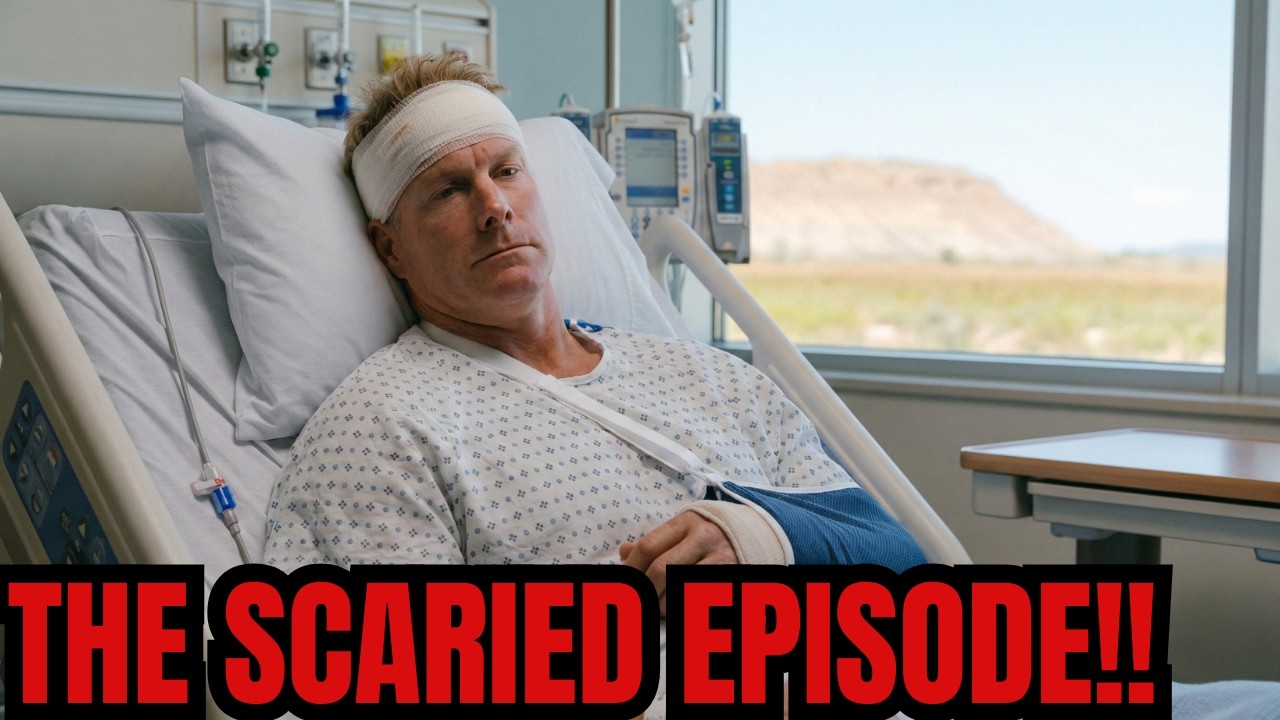
Then the readings changed abruptly. A surge registered across multiple instruments. Not a gradual rise, but a sudden violent spike that blew past the operational tolerance of several sensors. Overload warnings started flashing and two systems shut down automatically to prevent hardware damage. The intensity was simply off the charts. Travis moved to throttle back the laser output, thinking it was a feedback loop or a malfunction. He never reached the controls. Video footage of that moment is chillingly clear. In one frame, Travis is standing upright at the console. In the very next frame, he is propelled backward with extreme force.
He isn’t stumbling, he’s launched. His feet literally leave the ground and he travels several feet before slamming into heavy equipment cases. The entire sequence happens in under 2 seconds. And here’s the part that defies logic. There is no visible asalent, no projectile, or no mechanical failure on camera that accounts for that movement. Witnesses described it as if he’d been struck in the chest by a powerful, invisible, focused force. Part two, the biological cost. As the team rushed to Travis, the situation spiraled. Travis was conscious but couldn’t breathe properly, and deep, broad bruising began to spread across his chest. Bruising that didn’t look like he’d just fallen against a sharp corner. It was centralized and blunt.
While this was happening, the data streams were still glitching. What had been a controlled experiment had turned into something that looked a lot like physical retaliation. But Travis wasn’t the only one hit. Eric Bard, the team’s principal investigator, was positioned about 30 yards away. As he moved toward Travis to help, he suddenly staggered.
He stopped, bent forward, and collapsed to his knees, clutching his head. He started vomiting. His skin turned deep red and felt abnormally hot to the touch. His pulse was racing and he was completely disoriented. The symptoms looked exactly like acute radiation syndrome, but there were no radioactive materials involved in the experiment.
The laser system was infrared. It couldn’t produce ionizing radiation.
Yet, when the team used on-site monitoring instruments, they registered elevated radiation levels coming directly from Eric’s clothing and body, readings that exceeded standard safety thresholds. There was no identifiable source. Radiation doesn’t just appear out of nowhere. It requires an emitter.
Brandon Fugal immediately ordered a full evacuation and called for emergency medical services. When Eric reached the hospital, the doctors were baffled. His burns and systemic symptoms were consistent with significant radiation exposure, but there was no environmental explanation for how it happened. The pattern was undeniable. Travis had been hit by a kinetic force and Eric had been hit by a radiological insult. Two different weapons, two different people, both occurring the moment they tried to probe that airspace with a laser. Part three, the invisible escalation.
Brandon’s instinct was to clear the mesa and get his people safe. In any high-risk business, when people start getting hurt, you stabilize and extract.
But he was also realizing that they had just documented something historic. This wasn’t just an anomaly anymore. It was a responsive interaction. Whatever was there showed an awareness of their stimulus and a capacity to react with physical violence. Travis, even while in significant pain, actually argued to stay. He felt they had finally triggered a response and didn’t want to lose the data. Brandon overruled him. But shutting down wasn’t as simple as flipping a switch. As the technicians started disconnecting the gear, the attacks actually escalated. Several crew members reported being struck from above. Real physical displacements. One operator was pushed between the shoulder blades. Another took a hit to the arm that left immediate swelling. And then there’s the footage of the equipment case. We’re talking about an industrialgrade metal case weighing over 40 lb. In the video, it’s sitting on level ground. Suddenly, it lifts vertically, rotates in midair, and is hurled 15 feet across the mea. It hits the ground hard enough to split the metal latches. There was no wind, no cables, and no one near it. To move a 40 lb object like that requires a massive application of force. Yet, the air was empty. As they scrambled to leave, the environment itself seemed to turn hostile. Audio recorders picked up a low-frequency rumbling overhead and sharp, piercing highfrequency tones that caused physical pain. People described a rhythmic pulsing that they felt in their chests, like standing in front of a giant subwoofer. It felt coordinated.
Even the team members who weren’t on the Mesa weren’t safe. Thomas Winterton, the ranch superintendent, was doing a perimeter sweep in his truck when he reported something heavy moving through the brush alongside him. matching his speed. When he stopped, he heard footsteps approaching from all directions. When he tried to reset his radio, he was shoved so hard he lost his balance and he ended up with bleeding linear scratches on his arms. Scratches that appeared under his clothing.
Meanwhile, Bryant Arnold, the head of security, had his vehicle’s electronics go haywire. His GPS claimed he was a 100 miles away and he reported violent impact on the outside of his truck.
Blows loud enough to shake the cabin. It wasn’t just an experiment site that was affected. It was the whole property.
Part four, the physical evidence and new protocols. In the days following the incident, the focus shifted to documentation. This wasn’t just spooky stories anymore. They had clinical evidence. Eric Bart’s hospital records showed secondderee burns and blood work consistent with acute cellular stress, symptoms that usually take hours to develop but happen to him in minutes.
The doctors officially listed the exposure source as unknown. Travis Taylor’s medical imaging confirmed deep soft tissue trauma. Specialists compared the bruising on his chest to the force of a high velocity martial arts strike or a full contact football collision.
The weirdest part, the skin wasn’t broken. There were no abrasions. The force had been transmitted through his body without any surface friction. When Travis analyzed the data later, he found a perfect temporal correlation between the physical hits and massive electromagnetic pulses. At the exact millisecond Travis was thrown, the sensors recorded an EM spike that saturated every instrument they had. The data suggested the laser energy they were shooting into the sky was being amplified by something in the anomaly zone and then reflected back as a focused beam of energy. This incident changed everything for the ranch. It’s no longer just a place to study the unknown is now treated as a high-risk environment with a reactive inhabitant.
Brendan Fugal overhauled every safety protocol. Everyone now wears biometric telemetry. Heart rate, radiation exposure, and skin temp are monitored in real time by a medical command center.
There’s a permanent mobile medical unit on site. Every experiment now goes through a safety review board, and personnel are briefed on the very real risk of physical harm. The Mesa incident marked a hard boundary. Before that day, the team was looking for answers. Now, they’re navigating a relationship with a phenomenon that clearly doesn’t want to be probed. They’ve learned that on Skinwalker Ranch, if you stare too hard into the dark, sometimes the dark hits back. If you found this dive into the mechanics of the unexplained interesting, pass the story along to someone else who enjoys looking beneath the surface.