Did Europeans Reach Oak Island First? (S13) | The Curse of Oak Island
Did Europeans Reach Oak Island First? (S13) | The Curse of Oak Island

There’s so much activity on lot five.
Rick, Rick and Gary are searching for clues near the middle of lot five.
We’re still east of the Roman coins, aren’t we?
Yeah.
Oh, yeah. There’s no place like Rome.
After finding a mysterious lead piece nearby, they are eager to search an area of lot 5 where the team previously found evidence suggesting that Europeans could have visited Oak Island as far back as the 13th century.
This includes six ancient Roman coins that coin expert Sandy Campbell believes could be between 1500 and 2,000 years old.
According to Sandy and other experts, coins like these were still being circulated as everyday currency in Europe up until the 1400s.
Roman coins on an island in the North Atlantic.
There’s such a puzzle.
A little squeaker here, Rick.
Just there, please.
I like the sound of that.
Oh, come on. Got to be in there.
[Music]
Now, let us see what we’ve got.
Oh, what have we got here?
Another piece of lead.
You know, it’s really heavy.
And I actually think this is really, really interesting.
In fact, it’s an elongated piece of lead.
That makes that more interesting.
Then something like this, you never know.
It could be a match to an older piece of lead we’ve recovered.
Like that medieval lead cross.




We’re going to have to bag this and put a flag in it cuz we don’t know what Emma’s going to reveal when she scans this.
Another curiously shaped lead artifact.
Could Gary be correct that this might be a clue connected to the lead cross and perhaps even to the Roman coins found in this area of lot 5?
Right, mate. I’m going to put this in the bag and we’ll put the flag in.
Okie do.
It’s going in the bag.
I think the work on lot 5 has been exciting, interesting, dramatic, and there has been an extensive amount of finds that show this place, this story, this mystery goes further back in time than we had even thought.
Not too bad sounding.
Not too shabby at all.
Fingers crossed.
Check it and see if you got it out.
That’s not it.
Is it?
It is nice.
Where is it?
It’s the handle to a pair of old scissors?
Oh, while metal detecting near the middle of lot 5 on Oak Island, Gary and Rick have uncovered another potentially important clue.
Look at the fracture there.
Yeah, you’re right, Rick. It looks like it’s broken off.
So, there’ll be another piece.
I’ll recheck the hole.
Yep.
In fact, I can see you, mate. Look at this.
That’s the other side.
Look at that.
Yeah, they go together.
No, wait a minute. Look.
I wonder if they’re not scissors.
These are the same.
What do you think it is?
We need a second opinion.
Lid’s down the lot.
Hey, Lid, check this out, please.
Pretty cool, isn’t it?
It is.
Yeah, it really is.
What do we have?
Hey, mate. How are you?
We’ve just dug up a very curious artifact.
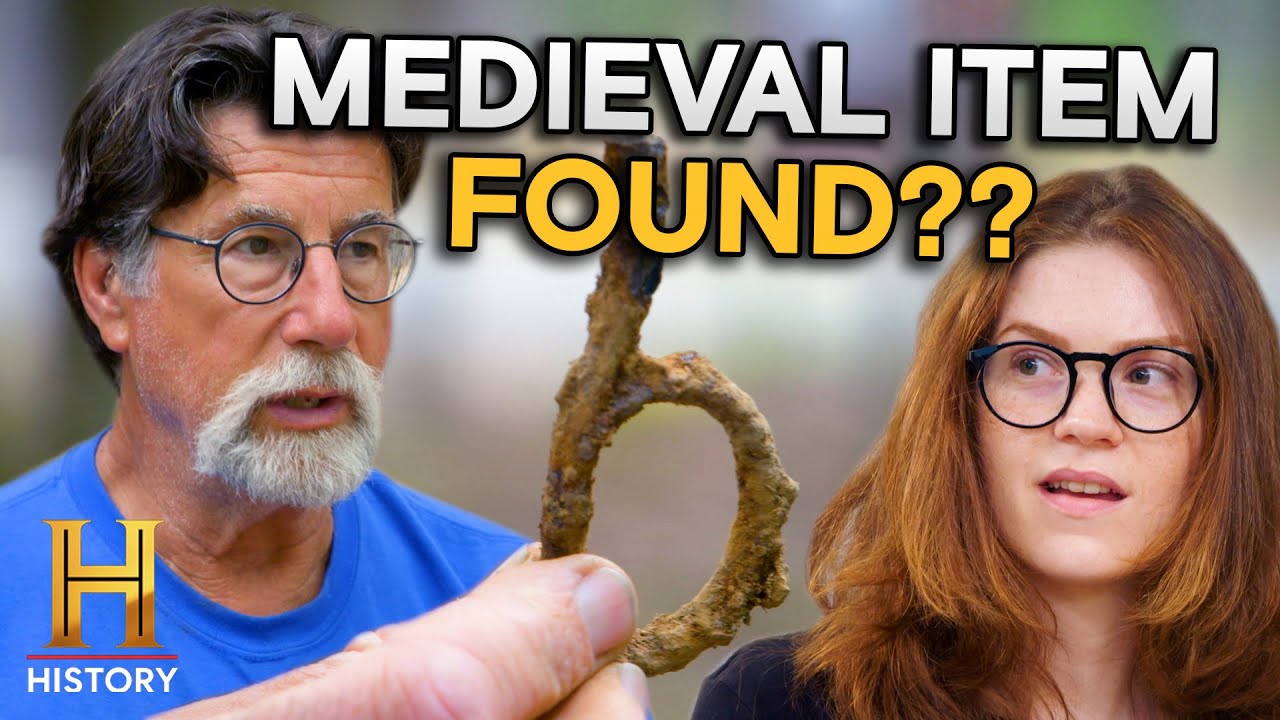
When this first piece came up, I was thinking scissors, old shears.
And then when the second piece came up, I was thinking, look at this.
Mhm.
I think this is something completely different.
Look at that.
I think this is horse tack.
Yeah.
Which is even cooler.
Looks like a bridal cheek piece with—
It would have been two either side at the cheeks.
Yeah, that is really neat.
Part of a possible horse bridal found on lot five.
While several lots on the island were inhabited by settlers and farmers before 1795, known records suggest the lot wasn’t used either as farmland or as a grazing area for horses.
So given the fact that the team has found artifacts in this area that could date back to medieval times and earlier, just how old is this horse bridal?
And might it help identify who built the structures near the shoreline?
I mean, look at it.
I mean, you can see it’s crudely made.
That’s got to be raw iron.
Uh, and an oldie.
Yeah, I can’t imagine that being on an ax.
I think this is horse tack.
Yeah, I’d like to do more research on it.
Um, would you mind if I took it to the lab?
Of course not, mate.
I’ll put it in the bag.
All right. Excellent.
All right, mate.
Giddy up.
So, I’m hoping you guys can tell us what these finds are.
Or maybe it’s just one find.
Rick, Peter, and Gary arrive at the lab to receive Lear and Emma’s report on the possible horse bridal that was found one day ago on lot five.
When I saw it in the field and you put it together, I could see that being part of the horse tack.
Yeah.
But in our research, we couldn’t correlate it to anything like that.
No.
Yeah. Design-wise.
So, you have the two pieces.
These are cross-sections right at that break.
And one is more square.
The other is a little bit more rectangular.
So, that just wouldn’t have come from the same break.
They were not connected as one.
Yeah.
So, they did break off from the same object.
It’s just the handles of scissors.
Yeah.
That’s what I thought when the first piece came up.
Yeah.
Well, it’d be interesting to see what the metallurgy is.
What does the actual data tell you?
Yeah.
So the composition there is a slight chlorine content.
The fact that I am getting some sodium values—
It does indicate it’s been in prolonged contact with salt water.
Mhm.
Oh wow.
There’s minimal impurities which means pre-blast furnace.
So it does indicate it’s 1700s.
Okay.
Potentially late 1600s.
Yeah. Good.
Is it possible that the team has found another artifact that could date back to the 1600s on lot 5?
If so, could it help identify just who occupied the structures there more than a century before the discovery of the money pit?
What country would this artifact be associated with?
It’s most likely UK in origin.
You had—I remember a book here of stylistically how shears changed over the years.
Do you still have that?
I do.
Did you want to take a look?
That would be your closest.
It looks pretty identical to that.
Yeah. Mid-17th century.
Yeah. Yeah.
That explains the sheer excitement we felt when we found these.
Stylistically they represent the period of the 1600s.
It certainly then raises the interest in the item.
Does it prove directly some connection to the money pit and the original work?
No.
But neither does it say it can’t be.
Look, let’s be honest.
There’s two lots on this island that are incredibly difficult to understand, right?
The money pit lot.
Mhm.
And lot five.
Given the enormity of finds, Larry, is it becoming clearer or more difficult to establish what happened on five?
Every little find like that brings us closer.
Every artifact we find tells a story.
And with finds like these, even though they’re quite puzzling in the moment, the next find might help explain it.
Exactly.
We haven’t finished in that area.
Yeah, that’s true.
Needs metal detecting and I say we go right now.
Yeah.
Okay.
Okay.
Thank you.
Great research.
[Music]