Codebreaking Adventures with Josh Gates | Expedition Unknown
Codebreaking Adventures with Josh Gates | Expedition Unknown

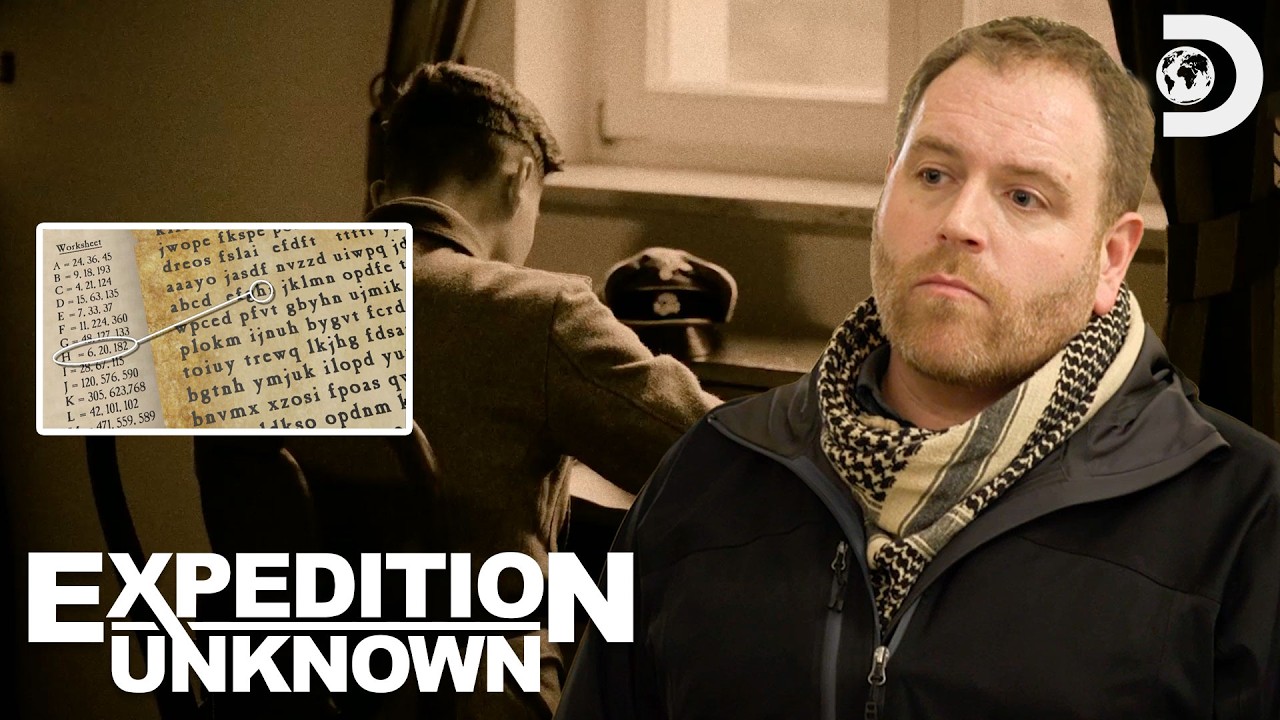
Wow, this is amazing.
>> This mouldering journal from World War II may contain the location of hundreds of tons of stolen gold. So, this whole thing is the diary down here.
>> That’s correct. Yeah.
>> Okay. I have a million questions. To start with, who wrote this?
>> So, it has been written by a highly ranked officer of Vafen SS under pseudonym Mihalis.
The Shustafel or SS were the paramilitary wing of the Nazi party led by Heinrich Himmler, one of the chief architects of the Holocaust. The SS was part combat brigade, part state police, a cadre of true Nazi believers who enforced the genocidal policies of Hitler and Himmler with religious fervor. If this diary was written by a highranking SS officer, he may well have had intimate knowledge of Nazi secrets and the fate of plundered treasures.
As for my search, well, there’s something bothering me. It seems suspicious that the second be code was broken hundreds of years ago, but there’s been no progress in deciphering the other two codes. I’m heading north to Annapapolis Junction, Maryland, because if you need a code crack, where better to go than the NSA. I’ve set up a meeting with Todd Matier, a seasoned crypt analyst who’s carefully studied the Beal ciphers. Matier has ripped apart the codes, and I’m eager to hear what he’s found.
>> So, what I did is I wrote a computer program that allows you to take the Declaration of Independence and apply the book cipher to the second bill of papers. And when you do that, when you plug all that into the to the computer, what do you get?
>> Then we get this sequence of characters.
>> His program reveals a major issue. It turns out that cipher 2 doesn’t actually line up all that well to the Declaration of Independence.
>> So across the entire second cipher, how how many errors are there?
>> There’s about five or six different errors, but only one of the errors will throw off the entire message. When the author numbered the words in the declaration, he screwed up. Each mistake like this created ripple effects, making part of the translation unreadable.
>> So, this is a serious problem because the person that created the message and the person who recovered the message would have had to have made the exact same mistakes.
>> Certainly, that casts some doubt here on on, you know, the ability for him to have cracked this code.
>> Yes. But what about the other two ciphers? Since each code likely has a different key, it’s no surprise that the Declaration of Independence doesn’t decode ciphers 1 or three. But Mr.
Matier ran it through his computer program anyway and noticed something very strange.
>> So if we apply the Declaration of Independence to the first eel cipher, >> Mhm.
>> then we get this strange sequence of characters A B C D E F G H I J K L M N O P. It’s very unlikely that that sequence of characters would have appeared by chance.
>> It’s more than just unlikely. The odds of this alphabetical sequence of letters appearing by chance are astronomical.
So, what does this mean? Mat believes the author of the ciphers got lazy and made a mistake. He believes the first and third ciphers were never intended to be solved. So, all the author had to do was fill up both ciphers with random numbers. But at some point he just started using the numbers he’d written down from the Declaration of Independence and he used them in alphabetical order.
>> Seems like kind of a sad mistake for someone who went through a lot of trouble to really >> Yes.
>> cover his tracks, right? So what’s your what’s your professional assessment as a cryp analyst?
>> I believe it’s a hoax.
>> You believe it’s a hoax and thereby meaning that the author of the papers >> is the same person as the person who cracked the code. This is a stunning find. Since the declaration doesn’t cleanly work on cipher 2, and since ciphers 1 and three seem to have been thrown together using strings of sequential letters, the only possible conclusion is that whoever wrote the cipher also faked solving it. In other words, the publisher, James Ward.
>> So, it’s really a publishing ploy.
>> That’s right.
Mr. Matier’s 21st century analysis of the Beal ciphers has led us to a definitive answer. This code is a brilliant hoax. James Ward, the man who published the Beal papers, created in a sense a viral marketing stunt for the ages. By solving just the cipher that describes the glittering treasure, he gave hope that the other two could also be cracked and that anyone who purchased his pamphlet could get rich overnight.
No doubt that countless be fortune hunters, present and future, will disagree and be undeterred.
And while I think that science has proved that there’s no gold waiting for them in Virginia’s back country, I don’t think they’ll come up empty-handed.
Dan gives my hunt a major boost by setting up a meeting for me with the puzzle master himself.
assuming he lets me past his gate.
>> Hi, I am uh here to see Forest Fen.
Here we go.
Fen rarely meets with hunters pursuing his fortune. And yet, I’m rolling up to the very spot where he assembled his treasure chest. But just as I start to picture a devious mastermind hidden away in a secret layer, Hello, Mr. Fred.
>> You must be Josh.
>> I’m Josh. Yeah.
>> I’ve been inspecting you. Come on in.
>> A.
>> So nice to meet you. Thank you for having me. I appreciate it.
>> Yes, sir.
>> It turns out he’s a lot more friendly grandfather than sinister puppet master.
Though his private art collection would make a Bond villain blush.
>> Holy smokes. Over the course of his life, Forest amassed a fortune in art and artifacts. Whatever’s in that treasure chest only represents a small sample of what he owns. Okay, so first question, Forest should be an easy one.
Where is the treasure hidden?
>> At least eight miles north of Santa Fe and below the Canadian border.
>> Okay. Still got a lot of ground there to cover. Can you tell me why you chose the place that you chose?
>> It’s a place that I’ve visited a few times. I have fond memories of that place.
>> Do you know how much the treasure is worth?
>> No, I don’t. There are 20.2 pounds of gold in the treasure chest. There are 200 some odd rubies. There are there are two salon sapphires. There are eight emeralds. There are lots of diamonds.
>> Forest admits that the treasure’s hefty weight forced him to take two trips from his vehicle to the hiding spot. What was your intention?
>> I had a number of reasons for doing it, but primary was to get people out in the sunshine again to smell the the pine needles in the mountains.
>> To find Fen’s treasure, you’ve got to decipher Fen’s poem, which supposedly points straight to the prize. Is this something you think that anybody could find? Well, anybody that’s physically able to get out in the mountains and walk through the countryside, sure. But you have to start at the first clue.
That starts the great adventure.
>> As I have gone alone in there, and with my treasures bold, I can keep my secret aware and hint of riches, new and old.
Begin where warm waters halt and take it to the canyon down, not far, but too far to walk. Put in below the home of Brown.
From there it’s no place for the meek.
The end is ever drawing nigh. There’ll be no paddle up your creek, just heavy loads and water high. If you’ve been wise and found the blaze, look quickly down your quest to cease. But Terry scant with marvel gaze. Just take the chest and go in peace. So hear me all and listen good. Your effort will be worth the cold if you are brave and in the wood. I give you title to the gold.
>> You were quoted as saying that you think people have been very close to the treasure.
>> I I know that some people have been within 200 ft, but they don’t know who they are. If you want to be a serious searcher, my advice is look at clues in the poem.
>> Are you worried that the treasure could be damaged or moved by the elements?
>> It certainly could be. I wanted the treasure to be hidden in a place where it was hard to find, but but not impossible to find. How many people do you think have looked for your treasure?
>> Last summer there were 30,000 people in Santa Fe.
>> That’s amazing. The safest thing probably would be for you to tell me where it is. I’ll check on it.
>> But then two people would know where it is and I’d have to shoot you.
>> Okay, that’s a fair point. Don’t tell me. Does anybody else know where it is other than you? Your wife doesn’t know.
>> No one knows.
>> Nobody knows.
>> I don’t plan to tell anybody.
>> Okay. It’s clear I’m not going to trick Forest into revealing the location of his loot, but I come away from my meeting with two strong convictions. I now believe 100% that the treasure exists, and I’m convinced that he wants it to be found. Forest revealed to me that the first clue is the most important. Begin it where warm waters halt. I’ve learned of a pair of treasure hunters who believe they know exactly where that is. I head to the Dupeskazind Kirk Church to meet journalist Carl Hammer. Josh. Hi.
>> That’s right. It’s hammer time.
>> Welcome.
>> Wow. Look at this. This is stunning.
>> Yeah. 17th century Menanite church right in the middle of Amsterdam.
>> And like everything else here.
>> Beautiful.
>> Beautiful. Okay, let’s talk about this uh mysterious music sheet.
This music sheet supposedly points to >> a stash of Nazi gold and Hitler’s personal diamonds, the most expensive diamonds the Nazis ever had.
And tell me how you got involved with this. Where did you first hear this story?
>> Well, I was working on another book about Nazi art theft. And this guy came up to me and he said, “I have this musical sheet which is actually a coded document drafted by Martin Borman, Hitler’s personal secretary.
If Adolf Hitler was the heart of the Nazi regime, then Martin Borman might have been its brain. A loyal servant of the party since the days before Hitler took power. Borman rose to become the Furer’s personal secretary. In 1945, with the war almost lost, Borman was among the inner circle that stood beside Hitler in the Furer bunker. On April 29th, 1945, Hitler signed his last will and testament. Borman was his witness and executive of his estate.
>> What’s interesting that at the end of the war when they were about to lose the war, they had decided that they wanted to continue their ideals in a fourth Reich, so to say.
>> This idea that if the war is lost, if the Third Reich falls, they’ll reorganize and come back.
>> Right. And they had this terror cell called Vwolfen. The werewolves.
>> The werewolves.
>> Yeah.
>> But even werewolves need money. So according to the story, Borman had to cover the bill >> to fund that terror group werewolf. They needed gold and diamonds.
>> Mhm.
>> And they had a stash placed somewhere in Bafaria.
Now Borman needed to get a message to the south to the leader of the werewolf group there. So he thought very cleverly, I’ll have this sheet of music coded to get to that gold and to those diamonds. and he sent a clergyman down south to bring that document to the werewolves.
>> The Nazis would allegedly use clergy to pass messages through Allied territory since they would be less likely to be questioned and searched. But if the story is true, the sheet music was never delivered, and it sat collecting dust for over 70 years.
>> If you want to, I can show you because I’ve brought it with me.
>> You have the original sheet music?
>> I have the original sheet music. Yes, I would love to see it.
>> Oh my word.
>> Take it out. Take it out.
>> We dawn white gloves because Hammer says can’t touch this.
>> Wow.
Look at that. This is the Marsh impromptu by the German American composer Gotautle Federline. First of all, before anything else, to think that we may be holding a document here that was in the furer bunker >> at the end of World War II is already kind of mind-boggling.
>> Yeah, it’s then probably the last document Warman ever drafted. So, it’s unique.
Now, I have to say also, if you just handed this to me and I had no context, you know what I see here? I see a pretty normal piece of sheet music, right? As a layman looking at this, I would have no sense that there’s a code here.
>> Well, one way to find it out, you play the music, look at the sheet, follow the notes, and see where you find things that are not in the music, but that are on paper.
>> Okay, that’s a good plan. and if I could play piano.
>> One step ahead of you, I’ve invited two friends for you who can play the piano.
>> Yes, >> gentlemen.
>> Carl has invited a pair of Dutch pianists to play a command performance of the March impromptu. But as I’m about to learn, there’s a lot more on the page than just the music.
Strange symbols, characters, and even cryptic text masquerading as lyrics.
These are the elements Carl believes constitute a secret Nazi message to find a cache of gold and diamonds.
Bravo.
Terrific.
>> So Josh, I have a copy of the sheet music and an overlay. All the markings you see here in red, for instance, are the things that they didn’t play, you couldn’t hear, but they are on the sheet music.
>> What is this writing that’s layered on top of the music?
>> It’s made to look like a poem, but it’s not.
>> So, the first line here says, >> which translates to >> where Matthew strokes the strings.
>> Where Matthew strokes the strings.
>> I mean, who’s Matthew?
What strings?
>> There are also those strange characters amid the music that Carl thinks are part of the puzzle >> where you see the little markers.
>> Yeah, >> they are all runic symbols. You see FXS in the first line down.
>> FXS means France Savier Schwarz.
Fran Zavier Schwarz was the treasurer of the Nazi party from its very beginnings and was so trusted by Hitler that the furer’s will was only to be opened in Schwarz’s presence. In short, he was Hitler’s personal banker and someone who would have certainly been aware of any secret Nazi slush funds. In fact, some believe Schwarz may even have been the intended recipient of the coded music.
What’s your own hunch? Is there something out there to be found? Yeah, >> that was a that was a quick Yeah.
>> Yeah.
>> All that’s left is to crack the code or find someone who already has. Are there people that are actively looking for this treasure?
>> Oh, yeah. Sure. And I’m sure that one day the code will be cracked. Question is, will there still be something in the ground?
>> We don’t know. We’ll have to wait.
This is Roman Formanac and Bart Zelitis of the Celasian Bridge Foundation, a group dedicated to strengthening the relationship between Germany and Poland.
And can we talk about how amazing this building is?
>> Absolutely. It’s a late 17th century palace that has been restored to this beautiful condition you see here and now.
>> It’s awesome.
>> It’s nice to have you here.
>> And and I understand you have something very special in this palace, a document of some kind.
>> That’s correct. It’s a war diary that has been written at the end of the World War II that points 11 locations where Nazi gold has been hidden. And we’re talking about anywhere between 100 to 300 tons of gold.
>> I’m sorry, did you say 100 to 300 tons of gold?
>> That’s correct.
>> Okay.
I thought a rafting trip through a flooded Nazi tunnel would be the wildest story I’d face this week, but a war journal that may point at 300 tons of plundered gold raises the bar to a new level. Any chance it tells you right where it’s buried?
>> In a way, yes.
>> Can I see this document?
>> Please lead on.
Oh, wow. Unbelievable.
>> Wow. This is amazing.
>> This mouldering journal from World War II may contain the location of hundreds of tons of stolen gold.
>> So, this whole thing is the diary down here.
>> That’s correct. Yeah.
>> Okay. I have a million questions. To start with, who wrote this? So it has been written by a highly ranked officer of Vafen SS under a pseudonym Mihalis.
>> The Shutafel or SS were the paramilitary wing of the Nazi party led by Hinrich Himmler, one of the chief architects of the Holocaust. The SS was part combat brigade, part state police, a cadre of true Nazi believers who enforced the genocidal policies of Hitler and Himmler with religious fervor. If this diary was written by a highranking SS officer, he may well have had intimate knowledge of Nazi secrets and the fate of plundered treasures.
He describes a completion of a mission where they hide Nazi gold, artifacts, archival stuff.
>> Any doubts about the authenticity of the diary?
>> We’re 100% certain it’s authentic.
According to Roman, the journal’s age has been confirmed as authentic by a German lab. However, many notable documents from the era, like the announcement of Hitler’s diaries in the early 1980s, have proven to be elaborate forgeries. As to the contents of the diary, which was donated to the Celasian Bridge Foundation by a German cultural society, the jury is out. The only way to be sure is to keep investigating. So this high-ranking Nazi officer, is he writing this diary as a personal diary?
>> So this is an official document of establishing a new nation.
>> Fourth Reich.
>> The Fourth Reich.
>> Correct.
>> So the Nazis know that the walls are closing in on them and this is kind of an emergency measure to say we’re going to hide all this stuff so that we can come back for it later.
>> Absolutely.
>> Bart offers me a translation of a particularly revealing entry. So the author says, “We are grateful that Providence appointed us to safeguard the part of Germany’s cultural and national heritage.” Correct.
>> According to Roman, the diary mentions 11 different places where the Nazis were quote safeguarding works of art, plundered from across the continent, looted religious and occult objects, and in this area a huge stockpile of stolen gold. Okay. where >> so for that we have to look in a diary.
>> We can actually look inside of it.
>> Yeah.
>> To read firsthand from this dark tome, Roman and Bart bring the diary to the palace’s ornate ballroom.
>> Oh my word, look at that. It is all handwritten >> and all in pencil. So it’s very fragile.
>> Yeah. So what do we see on this page?
>> This is a English translation.
>> Okay. So it says transports to the estates of vonstein and Siditz. So who was Siditz?
>> Sid.
>> Siditz was a 19th century German general who built a palace estate nearby >> and the village was named after him. And today the village is called Manowski and it’s 40 km north from here.
>> And then it also says the estate of vonstein. So who’s that?
>> Correct. He was the last inhabitant of the palace. He was also an assess officer.
>> Siditz or Minkowski today is are there many palaces there?
>> Just one.
>> Vonstein though wasn’t living at Minowski by himself. According to Roman, the SS used the palace as a kind of brothel away from home. Vonstein, it appears, got himself a girlfriend.
>> Because we have a letter from Vonstein, the last inhabitant of the palace, to Eningga, his mistress.
Long after Vonstein had been erased from history, his mistress remained at Minowski Palace. And for over 40 years, she held on to a remarkable piece of evidence.
>> And the letter is right here.
>> So this is the letter and a translation.
This is from Vonstein. So he writes, “My dear Ingga, some transports were successful. The remaining 48 heavy Reichbank chests, meaning chests of gold, from the Reichkes Bank.” >> Very likely. Yes.
>> 48 chests.
>> Correct.
>> As the war turned increasingly against the Nazis, the Reichkes Bank hid the country’s gold reserves in a salt mine inside Germany to keep it safe from the Allies. Roman and Bart don’t believe that was all of it. Not nearly. Only you know where they’re located. May God help you and help me fulfill my assignment.
Vonstein, February 1945. You’ve got an authentic World War II diary written by a high-ranking SS officer. You’ve got a real location and you’ve got a corroborative letter.
>> Well, what else can one want?
>> Proof that it’s all true. That’s exactly what we’re going to find.