Discovering Alexander the Great’s Lost Tomb | Expedition Unknown
Discovering Alexander the Great's Lost Tomb | Expedition Unknown

Josh Gates dives into ancient ruins and travels across continents chasing the mystery of Alexander the Great’s missing tomb. From sunken cities in Egypt to secrets hiding in Venice, the clues are wild!
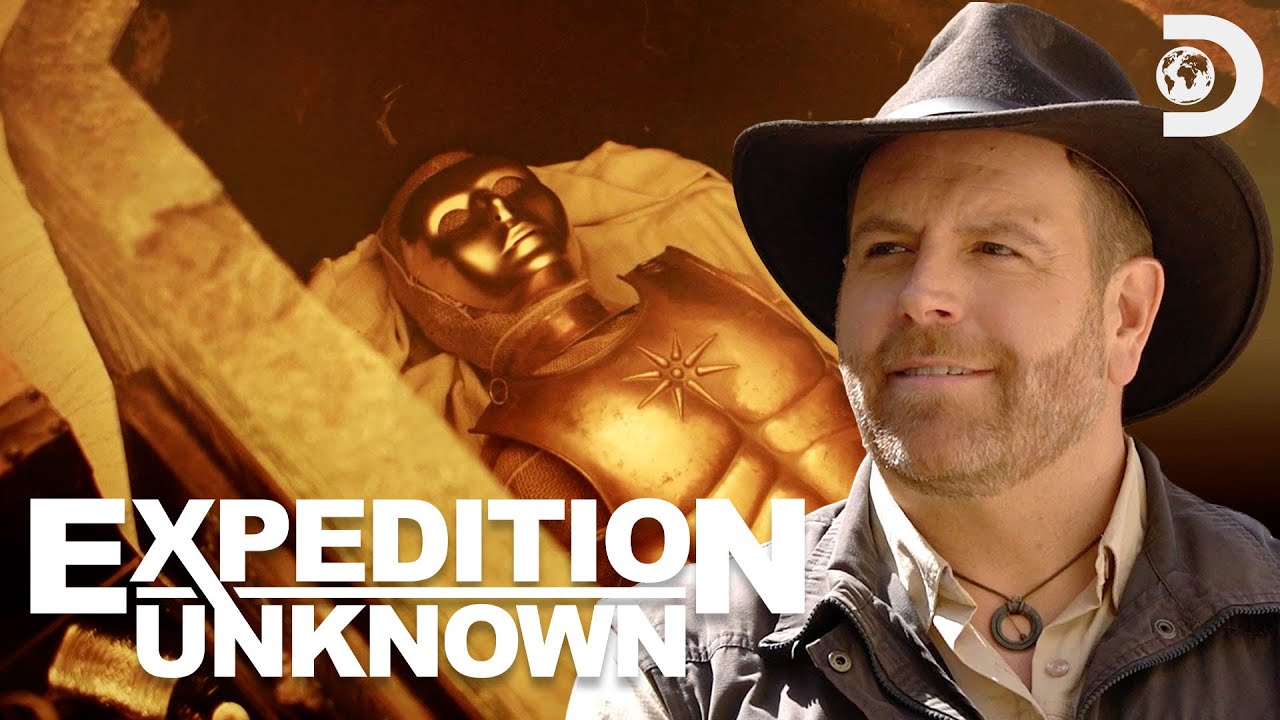
Wait a minute. Are you saying that the body of Alexander the Great is in the tomb of St. Mark in Venice? That’s certainly the idea.
[Music] We are now in full Da Vinci Code territory. This theory, if it’s true, would be like dropping a grenade into history. A revelation that the longlost body of Alexander the Great has been lying in Venice since the 9th century, masquerading as St. Mark the Evangelist.
Andrew believes that Alexander’s sarcophagus was wrapped in a custom casing, a Macedonian layer covering the original Egyptian inscriptions, meaning that the block in St. Mark’s Crypt was once mounted on the sarcophagus that is currently here in London. It’s a jigsaw puzzle. If we could prove that this star shield block fits the sarcophagus, it would prove the theory. It’s unlikely that the church will allow us to bring the block here. But if we could get a scan of the block, then if it interlocked with the sarcophagus, we would have proved the theory. It would demonstrate that Alexander’s body was in this sarcophagus and it would demonstrate that the body that was brought to St. Marks originally was also Alexander. Exactly.
[Applause] The last resting place of history’s greatest conqueror is also the greatest missing person’s case in history, not to mention a treasure-filled tomb beyond compare. One that has eluded scholars and adventurers for centuries.
My own search kicked off in Verina, Greece, in what were once the rolling hills of Macedon, a small tribal kingdom that grew into a lethal fighting force.
Thanks to Philip II, who began a revolution in warfare that his son Alexander turned into a fun hobby called taking over the world. Spreading his empire from Macedon into Europe and as far as the edge of India using honed military skills and innovative long-handled spears known as sarissas, Alexander crushed the competing powers of his day. And how would you describe his reign? the most successful military campaign in world history. In Egypt, he was welcomed as a pharaoh and pronounced a living god. It could be argued that no person changed the world as much as Alexander. Oh, and he did it all by age 32. I’ve never felt less accomplished. But then, a sudden and mysterious death from illness turned the game board upside down. It was probably the most devastating piece of news that the world had seen up to that point.
Philip’s subterranean tomb in Greece glitters with ancient treasures and is adorned with the royal emblem known as the Vginina star. This gave me a good idea of the even more valuable treasure that assuredly lies with his son Alexander. Except slight wrinkle, we don’t know exactly where he is. After Alexander died in the conquered city of Babylon, his massive funeral procession was hijacked by one of his successors, the pharaoh Talamy, who arranged for his body to be brought to the harbor city Alexander founded, Alexandria, Egypt. 2,000 years ago, the geographer Strao described the tomb as an immense structure with a pyramid roof surrounded by a large fortification wall.
But after 20 centuries of earthquakes, tsunamis, and modern construction, Alexandria is now the largest city on the Mediterranean. And that’s where archaeologist Kiapi Papak Costa comes in. She’s used ancient sources to unearth roads that Alexander the Great himself designed. Those landmarks led her to dig a very big hole 30 ft beneath modern Alexandria. You’re like excavating a city down here. In this sprawling site, we dug down to the so-called Henistic or Greek layer and found a coin from the period right after Alexander’s death. You know, just a 2,000-y old coin. No big deal. As well as the top of an ancient pillar.
The question is, a pillar from what?
Collopy has also discovered part of the foundation of a building from the same period. By exploring and escaping from a flooded tunnel, we now know that the mystery building was 140 ft long and 110 ft wide. Massive enough to be Alexander’s longlost tomb. But it’s still circumstantial. Collapy will need to uncover more secrets about the structure before she’s able to declare victory.
So, let me show you this. This is painted. It is painting. these red bands on here. This is similar to decoration we find in tombs. So this may be like aerary painting. I think it’s aerary painting. These colors match those that I saw deep under the street on the other side of the building. So does this convince you that somebody was buried here? No, it’s not enough. We must find much more to be sure about this. Yes.
One of those things is something that appears just outside the mystery building. You see this line of blocks?
Yes, these big limestone blocks. These look like the big limestone blocks from the foundation of the building. The same size and material with the stones of the building. But it’s not the only line of blocks. We have one here. Oh, behind us.
One and second one running parallel quite parallel to this line. So this is maybe a wall with fill in between. We have to continue the excavation to confirm that the ancient writer Strao says that Alexander’s tomb was surrounded by a pereibilos or a large wall. Could that be what we’re seeing here? Just the fact that this building might have a wall around it further reinforces that the building must have been very important. You don’t build a huge fortification wall around an insignificant building. So, if this is a wall and it’s running parallel to the building and maybe wraps around it, that would be huge. Exactly. Do we see more blocks on the other side? We have found a few, but we must see if they continue.
Okay. Can you show me? Of course. Yeah.
To determine if this wall was constructed to surround the building here on the site. We go to see how far it extends. So, here we are. Yes. And you see that we found the continuation of the stones. The stones continue at least for a little bit. Yes. But not only here. There is the other line also. Oh, the big stone over here. Yes. So we have the two lines of stones. So two lines of stones continuing and maybe the fill in the middle and it’s headed in the direction of the building which is over there. The mystery building is here and Collapy has discovered what looks like a run of blocks that could be signs of a double-sided wall. Now, if those blocks continue and truly run parallel to the building, she could prove that this is a wall matching the one that surrounded Alexander’s tomb. So, we need to go deeper deeper in the same uh layer with the stones with the blocks. Okay. So, we dig, of course.
Collopy’s team is ready to search for the critical evidence below our feet, which means it’s time to get to work.
Of course, we will continue. We have to excavate all this area. I hope that in another uh spot we’ll find also this line to be continued. Colliopy has been in this position before but doesn’t give up easily. So we cross our fingers and keep going finding only small pieces of broken stone. Look how many pieces there limestone everywhere. Yeah. Wow.
But we could try this really fly. Really? You found a stone? Yes. It continues. Yes. Ah, this is for sure another one of these big limestone blocks that continues right through here. This is just broken up in here. Oh my god. I will start crying now. No, I was disappointed when I didn’t see this area having the same stones. I said maybe I’m wrong. But now you see, look at it. You see, it’s amazing. It means I’m right. Yeah.
Great. Great. Let’s go and take a look.
Come here. So, up close and personal here, we can see this big limestone block, which looks exactly the same dimensions as the one leading up to it here. So, this does continue. This is a long continuous foundation of some kind in a parallel line with another one over here. So, I mean, that’s pretty cool.
We measure the stone to see if it matches the width of the previously found section. How wide? 60. 60 cm.
Okay. Okay. Let’s check this one now.
60. 60. Exact same width. Yes. Okay.
Great. Great. Great.
This could be it. We’ve confirmed that there was likely a fortification wall that surrounded our building. A wall like the one mentioned in the ancient account of Alexander’s tomb. We have this huge building with massive foundations right in the middle of the city, maybe surrounded by a large wall in the royal quarter of ancient Alexandria. Do you think that could be his tomb? For sure. It’s it is a very important building of the royal area of the royal quarter. We need more evidence, more clues to understand the identity. Are you hopeful?
Of course. Hope is everything in our work. Alexander is one of the most towering figures in history. It is kind of remarkable that he’s lost in a way.
Yes. That’s why it’s so important to find the tomb. So now we just need to excavate all of this all the way to the end of the site. Uh today I don’t promise you this. We can do it. Come on guys, let’s get digging. Got a lot of work to do.
Colliapy has invested decades into this dig, and I rest easy knowing that she won’t stop until she’s turned over every stone to confirm whether this is Alexander’s tomb. But while she continues to investigate here, another theory has emerged from an expert who believes Alexandria was not the final stop for the conqueror’s remains. In fact, he’s got a wild theory that if true would change everything we think we know about Alexander. To meet this researcher, I bid farewell to Egypt and fly 2,000 m to London.
You’re saying this could be the sarcophagus of Alexander? I think it very probably is. Very probably is.
That’s a That’s a big claim, Andrew.
Absolutely. But all the evidence points that way. I’ve joined historian Andrew Chug on his quest for the last resting place of the conqueror Alexander the Great, which he believes is connected to this relic in the British Museum.
There’s only one problem with it that I can see. All right, let’s start with this. It’s empty. So, let’s talk about this. This is a huge granite sarcophagus and it looks very Egyptian, right?
Covered in hieroglyphics. So, any chance these say here lies Alexander the Great?
If only it were that easy. We can read the hieroglyphs thanks to the Rosetta Stone. And they identify the sarcophagus as that of a preceding pharaoh called Necttonbo II. Okay, buckle up. Nectane II was the last nativeborn pharaoh of Egypt, driven out of the country by the invading Persian Empire.
And when he blew town, he left all of his stuff behind. And I do mean all of it. In the deserts of Sakara in Egypt, historian James Rahm showed me where Necttonibbo’s unusederary temple once stood. Since it was empty when Alexander died, it may have been the perfect place to temporarily store his body. And what about the sarcophagus?
Does this stay in Sakara? Was that Is that where it was found? No. The sarcophagus is discovered in Alexandria.
Wait a second. This sarcophagus, which weighs what? Seven tons. Seven tons was moved hundreds of miles to Alexandria.
Exactly. Yes. So why move this thing? He would only move this thing in order to carry the body of somebody really important like Alexander the Great, such as Alexander the Great, specifically Alexander the Great.
Andrew believes that this sarcophagus containing the gold lined mummy of Alexander was brought to Alexandria where it was used to hold the body inside his tomb and where it remained until the tomb itself disappeared around the year 400. Okay, this part sounds plausible, but now things get murky.
Andrew also believes that the body and the sarcophagus go their separate ways because of a major religious shift in Egypt. What happens historically is that the emperor of Rome decrees that Christianity will now be the only legal religion, right? And Alexander is a pagan god by order of the Senate. So this is a big problem. Andrew contends that the sarcophagus and the body within were hidden to keep them safe from the threat of a newly dominant religion. And what of this sarcophagus? Where does it go? We know that it must have been moved from the tomb because it turns up in a rather unusual place.
And just as I’m starting to think that Andrew has read too many Dan Brown novels, he shows me this, a map of Alexandria from 1575. On it is a structure known as the Atterine Mosque depicted by a minouret and a small octagonal building. And Josh, can you see what’s written underneath that small octagonal building? Domus Alexandri Magny.
Exactly. And that is Latin for the house of Alexander the Great. Andrew explains that by the late 1500s, the sarcophagus had moved to the mosque for safekeeping.
And he’s got the receipts. And we know that because of Napoleon. Napoleon. Yes.
Napoleon came to Egypt in 1798 with an invasion fleet and he took Alexandria, right? And that’s when he found the sarcophagus. If you look here on the next view Uh-huh. this is an engraving made by Napoleon’s scholars. And now, were we inside this mosque? We’re inside the courtyard of the mosque. You can see the minret again here. And you can see the small octagonal building. And inside, if you look very carefully, get out of here. You can see the sarcophagus that stands right behind us. It’s here in the mosque. Yes.
Once the British took Egypt from Napoleon in 1801, the sarcophagus was brought here to London. This means, though it sounds crazy, this 7 ton chunk of granite may actually have held none other than Alexander himself. But Andrew is sitting on an even bigger bombshell.
The true location of Alexander’s body.
Right around the time that Alexander’s tomb disappears, we have the appearance of another really important tomb. The tomb of St. Mark the Evangelist, no less. As in the book of Mark, as in from the Gospels of the Bible, exactly that Mark.
St. Mark the Evangelist was not only the source for a New Testament gospel. He was the founder of the Christian church in Alexandria. And it is true that his tomb conveniently materializes there just as Alexander’s disappears. So what about the body? Where does the body go?
Andrew thinks that the body of Alexander and the magnificent Soma, his lavish tomb, were simply repurposed. Instead of belonging to the founder of Alexandria, they were rebranded as belonging to the founder of Alexandria’s church, St.
Mark. Now, wait a minute. I thought that St. Mark’s body was in Venice. Isn’t it in Italy? in this giant basilica there.
Yes. That’s because uh in 828 AD when uh the Christians in Alexandria were under pressure from Islam, they allowed some Venetian traders to take the body back to Venice and rear it there as the patron saint of the city.
Wait a minute. Are you saying that the body of Alexander the Great is in the tomb of St. Mark in Venice? That’s certainly the idea.
[Music] We are now in full Da Vinci Code territory. This theory, if it’s true, would be like dropping a grenade into history. A revelation that the longlost body of Alexander the Great has been lying in Venice since the 9th century, masquerading as St. Mark the Evangelist.
And how could you possibly prove that?
The body of St. art used to be in a crypt in Venice, but the body in 1811 was moved upstairs because of the threat of continual flooding in the crypt.
Uh-huh. Then in 1960, an archaeologist discovered embedded in the wall of the crypt, an astonishing artifact.
a block of sculpted ancient limestone depicting a long-handled spear as well as a shield bearing the star of Vginina, the same Macedonian symbol that appears on theererary box of Alexander’s father, Philillip. What is it? Well, Andrew believes that Alexander sarcophagus was wrapped in a custom casing, a Macedonian layer covering the original Egyptian inscriptions, meaning that the block in St. Mark’s crypt was once mounted on the sarcophagus that is currently here in London.
It’s a jigsaw puzzle. If we could prove that this star shield block fits the sarcophagus, it would prove the theory.
It’s unlikely that the church will allow us to bring the block here. But if we could get a scan of the block, then if it interlocked with the sarcophagus, we would have proved the theory. It would demonstrate that Alexander’s body was in this sarcophagus. And it would demonstrate that the body that was brought to St. Marks originally was also Alexander. Exactly. Okay. Does this mean we’re going to Venice? You’re going to Venice. All right. Off to Venice. You just wait here and I’ll be right back.
Maybe. Don’t wait here. It’s going to take a few days. But I will be back.
Voyage. Okay. I I’ll be back.
I’m in Venice, Italy, home to St. Mark’s Basilica, in whose crypt this ancient casing block was discovered. One researcher believes it once adorned the sarcophagus of Alexander the Great, which if true could tell us where his longlost remains lie today. And this shield with the Macedonian symbol known as the Vginina star isn’t the only thing that connects to Alexander.
And have you seen the spear? Oh yes, this is a spear. This is the tip. And then it actually is broken off where the stone is broken. But clearly a long spear. It was a saresa spear. It does.
It looks like a saresa spear. Like the the exact spear that Alexander’s army used to great effect. Sarissas were long-handled spears pioneered by Alexander’s father, which helped Alexander conquer most of the known world. And then we have something else here that can’t really tell what this is. Could be an arm. somebody holding the spear. Could be a leg the way that it tapers. But these are very evocative of Macedonia. Like this is a very weird thing to find in the tomb of a Christian saint. Sure. We have to get a scan of this. Yeah. So that I can bring that data back to the British Museum and see if this somehow links in with the sarcophagus they have there. No problem.
I have a scanner with me. Let’s get into it. Pro breaks out an Artekch Leo scanner. It takes 40 photos a second which are knitted together to create an ultradetailed 3D image of the block accurate to within fractions of a millimeter. We start scanning every square in of the stone making sure to grab data from multiple angles. It’s painstaking work for those hard-to-reach spots. I stand a top a step ladder to scan above and behind the artifact.
Eventually though, we managed to cover the entire thing.
Okay, moment of truth. Do we have a good scan? Yes, it it looks great. Oh, look at that. Yes. Amazing. All of these features really jump out. We can even see to some extent behind it. Yes, we can explore the geometry of the block and we can also see it in plain color.
Wow. But that’s really interesting because you get a lot of highlights.
Yes. More details. much more detail when you look at it monochromatically. Sure.
This looks awesome. Thank you so much.
No problem. Okay. Well, back to London. With the scan complete, I hurry back to the British Museum where I reconnect with historian Andrew Chug.
Hi, Josh. Right where I left you. Hi, welcome back. To see if the block from St. Marks in Venice once belonged on this sarcophagus found in Alexandria.
I’d like to introduce to you uh Joe Steel, director and co-founder of Visual Skies. Great to meet you. Nice to meet you, Josh. It’s a 3D scanning company that can help us with our reconstruction. Terrific. That’s right.
And you got the data that I sent from Venice. Absolutely. I have it loaded here now. Did I do okay? Fantastic scan.
I’ve never seen better. I’m out of a job almost. Oh, come on now. You’re laying it on too thick, Joe. So, let’s take a look at it. Yeah. So, here we go. Here’s the scan you did. This is amazing. I think it’s like floating in free space here. Yeah, that’s right. This is augmented reality. Augmented reality will allow us to virtually place the casing block in real space and to see if it fits onto the sarcophagus in front of us. And I have to say, Andrew, it it really is, as you described it, this looks so Macedonian. This looks like that that classic star shield.
Absolutely. It has the symmetries and the sparness in the design. It has life-siz weapons. We can see a Macedonian cavalry sarissa. We can see the star shield itself with the famously emlazed star of vagina. And that very badly damaged feature there is a pair of greavves lower leg armor. So you think this would have been like battle armor?
It’s what we see in the same kinds of scenes in other contexts. Right. In fact, the greavves or leg armor of Alexander’s father were prominently placed in his tomb back in Greece. on the side. If we rotate it round a bit, we can see that there’s a Macedonian copus sword and it’s suspended diagonally from a tassled belt which is hung around a peg. And this is also a Macedonian symbol. Absolutely pure Macedonian symbol seen in other Macedonian tombs of high status. Okay.
So now the big question is does this fit on top of the sarcophagus? So how do we figure that out? So, what we can do is layer this on top of the sarcophagus as it exists today using augmented reality.
We can actually walk around it and see if it fits. Yes, exactly. Wow, the future’s amazing. Okay, let’s do it.
Yeah, it is so cool to see this digital scan projected into the real world here.
First thing I notice is that the block and the sarcophagus are really similarly sized. Yeah, I I noticed the uh same thing. And the block and the sarcophagus are the same size to within a centimeter, which is just crazy, Andrew.
That’s really promising right out of the gate. That’s absolutely incredible. But doesn’t quite work with this on the end, though, right? It would kind of be hovering off there in free space. That’s right. Let’s try it over here. Yeah, down here. Let’s go.
What do you think? This doesn’t work either because there’s no real indication that this stone connected to a curved segment. If anything, it seems like a straight piece came in there.
Okay, we keep we keep looking. We continue to test the block all around the sarcophagus. Andrew’s theory is on the line here. What if it doesn’t fit anywhere? Oh, I think it will. I have faith. You have faith?
Absolutely. Well, I hope that works out for us. Otherwise, we’re all going to be at the pub in about a half an hour. If the block doesn’t fit, then the body in St. Mark’s Basilica may only be St.
Mark, not Alexander the Great. And how boring would that be? So, this also seems like a bad fit. We’re not quite there yet. Could it have fit in the center somewhere, or you think it’s an end piece? It’s an end piece, I’d say, because of the sword on the side. Come on. Come [Music] on. There you go. Yeah, it fits. That’s it. That is it. Absolutely. Oh my god.
That is a perfect fit. That’s where it fits. Bang on. In the British Museum in London, we’re using augmented reality and have just matched a Macedonianerary block found in the crypt of St. Mark to a sarcophagus found in Alexandria, Egypt. It means the body inside may have been none other than the conqueror Alexander the Great. Look at how perfectly that sits there.
It’s an excellent fit. I mean, right right down to this almost seems like it it interlocks into the very edge of the corner here. So, the next step here is we can actually try to reconstruct the blocks that were missing. Okay. Andrew and Joseph have worked together and using Andrew’s decades of research on ancient Macedon, they’ve managed to visually reconstruct the rest of the casing that surrounded the sarcophagus so that we can view what the complete tomb might have looked like for the very first time. Right. If this stone wasn’t broken, it would look like what? There we go.
That’s incredible. We need to test that the corner of the spear hits the bottom right hand corner of the block. Get out of here. Oh my word. It goes. Yep. Hits the exactly the spot. And this goes right to the edge of the curve of the sarcophagus. Exactly where there would have been another block. This is like magic. means we have a fit between the casing and the sarcophagus in length as well as in height.
And can you reconstruct the other sides?
Yeah, absolutely. That end. What’s that look like?
Unbelievable. That is incredible. And can we see the long side over here?
Yeah, let’s go.
Okay, so now this [Music] side. There we go.
Unreal.
A mirror of the opposite side. Yeah, they were big into symmetry. Yes, absolutely. Symmetry was the whole thing. Look at that. That is unbelievable. It just looks so perfect wrapped around. Just perfect in every way. That’s the way it fits perfectly.
Okay. So, Andrew, I don’t want to say that I doubted you, but when you first hear this this story, it sounds far-fetched, right? It’s it sounds wild, but when you step through it, it sounds incredibly logical. We have followed the evidence. We’ve ignored opinions and followed the evidence at every step. And we’ve unwound what you’re correct is a very torturous story. And at the end, we found that we can bring the two parts of the story together. the sarcophagus in the British Museum and the body that went to Venice. And when we bring them together, we find they click together precisely and they’re literally a physical fit. Literally. We’ve seen it today, haven’t we? We have. Are you convinced? I’m absolutely convinced.
This is definitely Alexander’s tomb. I have to say, I’m really gobsmacked by all of this. I just can’t believe how compelling the data is and how well this fits and and the digital picture painted here is just really really hard to ignore. Incredible. Incredible.
Thank you so much. Cheers and thank you.
Awesome work. Thank you.