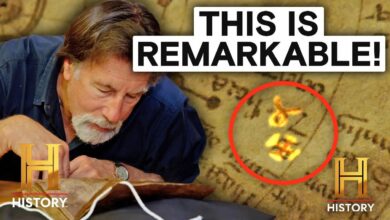
Is This Jewel Hiding a Bigger Secret? (S13) | The Curse of Oak Island
Is This Jewel Hiding a Bigger Secret? (S13) | The Curse of Oak Island


Oh my gosh, Lar. I think I just found something really cool.
Okay.
While digging in the rounded stone foundation on lot 5, Isabelle Whittier has just uncovered a potentially important clue. Check this out.
Oh, nice. Can you tell if this is a jewel?
It’s meant to look like a jewel, an imitation of a jewel. We found a larger one, but clear, just over here. It looked like costume jewelry. Then we found out it’s a technique that was developed in the 1740s in France.
Oh, that’s so cool. Imitation jewelry became very popular with the French royal family.
Oh, that’s awesome.
Yeah. In the early 18th century, French jeweler George Friedri St Ross invented simulated gemstones by mixing elements such as bismuth, thallium, and lead with glass powder. A pastel-like substance was formed, then heated and molded to create artificial stones nearly matching the brilliance of actual gems. One year ago, the team found a simulated diamond just outside of the round feature.




I can’t wait to get that back to the lab and see what Emma says about it.
Me, too. That’s cool. We’re finding some neat stuff here.
Yeah.
So, thank you everybody for coming. We have a really interesting artifact from lot 5 in the lab. Emma Culligan is about to share her analysis of the artificial gemstone found one day ago on lot 5.
This looks like the paste jewelry gem.
It’s exactly what it is. So this one’s obviously dark, and the one we found last year was white, was clear.
Mhm. And I guess you can explain the composition.
Well, it’s pretty much the same thing as last year, but this one is black. It’s black due to the addition of manganese and calcium, and it has less lead in it, which is why it’s not as brilliant or sparkly. They’re called diamontes, the official term. The purpose is to be dark and matte, but it’s the same era and similar composition. The fastener has a trace of tin around the edges, which we also found in last year’s jewel.
And something like that would have been made in the Old World.
Yep. Not here.
No, early to mid-1700s in France.
What’s it telling you about what was going on in lot 5?
I think it makes a statement about stature. This was a higher class of people. With the black paste, I’ve seen references to military uniform. Timeline-wise, it fits the Duke d’Anville expedition here, mid-1700s, French.
In 1746, France launched an armada to reclaim Nova Scotia from Great Britain. It was led by an admiral known as the Duke d’Anville, a nobleman from a family connected to the Knights Templar dating back to the 12th century. Due to severe storms and disease, the mission ultimately failed.
I found eight pages of what looks like a ship’s log. In 2017, Doug Crowell discovered an 18th-century ship’s log in the provincial archives stating that one of d’Anville’s ships carried a large cache of treasure to a wooded island near Oak Island, where the crew buried it in a deep pit.
This is a very strong indicator that somebody of high status was on lot 5. We know the Duke d’Anville came to Nova Scotia, and his family had connections to the Knights Templar. If an incredible historical treasure made its way to North America, it could have been part of that expedition.
Finding items that belonged to someone in a military position raises questions. Why were they on the island? What were they doing? Is it possible the two simulated French gemstones found on lot 5 are connected to the treasure reportedly buried by the Duke d’Anville’s crew?
The dots are very far apart right now.
Right. But we’re accumulating them. Exactly. It’s an interesting find, and I hope we can learn more.
All right, Jeff. Excellent.
Thank you.
Rick and Gary search through spoils removed from the round feature on lot five.
Come on, give us a signal. Here we go, mate. We’re in business. Non-ferrous. We don’t have to dig very deep, just surface layers.
You see what we’ve got here. This is my favorite part. A bit of roundness. Look how little that is.
Oh yeah. That’s a tiny cuff button. Look how small it is. You can definitely see a tiny loop knob on the back.
Could this small button be related to the artificial gemstones found in and near the round feature? Might it help identify who occupied lot 5 before the discovery of the money pit?
We’ve got a good hit here, Rick. A really good hit. That’s non-ferrous, not a nail. There it is in my hand. What is it? It looks like a stone. No, it’s not a stone. What we’ve found is something really special — a folded-over coin.
Really? That’s a copper coin folded over. You can see the shape.
I’ve heard of this, but not in North America. I’ve found these in Europe while metal detecting.
When copper, silver, or gold is completely folded over, it’s believed to be a talisman to ward off bad luck. Someone would fold it intentionally and bury it.
When would that kind of ritual be common? Three to four hundred years ago.
The ritual of folding coins as symbols of good luck or appeals for God’s protection dates back to ancient Rome and was common throughout Europe between the 12th and 18th centuries. The time frame fits lot five, the 1600s to 1700s.
If that’s a coin, you don’t just throw money away. You do it for a reason. People back then had a very different understanding of the world.
Many believe the work done on Oak Island was meant to protect something beyond material wealth — an idea, belief, or concept of historical or religious importance. The island has resisted treasure hunters for over 230 years, and whatever was placed here may still be here.
Well done, mate. This is absolutely fantastic.
Absolutely. Never seen anything like it.
I’m sure it’ll find a safe home.
Oh yeah. This one’s going straight in the top pocket.