Legends, Clues & Conspiracies | The Curse of Oak Island
Legends, Clues & Conspiracies | The Curse of Oak Island

-ROGER: Okay, Rick. -RICK: All set? ROGER: All set. I’ll hold the ladder for you.
RICK: Coming down.
NARRATOR: It is an extraordinary moment for Rick Lagina. Having been alerted that a large section of the possible treasure tunnel, located just beneath the Garden Shaft at a depth of some 100 feet, has been exposed. SCOTT: Look at that. Right there. -RICK: Wow.
-Those are big beams. -SCOTT: They are. -ROGER: Oh, yeah.
SCOTT: And no two are the same.
-RICK: That’s impressive. -SCOTT: Yeah.
RICK: To get down there and realize that there is hard evidence that the tunnel is not a interpretation, it’s real, you get a little bit of chills. Now we need to understand its relevance to the mystery.
Boy, I’d love to get one of those, though.
Well, what we’re gonna do is clean some of it off and then we’re gonna try to get the whole length out.
-RICK: And I think it would be nice to get that one. -SCOTT: Yeah.
-And then this one here we know is good and wide. -RICK: Yep.
And this one is definitely rounded here.
This is much thinner here.
-SCOTT: And that could be an upright piece. -RICK: Yep.
It’s cool. It’s very cool, especially given the C-14 results.
So, that’s why it’s imperative that we get samples.
It is.
The whole idea of what happened in the Money Pit, you know, we have a timeline.
NARRATOR: Earlier this year, wood samples from this tunnel, which the team obtained during a core-drilling operation, were carbon-dated to the 17th century. RICK: You know, you’d want to get that piece out whole.
ROGER: Yeah. Absolutely.
NARRATOR: But now that much more of the structure has been revealed, the team will remove some of the massive beams for additional testing, in the hopes of confirming just when this tunnel was created. It’s a year of pivotal moments.
Timber there.
This recovery of these timbers may be a pivotal moment if it represents original work. This is important. SCOTT: What I’d like to see happen here is these three timbers right here, even the fourth one being the one on top, get one pulled out so we can see a whole length.
-Absolutely. We can get that done for you. -Great.
If this is original depositor, there’s a good chance that there may be treasure at the end of this tunnel.
-Yep. -But I also want to get Steve Guptill to come down here and survey this.
-Yes. -RICK: Great.
I wonder, just, you know, have Gary come down, scan that real quick.
-SCOTT: Yep. -ROGER: Yep. Absolutely.
-So, anyway, we will let you get started. -Yes.
And I will get up and out of your way.
My thought was, you know, to have Gary come down, I mean, why not? It is a treasure hunt, after all.
And we have exposed a new area for him to investigate.
-STEVE: Ready, Gary? -GARY: Yep. Ready, mate.
RICK: And hope that we find a artifact or artifacts that can be associated with cultural context as it relates to the construct.
-How freaking awesome is this? -STEVE: It’s pretty great.
-We got everything we need, Gary. -GARY: Thanks, mate.
Time to unleash the beast.
You guys ready to find some treasure?
Let’s find some treasure.
Let’s strike up the magic wand.
-(beeping) -Right.
See if there’s any metals in there.
(beeping) And unfortunately, I can’t get too close to this iron.
All right, mate, well, unfortunately, no hits but we ain’t finished yet, mate.
If you can hang on to my detector, -I’m gonna try pinpointing. -Sure.
(beeping rapidly) -GARY: Oh. -Oh.
-Oh, you’ve got it. -GARY: It’s in me hand.
Let’s see what we got.
-It is this. -STEVE: What is that?
GARY: Tough to tell what it is.
I’m not getting a rapid vibration off it, which would tell me it’s iron.
-So, this is gonna go back to the lab. -STEVE: Yep.
And hopefully, Emma’s got some great news about this.
STEVE: All right.
-Good find, Gary. -GARY: Yeah. All right.
-Good find, Gary. -GARY: Yeah. All right.
Let’s see what we got here.
(beeping) Fingers crossed.
(beeping rapidly) STEVE: Gary, you’ve got another hit.
Yep. Now, what have we got here?
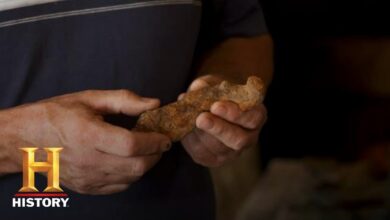
Yeah. We have got a piece of metal.
Look, it’s shaped.
-See that flat edge on it? -STEVE: Mm-hmm. -RODNEY: Yeah.
It’s an interesting shape, for sure.
You seen anything like this from your operation?
-So, it’s probably from the tunnel construction. -Yeah.
Even more curious now.
Yeah, it really is.
NARRATOR: Could Gary be correct that this metal artifact may have been used in the construction of the tunnel? It’s fantastic news.
NARRATOR: If so, could it be another critical clue that could help the team determine just when it was built? All right, chaps. I’m gonna put this in the front pocket there and zip it.
Do you want me to help you do some measurements, mate?
I wouldn’t mind. For the first time, I can put survey control points on this tunnel and this is gonna help me draft and project this tunnel accurately now because this is the first time we’ve stood on it.
GARY: Okay, mate.
I think it’s great we’re doing this, Steve, – for good measure. -(Steve chuckles) to understand what this represents. ALEX: Here it comes right here.
RICK: I absolutely hope that this leads us five steps closer to-to solving the mystery.
(straining): Oh, not quite. Now I do.
RICK: You can see in that piece of wood a man down there cutting that timber, creating that tunnel to-to go somewhere, hopefully, to hide treasure. Look at that. We got a rounded edge here -and rounded on this side. -CHARLES: Yep.
And it’s adze-cut.
GARY: Yeah, that’s adze-cut.
NARRATOR: A timber cut with an adze? Dating back to the days of ancient Egypt, an adze was a type of cutting tool designed for the construction of ships and wooden structures, until the 18th century, when they were replaced by mechanized tools. That’s a bit of Oak Island Money Pit history right here.
NARRATOR: So now, the question is just how long before the 18th century might this tunnel have been created? ROGER: Watch your fingers.
RICK: It’s real aha moment. There’s no question about it. After all the struggles and all the setbacks and all the time and all the effort, to see it there in front of you… Well, this is real history, and I want to hold it in my hand.
This has more going for it than anything else so far.
I mean, this could lead right to the treasure.
We don’t know yet.
Let me just test it, see if it’s sturdy enough for a gold dance.
-Yeah. It will be. -(laughter) RICK: The good news is we still do have the horizontal drilling.
-Still to come. -Still to come.
NARRATOR: Because the tunnel must be more fully exposed and inspected before the team can possibly access it, in the coming days, representatives from Dumas Contracting Limited will conduct a probe-drilling operation from the bottom of the Garden Shaft into the tunnel’s interior to hopefully pinpoint the source of the precious metals that have been detected nearby in the Baby Blob. Kudos to everybody, especially the guys down hole, you know, ’cause they did the work.
Let’s stay the course, get as much information as we can.
So, it’s been a very good day.
[music playing] I think we just go right in here.
Yeah.
NARRATOR: Rick Lagina and metal detection expert Gary Drayton– Start right here, actually.
NARRATOR: –continue their ongoing search for important clues.
This time, on Lot 21.
Well, this is 21.
And we’ve never been in here before.
You got the McGinnis Foundation over there.
Let’s see what we find.
All right.
Let’s go, [inaudible].
Let’s go.
NARRATOR: Shortly after Daniel McGinnis and two of his friends discovered the Money Pit in 1795, the young man moved to Oak Island and built a home.
Here, he lived for the remainder of his life, farming, raising a family, and searching for treasure.
Three years ago, while visiting the island, three of Daniel McGinnis’s direct descendants shared an incredible story with Rick, Marty, and the team.
Now, I’ve been told they found three treasure chests.
And what is in this box is one of the things that came from that chest.
NARRATOR: A log with an amazing object– Oh, my goodness.
NARRATOR: –that Daniel reportedly found some 30 feet deep in the Money Pit.
Wow.
NARRATOR: Although the remains of Daniel McGinnis’s house were removed more than a century ago, the rock foundation remains as a protected historical site.
Because of this, Rick and Gary are careful not to disturb any areas within 100 feet of the foundation in hopes their search of the surrounding ground will yield important information.
[beeping] It’s only reading three or four inches.
[beeping] We’re getting readings over here as well.
Oh, look at that.
Is that an oldie?
I don’t know.
That looks old.
Let’s have a look and see if I see any screw [inaudible] I can– these are old screws.
So we’ve got an in.
We need the chest.
The chest.
And that’s how it is on Oak Island.
A lot of times, once you find one or two good things, you find a lot of things in the same area.
Oh, come on, just one more nice little signal around here.
What we need to do is just circle this area– Yeah.
–a couple times.
[beeping] Well, that doesn’t sound too bad.
Is this a– [beeping] You never, ever know what’s going to come out your next hole.
What do I always say?
Just win, baby.
Change your whole day.
Here we go.
[beeping] It’s still sounding good, still looking good.
Oh, my gosh.
It’s another bobby-dazzler.
Look, that’s a stone.
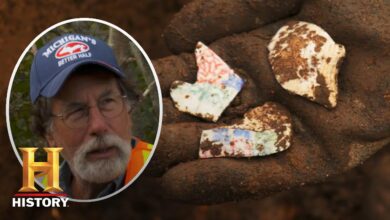
It’s a brooch.
That’s a bloody brooch.
Look at that.
That’s a gem.
That’s red too.
NARRATOR: A jeweled brooch found on the western side of Oak Island and nearly a mile from the Money Pit?
It’s heavy.
You gotta feel it.
We did it again.
Feel the weight on that compared to the other one.
Oh, look at that.
Isn’t that much heavier?
NARRATOR: Could it be related to the one discovered last year on Lot 8, which not only contained a semi-precious jewel, but which might also date as far back as the 16th century?
Gary reached in, and there it is, the brooch.
And you know, it’s a holy-schmoly moment for Gary.
Wow.
And it is for me too.
It was hard not to get excited.
Because if it predates searcher activity, it’s absolutely an excellent find.
Look at that.
That’s– That’s some sort of ornament there, some sort of ornament there.
I mean, a lot of work went into that.
That’s why I’m thinking this could be special.
I just think that how ornate it is is going to tell us something.
It’s beautiful.
That is unbelievable.
The brooch brothers are back, lucky diggers.
Right, you know what?
Top pocket find.
Top pocket find.
Just make sure you zip it up.
-GARY: Hey, Billy. -RICK: Hey, Billy.
BILLY: Hey, guys.
I’m ready to kick some swamp butt again, mate.
Find some good finds.
NARRATOR: Rick Lagina, metal detection expert Gary Drayton and Billy Gerhardt are searching for clues at the southern border of the mysterious triangle-shaped swamp. I figure it’s like old home week, right?
We came back home ’cause we never finished this.
Not quite. We were close.
In a way, we know what we’re looking for.
We’re definitely looking for more pieces of -what we found earlier. -Yep.
-Yep. -BILLY: We found wood from ships.
-GARY: Yep. -For that reason alone, it’s worth looking at.
DOUG: Is that a piece of cut wood there?
BILLY: Is that cut wood or not?
I’ll go get it.
NARRATOR: In recent years… -Oh, look at that. -…the team has found a number of ship-related artifacts in the swamp… SCOTT: That’s beautiful, actually.
…that have been dated to between the 15th and 18th centuries. Here’s another piece of it.
-Look at that. -BILLY: Look at that.
NARRATOR: However, in 2020, they unearthed a piece of ship’s railing right near the southern border that was carbon-dated to as early as the 8th century. BILLY: We’re off the end of the road, right?
Man, would it be something nice if we found something that really told us who was here -and when they were here. -I hope so.
-GARY: All right, mate. -RICK: All right.
NARRATOR: Now, in light of Dr. Doug Symons’ incredible theory about the medieval Viking culture potentially being connected to the Oak Island mystery, they are eager to see what other possible clues they may uncover in this area. This is new stuff here.
GARY: Whew. Smells like treasure.
Whoa. Whoa, whoa, whoa, whoa, whoa.
GARY: What did you see, Rick?
RICK: Wood.
Is that anything?
GARY: Good eye, Rick.
Is it cut?
RICK: Yeah.
GARY: Looks like it’s got a hole in it, Rick.
There’s no metals in there.
But it’s definitely shaped.
Think so?
GARY: Yep. And it looks like it could come off a boat.
We found something, Bill. Check this out.
It’s an interesting piece of wood.
Any ideas?
Uh…
Well, I’ll tell you what it looks like to me.
See how it curves up?
-Yeah. -When you have a wooden boat, you put little runners on that were used along the shore.
Like the keel of a boat.
Yeah, so, say you had a big boat here and you were bringing your little one to shore, they’d put these little ribs on because they would wear rather than wear the bottom of your boat out.
We would call them runners.
GARY: Yeah.
-Maybe it hit the rocks… -Yeah, exactly.
-Right there. -…and got broke off.
Good insight, Billy. I’ll be putting that in the bag.
NARRATOR: Is it possible that the Oak Island team has found more evidence of a sailing vessel in the swamp? If so, just how old could it be? And who were the visitors that left it here? RICK: I need to go back.
I got to check on a few things for the Money Pit drilling.
So, keep digging, keep after it, -and I’ll try to get back as soon as I can. -Yep.
-Okay? -GARY: Okay, mate.
-See you later. -All right, thank you.
I believe that this is a very old mystery. We have dates from 700 AD with the ship’s railing. We have the 1200 dates in the swamp. So, there are strong suggestions that there was activity very early on. But to what end? That’s what makes this so interesting. -Hey, Gary. -Hey, Steve.
-How’re you doing? -Good. Perfect timing, mate.
Billy’s just repositioned.
We’re digging. You never know what’s gonna come out.
-STEVE: That’s true.
What’s happening, Billy?
Just got a little wood here, and I– What kind of wood?
Somebody’s dug down in the swamp, and there– We got a bunch of horizontal and vertical boards.
There’s a wall of a…
shaft, retaining wall, something.
Maybe it’s what Fred probed.
GARY: So you think it could be -potentially what Fred was probing when he thought… -Well…
-…he hit the wall? -There’s-there’s potential of that.
NARRATOR: A possible wall buried at the southern border of the swamp? While investigating this area more than 30 years ago, the late treasure hunter and Oak Island landowner Fred Nolan reportedly discovered a wooden wall or dam. A dam that Fred believed represented evidence that the swamp was an artificial feature that had been created centuries ago in order to hide something of great value. Is it possible that the team has found a section of that same construct? And if so, could it be related to the potentially 1,250-year-old piece of ship’s railing that the team found nearby back in 2020? I think we’re onto something, mate.
BILLY: I think we got to get the guys here.
Looks like somebody was digging down in the depths of the swamp.
STEVE: You make a good point, Billy. I mean, it’s really close, I would say feet off of the stone road.
-Yeah. -So I think it could be really important and maybe related -to the stone road. -For sure. -GARY: Yeah.
Let’s get back to base, tell the guys.
Good eyes, Billy.
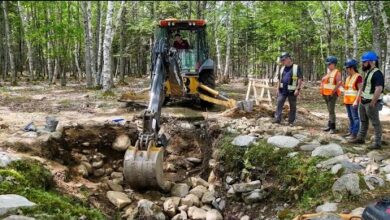
…Rick Lagina has invited geoscientist Dr. Ian Spooner to inspect the feature. IAN: What interests me is it’s down into the sediment.
I really want to see the context of that and the sediment around it.
RICK: Yep.
We can see this red stuff here.
-RICK: Mm-hmm. -That red stuff is what’s underneath -the stone road. -Right.
NARRATOR: Just to the west lies the potentially 500-year-old stone road or ship’s wharf, a feature that may date to roughly the same time period as the wooden tunnel below the Garden Shaft. IAN: If we start seeing that red stuff within and around that wood structure, that will possibly place it further back in time.
Yeah.
NARRATOR: Is it possible that this feature may be related to the nearby stone road, as Dr. Spooner is speculating? And perhaps also to the possible treasure tunnel in the Money Pit area? This was always the area that I…
was really interested in.
In terms of trying to find something that connects the stone road to something else.
-Right. -We know it had to be used for something else, and they were going somewhere and doing something.
-Mm-hmm. -STEVE: Yeah.
If this is as old as the stone road, could this have been some sort of a loading and unloading platform?
That’s kind of interesting.
STEVE: You tie something to it, the cargo, swing it off, unload, load, unload, load. -IAN: Sure. They’d pull the big boat up. -Yeah. IAN: They’d unload their goods. -GARY/STEVE: Yeah. -And they could have built other structures as well.
Yeah.
RICK: There’s precious little known about the southeast corner of the swamp. I wish I understood why we’re making these discoveries in the swamp that has endured over two centuries. I think there were activities conducted here, maybe not by the same persons but maybe by a same group or entity over generations, perhaps even centuries. This wood here is interesting, too, because it’s round on the edges, flat on the top.
That’s pretty old.
-Mm. -I think the desire on all parts is to dig and expose the structure in its entirety so we can come to a real good understanding of its purpose. And hopefully there’s an artifact or two that might tell us what its purpose was. Somebody put a huge effort into installing something, and, uh… Like, we have to be careful, is all I’m saying.
-RICK: Mm-hmm. -Okay.
RICK: I think that’s-that’s pretty cool.
-GARY: Yeah. -Yep.
RICK: Okay. For right now, -let’s call it a day. -IAN: Yeah.
-Okeydoke. -Okay.
-All righty. Thank you. -Yeah.
RICK: All right. Good job. -Thanks, Billy. -BILLY: Yep!