Secret Stonework Finally Revealed | The Curse of Oak Island
Secret Stonework Finally Revealed | The Curse of Oak Island



[music playing] GARY DRAYTON: Hi, chaps!
Hey, Gary.
Michael’s here to, hopefully, help you guys recover what are you searching for.
NARRATOR: One day after the Oak Island team discovered the remains of an ancient fire pit in the middle of the stone pathway, running along the eastern border of the swamp, Gary Drayton, along with Michael John, join Dr. Ian Spooner, and archaeologist Miriam Amirault, and Dr. Aaron Taylor, as they continue to carefully excavate the site as well as expose more of the pathway, to determine just where it is leading.
I guess Rick wanted you to go over the spoils.
OK, wow, there’s plenty of spoils.
We got lots of spoils.
So we’re going to work here.
And give us a scream if you get anything.
All right, mate, we’ll get [inaudible] the spoils.
[music playing] NARRATOR: It is the team’s hope that Gary and Michael can find more clues and artifacts that will help precisely date the fire pit and the stone pathway, as well as identify who made them.
Good place to start, just here.
[beep] [beep] [beep] That didn’t take long, did it, eh?
Just in here, mate.
[music playing] OK, mate, he’ll have a recheck.
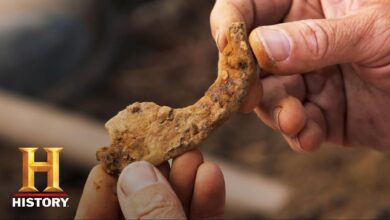
What is this?
What’ve we got here?
I mean, it’s quite heavy.
It feels old.
It’s irregular.
But it doesn’t look modern.
No, it doesn’t.
It doesn’t look factory, machine-made.
So it’s pre-industrial revolution.
Maybe even older.
Now, it could be some kind of, maybe, a wheel bearing.
And maybe it was off a cart, an axle of a cart.
So maybe this was connected to those [inaudible],, which were along this trail.
[music playing] NARRATOR: Could Gary be correct that he and Michael have found a wheel bearing that came from an old cart?
And if so, could it be connected to the large iron ring bolt, and the parts of keg barrels the team has recently discovered along this stone pathway?
Discoveries, which not only date back as much as 400 years, or older, but also serve as evidence that the pathway may have been used to transport heavy cargo off of a ship and onto Oak Island.
Aaron, can you come and check this out, please, mate.
Sure.
We found this irregular piece of iron.
It just– it’s got a heavy feel to it, looks kind of oldish.
Well, that’s a pretty cool find.
I was thinking maybe it was off a cart axle.
I have no idea.
Well, it’s not modern.
Potentially, yeah.
How about I bag it up, and I’ll take it to the lab?
OK, mate.
All right.
Well that’s great.
All right, mate.
On to the next.
RICK LAGINA: AARON TAYLOR: We got to clear it off a little more.
NARRATOR: Rick Lagina, along with members of the team, continue investigating the mysterious stone pathway running along the eastern border of the swamp.
AARON TAYLOR: I like this area right here.
It’s got cobblestone and big stone.
It hasn’t been disturbed yet.
So just keep a diligent eye on that.
Little, wee pieces can give us a lot of information.
MIRIAM AMIRAULT (VOICEOVER): Yeah.
AARON TAYLOR: Yeah.
So we clear this, and just keep following it and see where it takes us to.
MIRIAM AMIRAULT: Yeah.
AARON TAYLOR: I think that’s our best strategy right now.
MIRIAM AMIRAULT: Yeah.
[music playing] MIRIAM AMIRAULT: Oh.
You got an artifact?
MIRIAM AMIRAULT: Look at this.
Found a piece of coal.
Wow.
NARRATOR: Near the eastern border of the Oak Island swamp, archaeologist Miriam Amirault has just found a potentially important clue on the recently uncovered stone pathway.
MIRIAM AMIRAULT: I think the reason why we’re finding coal is because this is potentially a stone path.
I think people were transporting coal along this road.
It’s a rough road.
Things would have fallen off a cart or something like that.
I think we’ll definitely have enough for Dr. Spooner to send off to a lab and we can get some really good dates and information on that.
AARON TAYLOR: So that’s a good sign.
MIRIAM AMIRAULT: Yeah.
Nice find.
Cool.
AARON TAYLOR: Why don’t you call Rick over and he might be interested?
MIRIAM AMIRAULT: OK.
Rick?
Do you want to come look at this?
RICK LAGINA: What have you got?
We found a piece of coal.
Wow.
I’m happy to see that.
MIRIAM AMIRAULT: Yeah.
So now we have a connection from there to here.
AARON TAYLOR: Yeah.
Yeah, hopefully.
NARRATOR: Earlier this year, the team investigated a rock formation on nearby lot 15 that they believe could be a British military pine tar kiln, that not only could date back to the 16th century, but could also be connected to the construction of the original money pit.
Because charcoal was also discovered there, could they have now found evidence that links these two features together?
What we came here for, however many years ago it seems now, we came looking to solve a treasure mystery and find treasure.
And now we’re excited about finding coal on a road we knew nothing about.
Miriam, show Gary the connective tissue.
GARY DRAYTON: (AMUSED) Oh, hey.
It’s a coal.
– Bit of coal. – Yeah That is an oldie.
Right here.
GARY DRAYTON: Well, it’d be interesting to see, when we get this coal tested, where it comes from.
Yeah.
If we can get a country of origin– MIRIAM AMIRAULT: Yeah.
We always say, the most insignificant little findings– Right.
There, Miriam’s holding a little piece of charcoal that, in my mind’s eye, connects this and the building of this with the stone feature.
I mean, it’s almost incontrovertible evidence.
It’s very compelling.
RICK LAGINA: Just keep digging.
AARON TAYLOR: Absolutely.
IAN SPOONER: So here’s what we found.
RICK LAGINA: Holy cow.
NARRATOR: Near the Eastern edge of the swamp, Rick Lagina, along with geoscientist Dr. Ian Spooner and members of the team, are focusing their investigation on the stone road and pathway, looking for any more evidence of a ship or other clues that could help solve the Oak Island mystery.
Let’s see how far these stones go that way.
Yeah.
We’ll grab a detector.
[music playing] RICK LAGINA: You have to have context for these anomalous features, i.e., the possibility of making artifact finds certainly are near the shore.
So we’re going to investigate it and hopefully come up with some answers.
Whoa, whoa.
That’s a good depth there, Billy.
OK.
Oh, look at that.
So we’re getting more cribbing.
Something’s going on here.
Yeah.
Oh, wow.
Rick, check this out.
What have you got, Gary?
That’s unusual.
Came out of that last [inaudible]..
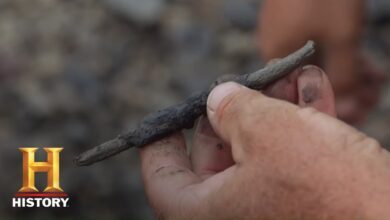
It’s one piece of wood.
That is strange.
It’s perfectly square.
It was made that way, by the look of it.
Aaron?
Check this out. – Hey, guys.
What do you got?
We’re hoping you can tell us.
Oh God.
Wow.
It’s got to be a tool.
Yeah, I was going to say, like something for architectural– Yeah, a little carpenter square.
Yeah.
NARRATOR: A possible carpenter’s square found near the stone pathway on the Eastern border of the swamp?
Could it be an important clue, like the wooden survey sticks and wood pieces dating back as far as the 15th century , that might be connected to the feature’s construction?
And if so, might it also help identify just who built it?
Interesting thing about something like that, you can actually date them.
It’s wood.
Yes.
So this is probably more important than we think.
I will put this away.
What a good find.
– Yeah. – Thank you.
Thanks, guys.
NARRATOR: While Rick and the members of the team continue their investigation in the swamp, later that afternoon– MIKE: Hi, guys.
MARTY LAGINA: Hey, Mike.
Thanks for coming down.
This is the [inaudible].
Well, that is cool.
NARRATOR: After learning of the discovery of the possible carpenter square, Marty Lagina meets with Oak Island historian Doug Crowell and Gary Drayton in the Research Center to inspect the potentially important clue.
At first I thought it was metal because of the shape of it.
That is actually kind of exquisite, isn’t it?
It’s one piece.
Yes.
This is not joined to this.
What do you think it is?
I’ve looked through shipwright tools, I’ve looked through old carpenter tools.
It came up as a stonemason’s tool, that’s what it most closely resembles.
Well, obviously its use is for right angles, isn’t it?
I mean, that is really cool.
This so-called mason’s tool, it’s nicely crafted, which seems to have sort of masonic connections.
And more to the point, creates angles that are very useful in a practical sense.
30-degree angles, 60-degree angles, 90-degree angles– those are very useful in building and laying out things.
So I want to get a date on it, and I want to find out what its uses.
Both those things are very interesting to me.
It’s amazing how it’s well preserved like that because of the swamp.
That’s a pretty cool find, Gary.
I’m going to say two things.
One, which I’ve been saying a lot lately, let’s put it in the line for carbon dating.
OK.
Yeah.
And what’s the second thing I always say?
That was nice, but go out and find some gold.
[laughter] – That’s right.
Sorry, Gary.
I hate to be so predictable.
All right, guys.
I’ll let you carry on.
See you.
See you.
See you, Marty.
It was just a stone by itself, and it’s looks like there’s some old etching on it.
Down here.
Yeah.
NARRATOR: Rick Lagina, Craig Tester, and Dan Henskee join gyroscope operator Tory Martin.
He has just informed them of an unusual discovery he made while assembling his equipment near the woods surrounding the money pit.
Yes, it’s just over here, guys.
OK.
I wonder how long that’s been there.
This is what caught my eyes really, this flat edge here.
It seemed like this almost looked like it was– Cut.
It just doesn’t seem natural to me anyway.
No.
I don’t know if it’s anything of interest, but just the way the light was shining on it I was like, that doesn’t look normal.
Figured it would be worth mentioning, anyway.
Absolutely. And we thank you.
That’s for sure.
Appreciate that, yep.
You know, when Tory Martin called and he mentioned that there was a strange stone in close proximity to the money pit, well, that’s an aha moment, right?
We had walked by that stone many times, and yet it took Tory, the fellow from Reflex who is doing the inclinometer work in the money pit, to notice it and to bring it to our attention.
It brings back what Dan Blankenship told us long ago.
Keep your eyes open on Oak Island.
It’s hard to tell right now, but if you put water on it and even you run your hands along it, but splash some water on it.
Definitely not natural.
It’s not actual letters, is it?
No, it’s not in a writing that we would recognize but almost like Roman numerals.
NARRATOR: Roman numerals, the same kind of characters that are carved on the mysterious U-shaped structure at Smith’s Cove?
Could this strange stone found near the money pit and the U-shaped structure be connected?
When I first saw the characters on the stone below the money pit, I thought they were Roman numerals.
Well, they’re very linear-carved features, very straight lines if you will.
There’s not much curvature to the orientation of the characters.
You know, that’s interesting but not definitive.
NARRATOR: After a day of exciting new discoveries, both at the money pit and at Smith’s Cove, Rick Lagina has asked his brother Marty, along with geologist Terry Matheson, to join him at the Oak Island research center where he has set up a meeting with island historian Paul Troutman.
Hi, Paul.
Good.
What you got here?
Good.
Who’s on your operating table here?
The new stone that was found near the money pit.
I know nothing about this.
Somebody explain this to me.
Tory told me about it, but I haven’t seen it yet.
So that’s– Tory brought me down there, and, you know, it was sitting by the old well and just in plain sight.
And, you know, the first thing you notice is this flat feature, and then these ridged areas.
Looks like a metamorphosis greywacke.
And what is a greywacke?
What’s the composition?
It’s basically the second-most common boulder we found on the island.
Most of them are rounded granites.
For Nova Scotia, there’s all kinds of it.
But, you know, upon further inspection we put some water on there, and you’ll see it looks like carvings.
Come down here and look.
You see them?
I though there were two Hs.
There was an H there and an H there, I thought.
Now they’re gone.
Well, right here, here, here, here, here, here, here.
Do you think this could be natural?
I mean, this one in particular looks like it’s cut, and then that looks like I would have thought maybe chiseled.
It seems like it might be a decorative piece at the base of a building block.
But bottom line, not natural?
Man made, right?
Yes, I would say.
On balance of evidence, it seems to be touched by man.
OK, well, here’s the thing.
Here’s the summary.
It’s odd.
It’s interesting.
It’s mysterious, and it was found near the money pit, which means we’ve got to chase it, which means, you know, let’s find an expert in– In languages.
–languages, carved languages or whatever.
Ancient script.
Ancient script, things what are normally carved on stone.
Let’s see what it might mean.
All right, great, guys.
Very cool.
Very cool.
Let’s keep finding stuff.
Let’s get back out there and get to work.
– Charles! – Hey, Terry.
– How you doing, Charles? – Good.
Good. – Good to see you.
Terry, how you been?
How are you?
Good to see you again.
So I really want to show you this stone that I think could be pretty important.
Now, this is a stone that is not widely known.
Myself and a few other people, as far as I know, are the only ones who know about it.
So this is something new for you guys to– to take in.
Well, if it’s half as intriguing as, you know, what you showed us last year, I’m on board.
NARRATOR: One year ago, Terry Deveau invited Rick, Marty, Craig Tester, and Dave Blankenship to the town of Overton, some 144 miles west of Oak Island.
There, he showed them an incredible series of carvings which are believed to be hundreds of years old.
You have the cross with the circle that obviously is a Christian symbol.
That is quite remarkable.
And isn’t that a Templar cross?
NARRATOR: Could Terry have found another important clue– one that connects Peggy’s Cove to the Oak Island mystery several miles away?
So Terry, when exactly did you discover this stone?
Yeah, about four years ago, just scouring the area around here, looking for any old walls or foundations or– I’m always on the lookout for petroglyphs.
You don’t find them very often.
So when I noticed that this particular stone had been worked, as opposed to just being a purely natural boulder, obviously that really caught my attention.
NARRATOR: In recent years, Rick, Marty, and the team have found a number of strange and potentially significant stone carvings, both on and around Oak Island, from New Ross to the Bedford Barrens.
Is it possible that a number of these carvings were deliberately created to form a series of clues, clues that would help solve the Oak Island mystery?
There we have it, gentlemen.
What do you think?
Do you see the features.
Definitely features.
Yeah.
See where the mouth, the nose?
And the face is this way.
The face is out to sea, yeah.
I’m also intrigued by do you think that that was manipulated into that position?
Because I see little rocks underneath it.
Exactly.
Yeah.
This does look like there are some shims under there that were put down to make sure it stayed in that configuration.
And there are some modifications to the outline to– to make the facial features more prominent.
If you look carefully, there’s a difference in texture from this surface to this surface.
It’s rougher, which means it’s younger.
And if– if you look here– Right here.
Yeah, this has been hacked off, right, to make the shape better.
And it’s not here, as though– No.
Or even here.
I mean, these surfaces appear to be natural weathering, the result of glaciation.
But these surfaces look like they’ve been subsequently worked.
What else could have subsequently shaped it, other than the hand of man?