Testing the Bubble: Portal or Something Else? (Season 6) | The Secret of Skinwalker Ranch | History
Testing the Bubble: Portal or Something Else? (Season 6) | The Secret of Skinwalker Ranch | History

ERIK: Hey, Preston. -PRESTON: What’s up, guys? -How you doing?
-Hey, fellas. -Welcome back.
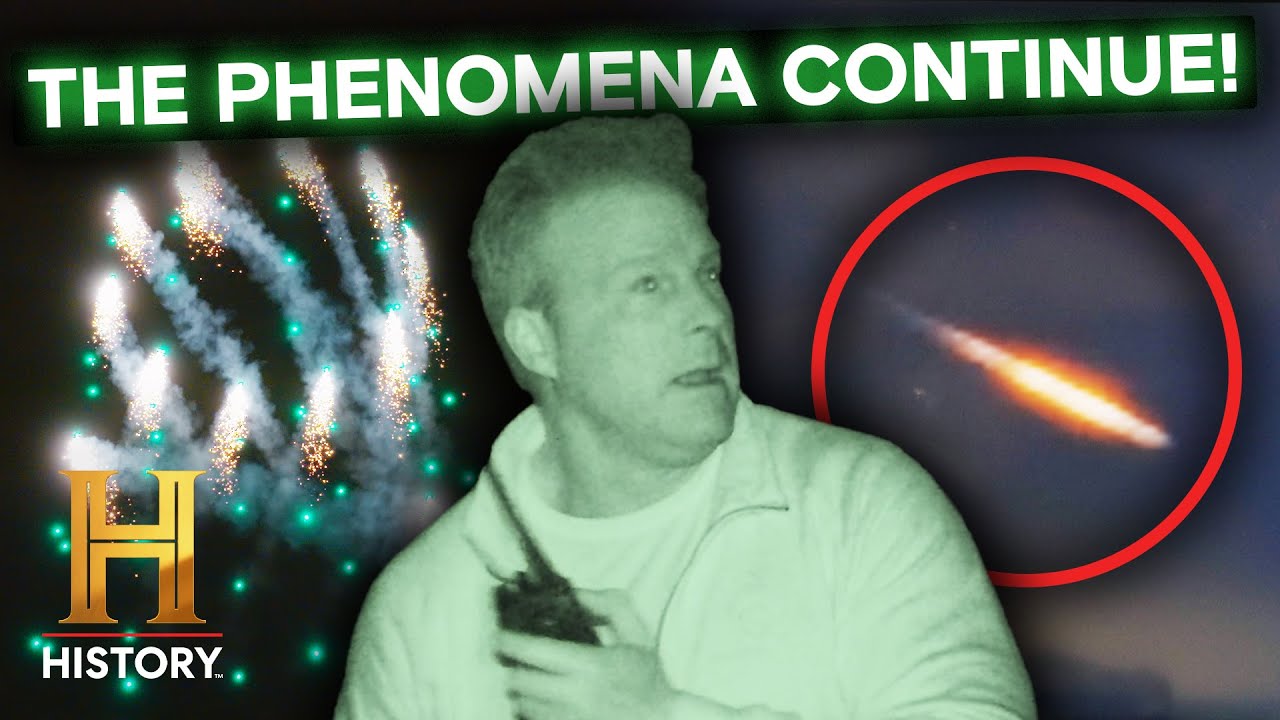
TRAVIS: The next day, as the drilling operation at the mesa continued, we welcomed back our friends Pete Kelsey, as well as Preston Ward and his team from a drone light show company called Sky Elements to once again help us investigate another gigantic mystery, an invisible bubble that we’ve detected with multiple lidar devices that covers a huge area of the ranch both above and belowground. Its epicenter is at the triangle, and it has a radius of about 2,000 feet. So that means it contains a lot of the areas where we’ve documented tons of phenomena, like UAPs and strange radio frequency signals. TRAVIS: For tonight’s experiment, the plan will start by launching the two illuminated swarms simultaneously, each made up of 100 drones. One will be at the triangle, which is at the dead center of the bubble, and the other will be in the east field, several yards outside of the bubble’s barrier. The first test of the experiment will be to see if both swarms will launch at the same time and form perfect cylinders like they’re preprogrammed to do.
Or will something prevent that and mess up their timing?
Drones are armed and ten seconds to launch.
TRAVIS: Everybody, we are good to go with the experiment. We are good to go with the experiment. Let’s go, let’s go, let’s go!
Five, four, three, two, one.
Drones launching.
TRAVIS: Drones are going up.
Everybody, get ready at your stations, ready to launch the rockets.
THOMAS: Hundred drones in the air, east field.
PRESTON: All 100 drones are in the air in the triangle.
Everything looks locked and solid.
Yeah, all the drones are up.
Taking off.
TRAVIS: So, once the drone swarms made their cylinder formations, Brian Woodward’s FPV drone looked for any more phenomena around the swarm in the east field… ROYSTON: Okay, I’m going up.
TRAVIS: …as Jim Royston’s lidar drone scanned that area outside the bubble. And meanwhile, Pete Kelsey used his thermal drone to scan the swarm… PETE: Taking off.
TRAVIS: …inside the bubble at the triangle. PETE: That looks really cool.
Fire pyro in three, two, one, go. TRAVIS: Here goes the pyro!
The pyrotechnics on both swarms worked perfectly. They were filling the area around the drone swarms with sparks and smoke, which we hoped might help us see invisible phenomena inside and outside of the bubble.
Oh, look at that.
All right, Thomas, get ready for the rocket launch!
Copy that.
TRAVIS: So, to try and stimulate more invisible phenomena inside of the drone swarms, Thomas and I prepared to launch rockets up through them. We wanted to see if the rockets would make contact with anything strange and reveal just what we might be dealing with.
I’m going to go in five, four, three, two, one.
We had a beautiful launch over here in the triangle.
TRAVIS: That should’ve launched.
Why did that not launch?
Son of a…
We were assuming that more phenomena would happen with the swarm in the bubble than the one in the east field. So, I was stunned when Thomas’s rocket flew straight up and hit nothing while mine didn’t even launch. Everything’s fine. It ain’t getting power.
So, is it possible that the bubble caused something strange to happen outside of its barrier in the east field?
Nope, it will not go.
This battery is bust– it’s gone.
Son of a gun.
Hey, Travis, what’s your status on that launch attempt?
TRAVIS: We have a rocket malfunction. We have a rocket malfunction. Something has zapped this battery completely dead.
TRAVIS: The initial failure may have just been a glitch. But Erik and I needed to be sure before we gave up on trying to reveal something that might explain the weird phenomena we keep experiencing.
Let’s try it again.
Five, four, three, two, one.
THOMAS: Wow.
(Travis sighs) Come on, chute.
At least it went.
-Looks like it’s raining real good. -(rain falling) It’s raining pretty good over here in the triangle.
All right, copy that.
Uh, rain’s picking up.
This is crazy.
Drones landing.
TRAVIS: Man, I finally get a launch to go, -and then it starts raining. -(thunder rumbling) Pouring. I’m still not ready to go there about the weather on the ranch, but it seemed like a definite sign that it was time to end the experiment.
-Interesting night, fellas. -(sighs) -Very eventful. -Right?
TRAVIS: Erik, I think we got a lot of really interesting phenomena observed tonight, and I’m hoping that there’s a lot of data that’s coinciding with it.
AKA a lot of homework for me.
Well, I say we pack up and call it a night.
-Sounds good. -All right. -Let’s do it.
-Nice job. -Nice job, guys.
TRAVIS: Great, guys. Good work, everybody.
ERIK: Hey, Preston, Brian, Pete, thanks for jumping on with us.
Hey, thanks for having us. TRAVIS: A couple days after our drone experiment, Erik, Pete Kelsey and the team from Sky Elements were all ready to review their processed data.
So, Pete, did you see anything with, uh, any of your instruments on the inside of the bubble?
Yeah, yeah. So, I can show you what I have. So, this is one of the SLAM scans from the triangle, and this is the second flight. I mean, these drones are locked in. I mean, it looks great. SAM: I mean, that’s really cool.
But this I had to think about for a little bit.
Here it is. Whoa.
-Look at that. -That’s interesting.
Yeah.
TRAVIS: What in the world are we looking at, Pete?
PETE: You can see all this blue on the ground at the triangle. Oh, yeah.
Oh, wow.
TRAVIS: Just when we thought nothing really strange happened in the bubble during our drone experiment, Pete Kelsey’s lidar scanner at the triangle captured something that we had never seen before. -Didn’t it start to rain? -TRAVIS: Yeah. -Yes. -Yes.
TRAVIS: But the really interesting thing to me is you’re getting a return on the drones 300 feet high.
Why are you not getting a return on the rain 300 feet high?
ERIK: Exactly.
I don’t think this is rain just yet.
So, what is all of that if it’s not rain?
-That’s a good question. -Right.
ERIK: I don’t know what this is, but I take the position that we have an interesting feature in the data.
These are obviously very strange readings we’re looking at in the center of the bubble. So, I’ve got one more thing. Let me bring it up.
-TRAVIS: Oh, it’s a… -Time-lapse.
Time-lapse. Okay.
Yeah, this is one of the cameras that’s placed down there to the south, looking towards the north.
-TRAVIS: Got it. -Let’s watch in this region.
-TRAVIS: There it is. I saw it. -(excited murmuring) -THOMAS: What was that? -Yeah, I saw it.
Let’s go back and take a look at that frame.
THOMAS: Wow.
ERIK: This is one frame in a time-lapse video.
We just happened to catch this, whatever it is.
-It means it’s moving pretty fast. -Yes.
TRAVIS: This is why Erik always records our experiments with multiple types of surveillance cameras. -Can you zoom in on it? -Yeah.
-Wow, look at that. -Check that out.
KALEB: Whoa.
ERIK: What do you guys make of that?
There’s something to it.
That looks like it’s going, uh, hypersonic.
Whatever this bright UAP was, it appeared to be flying several thousand miles per hour, and then it just disappeared. When we capture data like this, it sparks all kinds of questions.
Was it related to the bubble or our equipment failures?
And was it the source of the communication-like 1.2 gigahertz signal that came from the mesa? Wow.
We haven’t seen that here before.
ERIK: Well, guys, this review has been exactly what I was hoping for.
I look forward to the follow-up.
You know, we’re gonna have to decide exactly what form that’s gonna take.
-Thanks, guys. -PRESTON: See you, guys. -ERIK: We will be in touch. -TRAVIS: See y’all.