The Stone Foundation Mystery (S13) | The Curse of Oak Island
The Stone Foundation Mystery (S13) | The Curse of Oak Island

-[Peter] Hey, guys. -[Laird] Hey. -[Fiona] Hi. Every time I look at this, I don’t know what to make of it.
[Fiona] It’s getting incredible.
-It’s really quite spectacular. -[Laird] Yeah.
[Narrator] …Rick and Peter arrive on Lot 8 to check on the investigation of the cradle-like formation of stones that were found beneath a 40,000-pound boulder. How in the world was that made?
It’s a 40,000-pound boulder.
If you were to drag it in, it would destroy this.
-Yeah. -I’m not thinking about how they did it as much as the why.
I mean, this was definitely purposeful.
We didn’t remove any soil from down here whatsoever.
It was filled with rocks.
[Narrator] After removing the boulder revealed this mosaic-like stone feature, archaeologist Fiona Steele has begun removing debris and some of the stones to determine what purpose it might serve. Especially since the team has already detected possible evidence of a shaft and even silver in the soils below it. [Rick] I’ve worked with stone most of my life.
And the labor that you see, uh, in front of you, is…
it was quite laborious.
It meant something to someone. I think we need to do as much work as possible to address one key question: what’s underneath the boulder? [Fiona] We had a lot of smaller rocks, the ones that are these size, all in the center, and they were very loose, so once I started removing them, I started seeing these other rocks underneath, and you can see the ones underneath are a fair bit larger in size than the ones that were actually on top.
And they extend all the way down here.
-Hmm. -[Fiona] This is what’s starting to produce itself as we’ve been excavating here.
I will say this, that one there, when I look at that, the way it’s positioned…
Coming this way.
It-It’s a very curious positioning of that.
Yeah. I still can’t get it out of my head, the shape of these boulders that we had, which were very triangular.
We had this big one down here, and we had another big one there and a big one there.
And it almost felt like there was a triangle pointing down to this boulder.
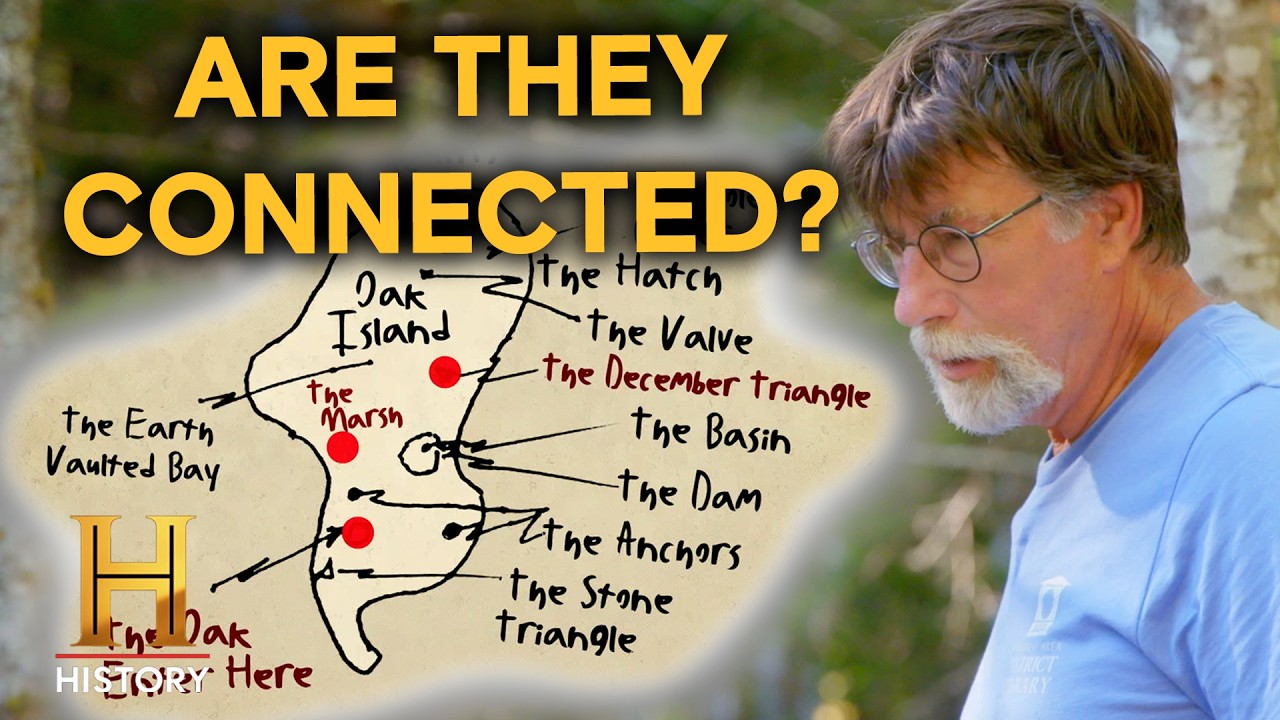
[Peter] I mean, when you think about this area, you think about Zena’s map and the December Triangle.
This could also be related to that.
[Narrator] In 2016, the late author and researcher Zena Halpern shared documents with the team believed to have been created by members of the Knights Templar. One was a 12th-century map of Nova Scotia and the other was a map of Oak Island possibly dating back to 1347. Astonishingly, it featured several locations written in French, but when translated to English, they marked known sites on the island, such as the Money Pit, the Swamp, and a site called the December Triangle. Could the stone cradle and boulder align with a location on a possible Templar map? [Rick] I’ve puzzled about whether or not this area could be referencing the so-called December Triangle on Zena’s map.
I think we have to have a really proper look in the area in the vicinity of the stone and see if there’s more information to be revealed. That will help us understand the relationship between the drawing on Zena’s map and this megalithic stone structure. [Fiona] I came across this area here of a blue-like clay, and you can clearly see that there are chunks of-of charcoal-like material mixed in with this clay.
I’m just not convinced that this blue, um, gray clay is natural to this area.
Clay like this could be very similar to the clay that we find at the Money Pit.
[Narrator] In 1804, the Onslow Company carried out the first large-scale excavation of the Money Pit and encountered wooden platforms every ten feet down to the 90-foot level. During the dig, they also reportedly found a thick layer of hand-worked blue clay at the 40-foot level, which they believed was used as a sealant to keep water out of the shaft in order to protect something buried deeper below. Curiously, in recent years, the team has discovered hand-worked blue clay in the swamp, and in the round feature on Lot 5. If Fiona is correct that she has now found the same kind of blue clay material in this stone feature on Lot 8, could it be more evidence that this feature was created to hide something? This could be anything.
The reality is there are lead and silver beyond baseline values within the structure itself, possibly in association with a shaft or a tunnel. So, we have to be patient at this point. This has to be driven by the archeological process. -Is there anything we can do with the clay? -Yeah.
We’ll get a nice big chunk of that soil and then take that back to the lab.
And then, we can run it through the XRD and see if it matches the Lot 5 till or the Money Pit till.
-That’s where it gets fun. -That’s where it gets fun.
[Fiona] All right. Let’s get the sample done.
There, that’s a good sample.
I’d like to give you this little bit here.
[Laird] We’ll need to get that to the lab -as soon as we can. -There’s a “why” here, and hopefully, we can figure out what that is, but I’m sure you’ll get to the bottom of it.
But let’s keep moving this forward, because we want to understand it, what it may mean.
-Yeah. -Yeah. -We’ve got a plan.
-Thank you. Appreciate it. -All right, see you guys.
[Narrator] Later that day… [Rick] How’s it going? [Jack] Hey, Rick.
[Laird] We just lifted a couple more rocks.
Right.
And under those rocks, we’re getting organics.
-I got to get down there. -[Jack] Go for it.
[Narrator] …Rick joins Jack and the archeology team as they continue excavating the cradle-like formation of stones on Lot 8. -No idea how deep? Yet? -[Laird] No, not yet.
No, but it’s giving us a reason to keep going.
So, we’re gonna try to expose the base and then work our way up to see how it was built.
Do you think what you’re calling the second level, is that natural?
Or are those placed as well?
No, I think they’re-they’re still all placed.
Right now, this seems to be… firmly affixed.
-I can’t get it out. -[Rick] We’re all curious, you know.
I can give it a try. I’m not saying I can do it, though.
-What’s und– What’s under it. -Yeah, yeah, yeah. Absolutely.
You come this way. I’ll go that way.
I’ll disturb those.
Oh, no, that one’s there.
Oh, there’s no give to that.
That’s amazing, they are locked in there tight.
Lot 8 presents all kinds of possibilities. One of which has to include that Zena’s map may have some relevance here.
Oh, boy. That’s in there.
Whether because this construction was some sort of alignment, or maybe there’s something under there. We need to figure out what this construction represents. Oh, wow. That is definitely in there.
[Laird] Yeah, I think that’s in there. I think that could be redeposited and it’s just…
-I think it is. -…it’s embedded.
-Now I really want it out. -[laughs] -They’re fixed in there quite tight. -Yeah.
[Rick] Scrape this stuff.
Yeah, it almost looks like some sort of hard clay.
Yeah, it’s, uh…
I would put a little chunk like that in some water -and see what its consistency turns into. -[Jack] Hmm.
-[Laird] yeah. -[Rick] We might be able to reconstitute it, -as it was used. -Yeah.
You have a little water there, Jack?
-Yeah. -See if it turns into anything.
Okay. Thank you.
Is it turning into, like, a clay?
Once it dries, I bet that adheres perfectly to that.
-[Jack] Really gritty cement. -[Rick] Yep.
And you wouldn’t think. When you break it apart right now, -it’s just sand. -[Jack] Yeah.
[Rick] I bet there’s a lot of calcium carbonate in here.
Mm-hmm.
When you compare this, elementally, to…
cement through the ages, I think you’re gonna get a fairly accurate date.
Like from Roman cement on forward.
Be interesting to see which kind of cement this matches.
Oh, yeah. That would be interesting.
-That would be crazy. -[Laird] Yep.
[Narrator] Because different types of concrete mixtures have been used throughout the ages of human construction, dating back as far as ancient Egypt, could determining the contents of this material help the team approximate when this feature was created? I believe the mortar or the cement-like material might reveal a-a when.
And maybe even tell us where does it come from? Is there a cultural association? Hopefully, there can be some answers derived from this analysis.
That mixture might be quite revealing.
There was a reason for this, and it wasn’t just to support that boulder.
-It could go deeper. -It could. -[Laird] Yeah.
-And the archeology will tell. -[Rick] Okay.
Well, you know what? I’m gonna let you two get back to work.
-All right. -[Rick] I have a feeling those rocks are gonna need a little bit of persuasion to come out of there. [laughs] Yeah. I’ll do my best.