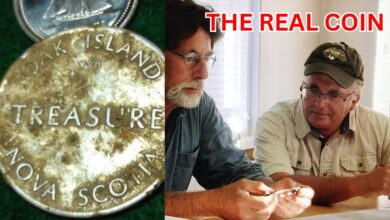
Coin Discovery Changes Everything (S13) | The Curse of Oak Island
Coin Discovery Changes Everything (S13) | The Curse of Oak Island
 LD
LD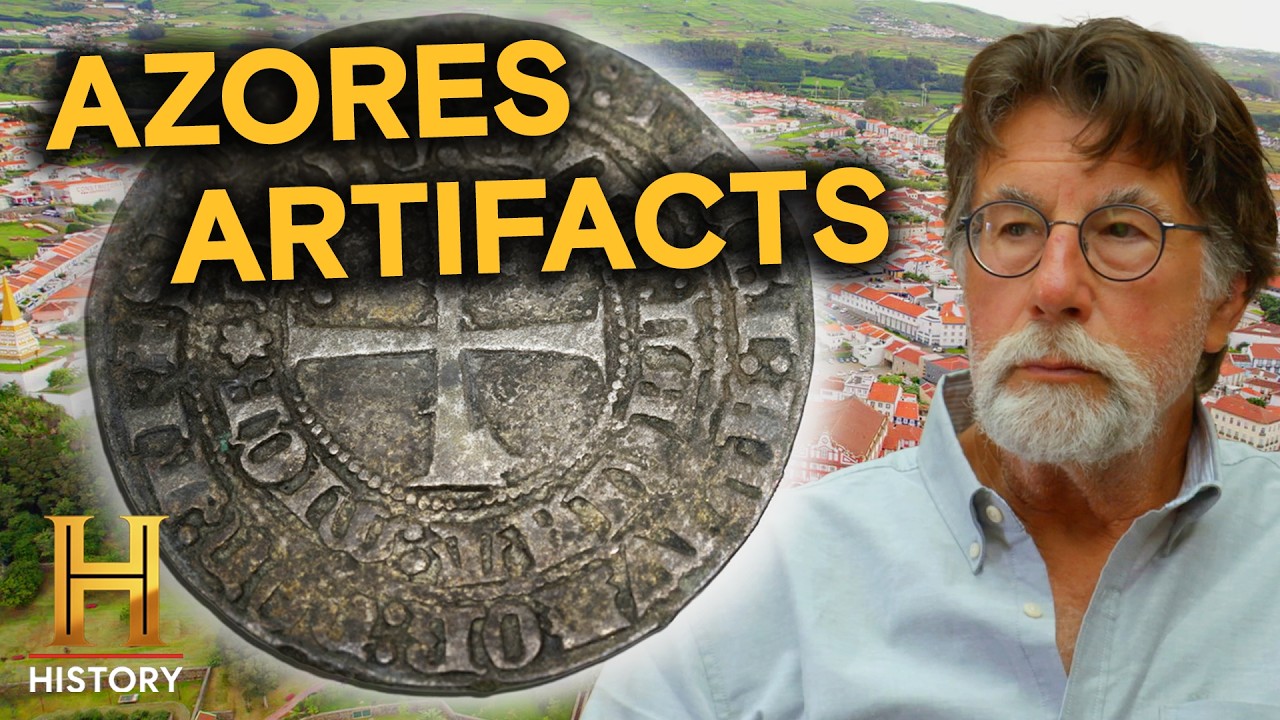
[Narrator] While the work continues on Oak Island… …over 2,000 miles to the southeast in the Azores islands of Portugal…
♪ ♪
-[Doug] Gentlemen.
-[Manuel] Hello. Welcome.
-Hello.
-Welcome to Azores.
-Thank you very much.
-Appreciate it.
…Rick and other members of the team have traveled to Terceira.




They are following up on the research that suggests members of the Portuguese sect of the Knights Templar, known as the Knights of Christ, may have used the Azores to safeguard a portion of their sacred religious treasures before sailing them to Oak Island between the 14th and 16th centuries.
Everybody, this is Francisco. He’s a historian here in the Azores.
[Narrator] …Rick and members of the team arrive at the Angra do Heroísmo Museum.
It’s incredible.
-Thank you. Great to see you. I’m Alex.
-Thank you.
[Narrator] Francisco has arranged for the team to look for clues in the museum and meet with local archaeologist Tiago Rodrigues regarding artifacts that have been found on Oak Island.
[Alex] We have a Portuguese coin dating to the late 1300s, and if it came through the Azores, that’s about 50 years, give or take, prior to the official date that the Azores were discovered and then colonized.
Uh, so, is it possible that some people knew that the Azores were here?
Before you arrived, Emiliano and myself did some, uh, scouting here in the museum.
What we came to do here is well-illustrated by, by this stone here.
This is 15th century, Emiliano?
[Emiliano] Mm, uh, 1454, probably, and it’s the oldest stone carving that were found here in the Azores.
[Corjan] This caught our attention not only because it’s possibly one of the oldest or the oldest carved stones that there are on this island, but particularly because of what it’s showing, you know, the…
…swirls here from the copper piece from the ribbon.
[Narrator] In 2022, the team unearthed part of a copper artifact on Lot 8 decorated with an ornate symbol.
Incredibly, one year later, they saw the similar symbol in a Templar-related manuscript in Reykjavík, Iceland, that dated back to the 12th century.
I actually have a photo of our copper a-artifact from Lot 8 that shows that symbol.
Let’s see if it compares to what we’re seeing here.
Hmm. It could be a match.
[Peter] It could be a match.
It has the same middle feature here, and then on the ends, it could round closed.
[Emiliano] And also, that symbol is, um, the one we found in a manuscript in Reykjavík, Iceland.
Tiago, we’ve actually brought some artifacts from Oak Island with us.
We were hoping you’d take a look at them.
[Rick] We’re trying to understand the pre-Columbian history of Oak Island and what happened there.
After you.
[Rick] We’ve brought a number of artifacts, and Tiago is qualified to look at them and render an opinion.
Uh, I hope that he can speak definitively about them.
[Doug] Tiago, we really appreciate you taking a look at these items.
I guess, maybe we just dive right in and get your thoughts.
This is actually one of the stoneshot that we have found on the island.
This was found this year, actually.
This was found this year, actually.
Right.
So, most, most probable then, is that this is from the 1300s or-or earlier?
Have you found any around here in the Azores at all?
-Mm-hmm.
-[Doug] You know, we’re looking at several.
This is a very interesting artifact, and we believe that it may be a small hand cannon.
And I have the report to go along with it.
[Narrator] Earlier this year, when the team first discovered a section of the sand-covered road in the western region of the swamp, they found part of a hand cannon, a weapon first invented in China during the 12th century.
After having Emma Culligan examine the piece in the lab, the team sent photos of the artifact to Maltese military historian Matthew Balzan for his analysis.
[Alex] Wow.
Mm-hmm. Mm-hmm.
[soft chuckling]
[Doug] Okay, next up.
This, uh, sparked a lot of excitement for us this year.
It was, uh, revealed to us by a family that was associated with the treasure hunt on Oak Island in the past.
And that family showed it to us this year, and it’s a Portuguese coin, of Ferdinand I.
The mint is somewhere between 1367 and 1383.
[Doug] Yeah, the story behind this coin is that, in 1849, they were drilling to try and strike the treasure chamber, and this may have come up on the drill bit.
Mm-hmm. Mm-hmm.
[Doug] Yeah.
And you previously said with the stoneshot that it was most predominately used…
-Yeah.
…likely, in the 14th century as well.
Both those objects, we believe, came from underground on our island in the so-called “treasure pit.”
-Yeah.
So, there’s a, there’s a connection there.
Oh, almost for sure.
[Doug] So, a lot of these artifacts seem to be centering on the 1300s, that we’ve shown you here today, so…
Several have, and-and several are also converging on the 15th century, which happens to be kind of the two timelines that we were wanting to investigate when we came here.
-[Tiago] Yeah. Right.
[Alex] Yeah.
The proof might be underground on Oak Island.
-[Corjan] Yeah.
-[soft laughter]
-And-and we might only do as good as, uh, establishing plausibility until something comes out of the ground.
[Rick] Yeah, the forensic evidence seems to point to silver a-and gold underground, almost certainly.
-Mm-hmm. Mm-hmm.
[Rick] It’s quite impactful to have a person of his experience and his understanding confirm the clues to the possibility of a treasure moving east to west.
-Mm-hmm.
[Rick] There might be multiple treasures connected to the Templars and their descendants.
So, we learn that, as you uncover clues, you not only advance the search agenda but you-you learn about history worldwide.
LD