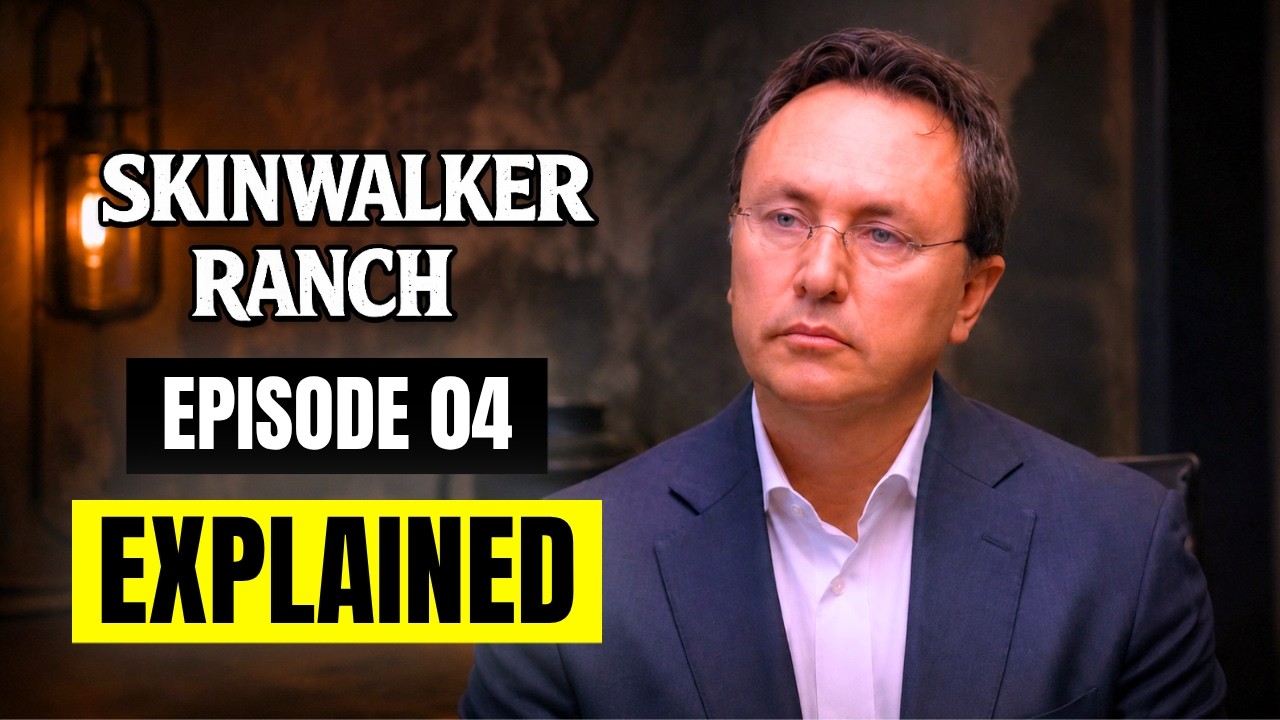
The Secret of Skinwalker Ranch Season 7 Episode 04 | Breakdown & Details
The Secret of Skinwalker Ranch Season 7 Episode 04 | Breakdown & Details

There comes a point in every long mystery when the question is no longer whether something strange is happening.
The real question becomes far more unsettling.
What if the strange events are connected? What if the clues are not random?
What if they are pointing toward a hidden design that can be sensed but not fully seen? That is the mood hanging over the secret of Skinwalker Ranch.
Season 7, episode 4, Smoking Guns.
This is not an hour built on easy shock.
It is built on something more durable.
A feeling that the ranch is beginning to answer back. Not clearly, not kindly, but just enough to keep the team moving forward. In this episode, two threads begin to tighten around each other.
Deep inside the mesa, the mystery of the ceramics grows darker after a new test raises more questions than it resolves.
Out in the open at the triangle and along the edge of the so-called bubble, the team turns to smoke in hopes of making the invisible visible. What they find does not bring closure.
It brings pattern.
And pattern on Skinwalker Ranch can be more disturbing than chaos.
That matters because the ceramics were already unsettling before this hour even began. They were not just scraps in the dirt, not just something left behind and forgotten.
Their presence inside the mesa had already suggested a story that did not fit neatly into any ordinary explanation.
So when a new test is brought in, the hope is simple. Learn what these materials are. Learn where they belong.
learn whether they are part of something natural, accidental, or deliberate. But this episode understands a hard truth about serious investigation.
Sometimes the most troubling result is not a dramatic answer. It is an answer that refuses to settle into place. The
kind that deepens the mystery by showing you that your first assumptions were too small. That is the pressure inside smoking guns.
Every step forward seems to widen the ground beneath the team’s feet. The ceramics become the first major engine of that tension.
Because once an object found inside the mesa survives curiosity and enters the world of testing, it changes status.
It is no longer merely odd. It becomes evidence.
Evidence demands interpretation.
An interpretation on this ranch is always dangerous.
Not because the team wants to exaggerate.
Quite the opposite.
Because the more careful they are, the more unsettling the object becomes.
The mesa has always carried a certain weight in this story. It is not just a backdrop.
It is a barrier, a mass of earth and rock that seems to hold on to answers while revealing only fragments.
So when ceramics are found there, it is not hard to understand why the discovery lingers.
A buried object suggests intent. It suggests time. It suggests a human relationship to the place. Yet in a setting like this, even that familiar idea feels unstable.
The new test does not relieve that instability.
It sharpens it. The significance of the test is not that it offers a neat label and closes the file. The significance is that it pushes the ceramics further away from being dismissed.
It makes them harder to explain as simple debris, harder to wave off as meaningless, harder to separate from the larger unease surrounding the mesa itself.
And that is where the episode becomes quietly effective.
It does not pretend that one material result can explain the ranch.
It lets the uncertainty breathe. If the ceramics matter, then they matter in relation to something bigger, something buried, something hidden, something that may connect physical evidence to the repeated sense that this landscape contains structures of behavior no one has yet mapped in full.
That is why the investigation cannot stay underground.
After the mesa deepens the question, the team shifts tactics.
They move outward into the open air into the light into terrain where motion can be observed, where shape can be guessed at, where an invisible force, if one exists, might leave a visible trace.
It is an elegant move.
Smoke is simple, ancient, almost humble.
It does not argue.
It drifts.
It reveals currents.
It shows resistance.
It shows direction.
It makes empty space less empty. On a ranch defined by things that refuse to be seen directly, smoke becomes more than a tool. It becomes a test of whether absence is truly empty at all.
This shift also gives the episode its title real meaning. Smoking guns is not only a dramatic phrase.
Here it becomes a method. The team is not chasing a metaphor.
They are trying to smoke out clues, trying to expose a shape in the air, trying to learn whether the mystery that seems to live in data and testimony can also be traced in movement across the land. And no place carries more symbolic pressure than the triangle.
That area has long felt like one of the ranch’s most charged spaces, a place where the ordinary often seems to hesitate.
So when the team brings smoke into that zone, the moment carries a different kind of suspense.
Not the suspense of noise or impact, the suspense of watching, of waiting, of asking whether the environment itself will behave in a way that ordinary terrain should not. This is where older viewers, especially those who have lived long enough to distrust sensationalism, may find the episode at its strongest.
Because the power is in the observation, in the refusal to rush, in the willingness to look closely at behavior rather than leap toward fantasy.
The triangle does not need embellishment.
It only needs careful attention.
If the smoke moves in a way that hints at hidden boundaries, pressure changes or unseen structure, then the scene becomes memorable precisely because it remains grounded. And if that sounds modest, it should. The best mysteries are rarely loud at first. They gather strength through repetition, through pattern, through small moments that begin to align.
This episode seems to understand that it asks the viewer to notice the possibility that the land is not merely passive, that certain zones on the ranch may respond differently.
Not always, not perfectly, but often enough to keep suspicion alive.
Then the investigation widens again. The team follows the experiment along the boundary of the bubble. Even the language there feels eerie. A boundary implies division. It implies one condition on one side and another condition on the other. But the bubble by its very nature resists easy definition.
It is spoken of as though it exists.
Yet it is not something the eye can simply confirm.
That is what makes smoke so compelling in this context.
It offers a chance to see how space behaves where vision alone has failed.
At the bubble’s edge, the stakes suddenly change. The question is no longer just whether the triangle is active.
The question becomes whether there is a broader geometry at work, whether invisible limits can influence what happens on the ranch, whether the mystery has edges.
That is a profound shift.
Because once a mystery begins to show boundaries, it starts to resemble a system, and systems are harder to dismiss than stories.
That may be the most important dramatic turn in this episode. The smoke test appears to reveal clues not only at the triangle, but also along the bubbles’s boundary. That does not solve the ranch.
It does something more provocative.
It hints that the anomalies may organize themselves in space, that there may be regions, lines, or transitions where the ranch behaves differently.
If true, even in part, that would pull the mystery out of the realm of isolated incidents and into the realm of structure.
Now, the ceramics begin to matter in a new way. What if the buried fragments inside the mesa are not just an oddity from the past? What if they are part of the same larger puzzle suggested by the smoke in the air? One clue locked in matter, another traced in motion, one hidden in the rock, another outlined in the sky. On their own, each is strange.
Together, they begin to feel like separate expressions of one unresolved reality.
This is where Smoking Guns finds its real dramatic center.
Not in any single reveal, not in any one test, but in convergence.
The unsettling possibility that physical evidence and spatial anomaly may be touching the same unseen architecture.
That the ranch is not simply a collection of mysteries, but a place where different forms of evidence keep bending toward the same unanswered question. If that idea feels heavy, the episode earns it by staying restrained.
There is no need to force grand declarations.
In fact, the tension becomes stronger because the team does not have the luxury of certainty.
They must work with fragments.
Results that intrigue but do not conclude.
Observations that suggest but do not prove. That discipline gives the hour credibility.
And credibility is what lets the sink in. Because uncertainty when handled honestly becomes its own form of dread.
There is something deeply human in that.
We all want the puzzle solved. We want the object identified.
We want the smoke to draw a clean line.
We want the boundary to hold still long enough to be measured and named. But on Skinwalker Ranch, the closer the team seems to get, the more the mystery changes shape. It does not vanish.
It adapts.
It offers a clue then withdraws behind it. That is why the emotional tone of this episode matters so much. It is not just curious.
It is patient, wary, thoughtful.
It understands that what unsettles people in later life is not cheap fear.
It is the sense that the world may still contain orders of reality. We have not mastered that after decades of experience there may still be landscapes that do not behave as expected.
Places where evidence accumulates faster than explanation.
The mesa in that sense becomes more than a location.
It feels like memory sealed in stone, a place that keeps yielding pieces but never the whole story.
The ceramics are important not only because of what they are but because of where they were found inside the mesa in a place already loaded with secrecy.
So when testing deepens their mystery the effect is cumulative.
It tells us that the object cannot be separated from the setting. The evidence belongs to the place and the place refuses to become ordinary.
The triangle offers a different kind of unease.
It is open, visible, exposed.
Yet, it too seems to deny clarity.
That contrast is powerful.
Beneath the mesa, the mystery is hidden in matter. At the triangle, it may be hidden in behavior, and along the bubble’s boundary, it may be hidden in transition itself.
One episode, three spaces, one growing suspicion.
The ranch may be organized by forces or patterns that reveal themselves only in pieces.
That possibility is enough to change the tone of everything we have seen. Because once you begin to suspect an unseen structure, every experiment becomes more than an experiment.
It becomes a conversation with the unknown, a question posed to the land, a test of whether the ranch will answer in trace form, partial form, fleeting form, and in smoking guns. The ranch does seem to answer, not clearly, not generously, but enough to deepen the sense that the team is no longer dealing with isolated curiosities.
The smoke appears to map something. The ceramics appear to matter. The boundary appears to behave like a boundary.
Those are not final truths, but they are meaningful pressures enough to force a serious viewer to consider that the separate mysteries may not be separate at all. Still, the episode is careful not to overreach.
That restraint becomes one of its quiet strengths.
The team does not claim to possess the final picture.
They do not pretend that one night, one test, or one discovery has solved what years of investigation have left unresolved.
Instead, they remain inside the tension.
And by doing so, they allow the viewer to feel the cost of not knowing. That cost is real. It is the cost of patience, the cost of discipline, the cost of living with incomplete answers while refusing to replace them with fantasy.
In an age where certainty is often performed long before it is earned, there is something almost old-fashioned in that posture, something honorable.
Watch closely.
Record what happened. Admit what you still do not understand.
That may be why this episode lingers.
Not because it offers a spectacular conclusion, but because it suggests the outline of something just beyond conclusion.
By the end of Smoking Guns, the most haunting thought is not that the ranch remains mysterious.
We already knew that. The haunting thought is that the mystery may be more organized than it first appeared.
that the ceramics in the mea and the clues revealed by smoke near the triangle and the bubbles boundary may belong to the same hidden order. Not random, not isolated, just incomplete.
And that is a far more powerful place to leave a viewer because an unsolved mystery can be set aside.
A patterned mystery cannot. It follows you home. It stays with you in quiet moments.
It returns when you think about buried objects, drifting smoke, edges in open space, and landscapes that seem to keep their own council. The title Smoking Guns promises evidence.
What it finally delivers is more unsettling than proof.
It delivers the feeling that evidence is gathering around a shape we still cannot fully see. A shape inside the mea.
A shape over the triangle.
A shape along the invisible boundary of the bubble. For a moment, the fragments almost align, but only almost.
And maybe that is the true power of this episode. It does not tear the veil away.
It lifts one corner just long enough for us to realize that whatever is happening on Skinwalker Ranch may not be scattered at all. It may be connected.
It may be waiting. And it may have only just begun to show its outline.